Mercedes Sprinter Camper Van Conversion: What It Actually Involves
Published
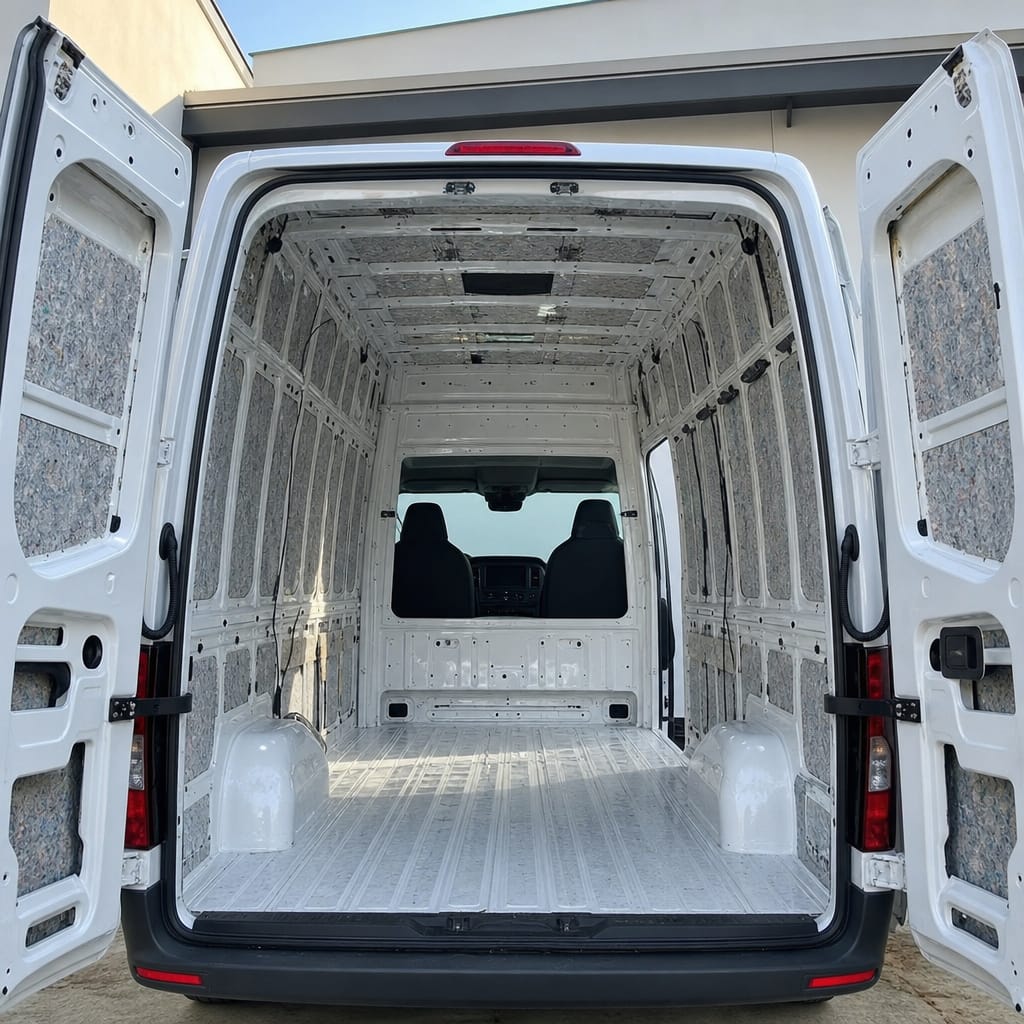
Most people researching a Mercedes Sprinter camper van conversion — or a sprinter camper van conversion, same project — are deciding whether to start, not how to wire a specific outlet. Most of what's online skips past that.
This guide covers what a Sprinter conversion actually has to solve — insulation, the 12V electrical system and house battery, roof ventilation, and a note on flooring and water — the order they depend on each other in, one sourced product example per system that has a stable one, and a real interior-dimensions table so "which configuration" isn't a guess.
It does not cover a step-by-step build log, wiring diagrams, roof-cutting instructions, or propane/LP work. Those are described below at the level of what the job involves, not walked through — see "Have a Pro Do This."
Disclosure: This article contains affiliate links. If you buy through these links, we may earn a commission at no extra cost to you. We do not claim hands-on testing unless clearly stated.
Quick Answer: What a Sprinter Conversion Has to Solve
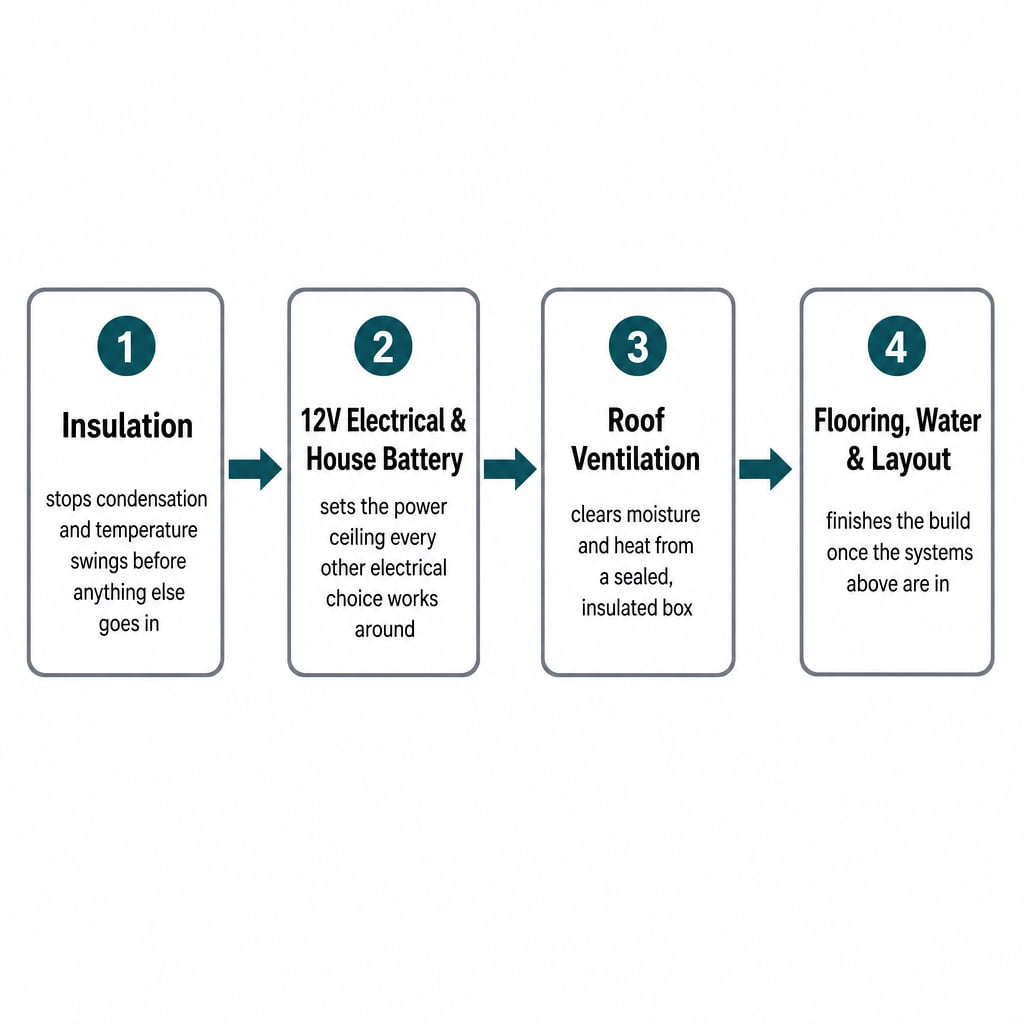
A Sprinter conversion isn't one project — it's several systems that depend on each other in order.
| System | What it has to do | Covered below as |
|---|---|---|
| Insulation (wall/ceiling) | Stops condensation and temperature swings before anything else goes in | "Insulation (Wall and Ceiling)" |
| 12V electrical / house battery | Sets the power ceiling every other electrical choice works around | "12V Electrical System and the House Battery" |
| Roof ventilation | Clears moisture and heat from a sealed metal box | "Roof Ventilation" |
| Flooring, water, layout | Real parts of the build; no sourced product example this pass | "Flooring, Water, and What This Guide Doesn't Detail" |
Sprinter Interior Dimensions by Configuration
Before any of the systems below, the Sprinter you start with already decides a lot of the answer. Wheelbase and roof height set how much wall and ceiling area there is to insulate, how much standing headroom survives once a roof-fan riser eats into it, and how long a bed or cabinet run can actually be. The table below puts Mercedes-Benz's own published cargo volume, standing height, and cargo bed length side by side for all four wheelbase/roof-height configurations, so comparing them doesn't mean digging through four separate spec pages.
What the Build Actually Involves, System by System
Build these systems in roughly this order — insulation first, then wiring and the house battery, then the roof vent cutout, then paneling and flooring — because each one assumes the last is already in place.
Insulation (Wall and Ceiling)
Insulation goes in before wiring or paneling — it's the first thing standing between the van's bare metal shell and both outside temperature swings and the condensation that forms when warm, moist air meets cold metal.
3M™ Thinsulate™ Acoustic Insulation SM600L is one of the materials most Sprinter build guides land on, sold by the roll. Treat it as a representative example, not "the" answer — calculate your own van's wall and ceiling square footage and pick a roll length to match, rather than assuming one length fits your van.
Before you order: 3M does not publish an official R-value for SM600L — it's categorized as acoustic insulation, not thermal insulation. Any R-value figure quoted for this product elsewhere online is a third-party estimate, not a 3M-stated figure.
Buyer warning: several resellers private-label the same 3M material under their own brand name. Buy a listing whose title names "3M Thinsulate SM600L" directly, not a generic or unbranded insulation roll making the same claims without naming the material. For a shell build that bundles insulation with the rest of the materials, see our complete conversion kits that bundle insulation with the rest of the shell build.
12V Electrical System and the House Battery
The house battery's capacity is the sizing decision everything downstream — inverter, solar, lighting, any 12V appliance — works around. Covering it alone keeps this a planning explainer, not a parts list.
The LiTime 12V 100Ah Group 24 Self-Heating LiFePO4 Battery is one representative example, not a sizing prescription. Self-heating matters for a Sprinter conversion that might see winter use — a plain lithium cell can refuse to charge below freezing, where a self-heating one keeps working.
Before you order: size your battery to your actual appliance draw, not to this example. See sizing a lithium battery to your actual power draw before you buy, rather than guessing at a round number.
Buyer warning: LiTime sells several near-identical single-battery listings under slightly different product pages. Buy from the exact listing linked here rather than assuming every 100Ah listing from the brand is interchangeable. For the broader decision of which lithium battery to buy, see our guide to choosing a lithium house battery.
Full 12V wiring, fusing, and the battery-to-inverter connection are described under "Have a Pro Do This" below — this section doesn't walk through wiring.
Roof Ventilation
A powered roof vent is the standard answer to moisture and heat buildup once the van is insulated and mostly sealed. Cutting the roof opening for it is the single most consequential structural step in the build.
The MaxxAir MaxxFan Deluxe is the fan most consistently recommended across Sprinter build guides. The manufacturer's page confirms a 14 in × 14 in roof cutout, a 10-speed motor, a built-in thermostat, a remote, and a rain-capable lid.
Before you order: confirm the 14 in × 14 in cutout against your own roof panel before anyone cuts anything. Treat airflow and weight figures as something to check on the product listing itself — the manufacturer's page doesn't publish those two directly.
Buyer warning: more than one listing exists under this model name. Buy from the listing linked here to get the current version, not an older or discontinued variant. For other options, see our roof vent fan options beyond this one example.
Cutting the roof opening and sealing it against water intrusion is described under "Have a Pro Do This" below, not walked through here.
Flooring, Water, and What This Guide Doesn't Detail
Subfloor and finish flooring, plus fresh and grey water systems, are real parts of a Sprinter conversion — but this guide doesn't include a sourced product example for flooring. The candidates we checked had no manufacturer page for either brand, and thickness claims that varied five-fold across one brand's own listings with no way to confirm which figure applied to which product. Rather than recommend a product we can't accurately specify, this section stays a pointer instead.
For budget questions, see what a Sprinter conversion actually costs. For the build-order side once you've settled on the systems above, see a DIY-focused walkthrough of the build order.
Have a Pro Do This
Two steps in this guide cross this site's safety boundary: installing a lithium house battery, and cutting a structural opening in the van's roof.
Leave these to a qualified installer or technician, not a DIY step from this guide:
- All 12V wiring, fusing, and battery-to-inverter connections beyond visually confirming a connection is seated.
- Cutting the roof opening for the ventilation fan and sealing it against water intrusion.
- Any propane or LP gas appliance work, if your build includes one — no gas product appears here, but many conversions add one, and the boundary is worth stating before you hit that decision elsewhere.
Nothing above substitutes for the manufacturer's own installation instructions or a qualified installer for electrical and roof work.
Common Mistakes
Mistake 1: Insulating Before Wiring and Layout Are Decided
Insulating first, then deciding where wires and outlets go, means cutting into finished insulation or redoing sections later. Decide your rough electrical layout before the insulation goes in, even if you won't run the wires until after.
Mistake 2: Sizing the Battery to Whatever's Discounted
Picking a battery capacity because it was on sale, rather than because it matches your actual appliance draw, means either running out of power daily or paying for capacity you never use. Work backward from your appliances — see sizing a lithium battery to your actual power draw.
Mistake 3: Cutting the Roof Vent Opening to a Guessed Size
Guessing at the roof cutout instead of checking the fan manufacturer's stated dimensions risks a cut that's the wrong size, on a step you can't easily undo. Always confirm the manufacturer's stated cutout before cutting.
Mistake 4: Treating "Convert a Sprinter" as One Project Instead of a Sequence
Treating a Sprinter conversion as one undifferentiated project, rather than a sequence of systems that depend on each other in order, is the planning mistake this guide exists to correct. Insulation, wiring, ventilation, and flooring each assume the step before them is already done.
Sprinter Interior Dimensions by Configuration
Which Sprinter wheelbase and roof height you start with decides how much wall area there is to insulate, how much standing headroom survives a roof-fan riser, and how long a bed or cabinet run can actually be — it is the first number every later build decision depends on. This table puts Mercedes-Benz's own published cargo volume, standing height, and load length side by side for each wheelbase/roof-height configuration, in the same units, so comparing configurations doesn't mean opening four separate pages.
| Configuration (wheelbase / roof height) | Cargo volume | Interior standing height | Cargo bed (load) length | Interior width between wheel wells | Source | Source checked |
|---|---|---|---|---|---|---|
| 144" wheelbase / standard roof | 319.0 cu ft | 68 in | 133 in | Not confirmed — see caveats | Mercedes-Benz Vans USA — Sprinter Cargo Van specifications page (manufacturer) | 2026-11-12 |
| 144" wheelbase / high roof | 374 cu ft | 79 in | 133 in | Not confirmed — see caveats | Mercedes-Benz Vans USA — Sprinter Cargo Van specifications page (manufacturer) | 2026-11-12 |
| 170" wheelbase / high roof | 488 cu ft | 79 in | 174 in | Not confirmed — see caveats | Mercedes-Benz Vans USA — Sprinter Cargo Van specifications page (manufacturer) | 2026-11-12 |
| 170" extended wheelbase / high roof | 533 cu ft | 79 in | 189 in | Not confirmed — see caveats | Mercedes-Benz Vans USA — Sprinter Cargo Van specifications page (manufacturer) | 2026-11-12 |
How these numbers were produced: Cargo volume, interior standing height, and cargo bed (load) length are taken directly from Mercedes-Benz Vans USA's own Sprinter Cargo Van specifications page, checked for each wheelbase/roof-height configuration. No figure here is derived or converted; all are reproduced in the units Mercedes-Benz publishes them in (cubic feet, inches). A fourth figure — interior width between the wheel wells — is published on the same page but could not be confirmed to this table's sourcing standard (see caveats) and is left blank rather than printed as a possibly wrong number.
- Interior width between the wheel wells is left blank for every configuration. Mercedes-Benz's specifications page does publish a wheelhouse-width figure, but repeated automated checks of the same page returned inconsistent numbers for the same configurations, so no figure could be confirmed to the standard this table requires. Confirm this measurement directly against mbvans.com or a current printed brochure before using it to plan cabinetry, battery box placement, or any other width-critical build decision.
- A primary-source PDF brochure was also attempted for cross-check; its text layer uses a non-standard font encoding that could not be extracted as readable text, the same failure mode documented for some encrypted standards-body PDFs elsewhere on this site. The figures here come from the manufacturer's live specifications page only, not the brochure.
- These are factory base cargo-van figures before any conversion work. Insulation, paneling, flooring, and any interior build-out reduce the usable interior space below every number in this table.
- Mercedes-Benz revises trim and configuration specifications between model years. Confirm the current figures for the exact model year you are buying against mbvans.com rather than assuming this table tracks every future revision.
- Cargo volume, standing height, and load length are published per wheelbase/roof-height configuration, not per individual van — options like a raised floor or aftermarket roof modifications will change the real interior numbers for a specific build.
Download the data (CSV) · last updated 2026-11-12 · version 1.0 · CC BY 4.0, attribution to RV Field Manual.
FAQ
What's involved in a Mercedes Sprinter camper van conversion?
At a planning level: insulation, a 12V electrical system built around a house battery, roof ventilation, and flooring/water — roughly in that order, since later systems depend on earlier ones. The same answer applies to a "sprinter camper van conversion."
Which Sprinter wheelbase or roof height is best for a conversion?
No single best answer — it depends on your layout and standing-height needs. See the interior-dimensions table above for how volume, height, and bed length change across configurations.
Do I need to insulate before running wiring?
Yes. Deciding your rough wiring layout first avoids cutting into finished insulation or redoing sections later — see Mistake 1 above.
How big a house battery does a Sprinter conversion need?
No universal number — it depends on your appliance draw. See sizing a lithium battery to your actual power draw rather than copying someone else's figure.
Can I cut the roof vent opening myself?
Measuring and planning the cutout location, yes. Cutting and sealing it against water intrusion is the "have a pro do this" line above.
What does a Sprinter camper van conversion cost?
No number here — costs vary too much by build quality and scope to state one honestly. See what a Sprinter conversion actually costs.
Is a DIY Sprinter conversion realistic without professional help?
Most of it, yes. The wiring and roof-cutting boundary in "Have a Pro Do This" above is the exception — see a DIY-focused walkthrough of the build order for the realistic parts.
Sources Reviewed
Manufacturer pages for 3M, MaxxAir (Airxcel), and LiTime, plus Mercedes-Benz's own published Sprinter interior-dimension specifications, were reviewed for the claims and the unique-asset table here. No customer review text was used. Recurring patterns from public conversion-planning discussions were considered only when deciding which systems and sequencing points deserved a section, never as a source for a figure.
Related Guides
- RV Camper Van Conversion: Best Parts and Products
- Camper Van Conversion Kits Compared
- DIY Camper Van Conversion Walkthrough
- What a Camper Van Conversion Costs
- Choosing an RV Lithium Battery
- Sizing a Lithium Battery to Your Power Draw
- Best RV Roof Vent Fans