Fix RV Water Heater Problems: Symptom-by-Symptom Guide
Hot water stops working, and there's no way to tell from the faucet alone whether the fix is a valve you can turn in ten seconds or a service call. RV water heaters fail in a small number of predictable ways, each with its own symptom.
This guide works by symptom, across the three common designs: gas-only, gas-and-electric, and tankless. It tells you what's genuinely safe to check yourself, with no tools and no disassembly — not repair or installation steps, propane work, or a universal error-code list. Those belong to the manufacturer's manual or a certified technician; a generic "5 easy fixes" list would just be guessing at your unit.
Disclosure: As an Amazon Associate we earn from qualifying purchases. This guide links to other RV Field Manual pages that recommend products through Amazon affiliate links, at no extra cost to you. This page itself recommends no specific product.
Quick Diagnostic Table
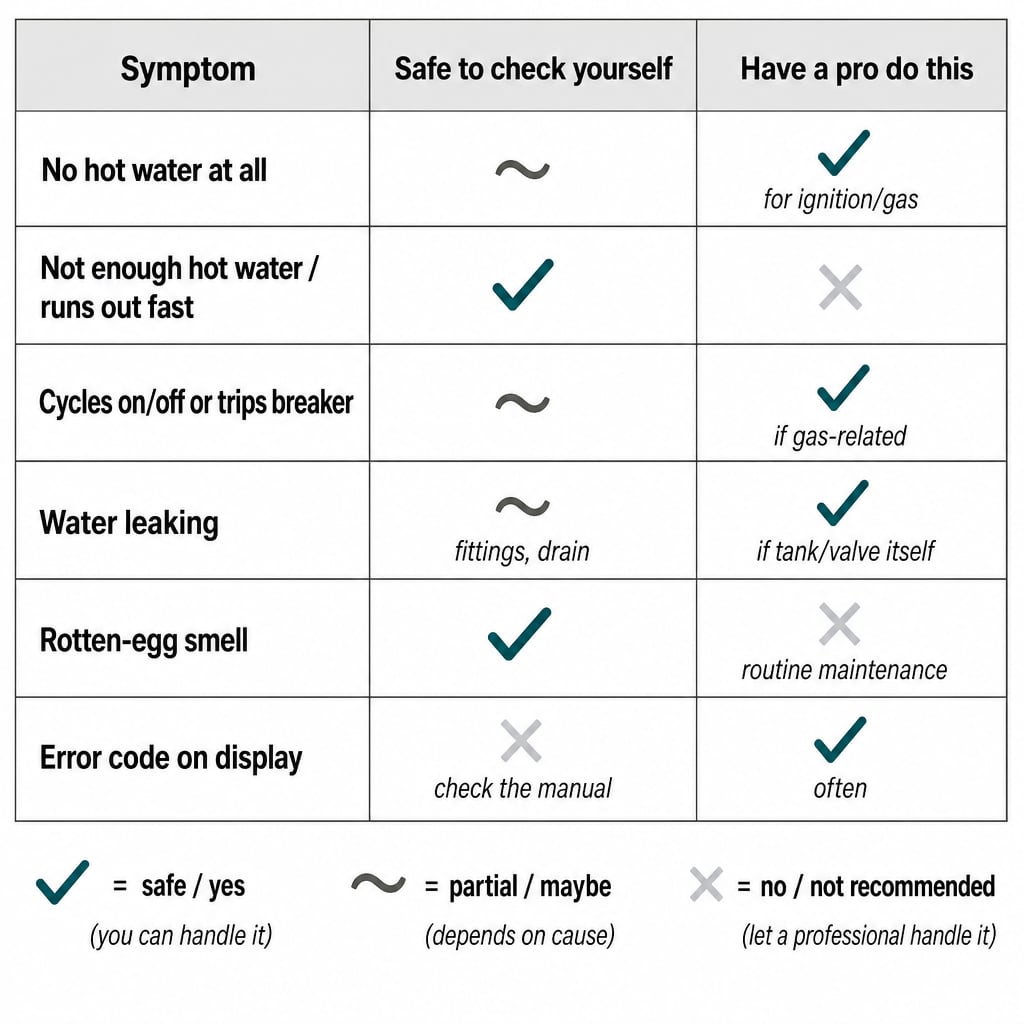
Match your symptom to a likely cause and a first read on who should check it.
| Symptom | Likely cause(s) | Safe to check yourself | Have a pro do this |
|---|---|---|---|
| No hot water at all | Empty or closed gas supply, tripped high-limit (ECO) switch, no 120V power, ignition fault | Partially | Yes, for ignition or gas faults |
| Not enough hot water, or it runs out fast | Bypass valve left in bypass position, thermostat set low, demand exceeding tank recovery | Yes | No, usually |
| Cycles on and off, or trips a breaker | Tripped ECO switch, faulty thermostat, loose or degraded gas connection | Partially | Yes, if gas-related |
| Water leaking | Failed pressure/temperature relief valve, loose fitting or drain plug, cracked tank | Partially, for fittings and the drain plug | Yes, if the tank or valve itself has failed |
| Rotten-egg smell from the hot tap | Sacrificial anode rod reacting with bacteria in the water | Yes, to confirm | No, this is routine maintenance |
| Error code on a digital or tankless display | Model-specific fault — varies by brand | No, check the manual first | Often, yes |
How RV Water Heaters Actually Work
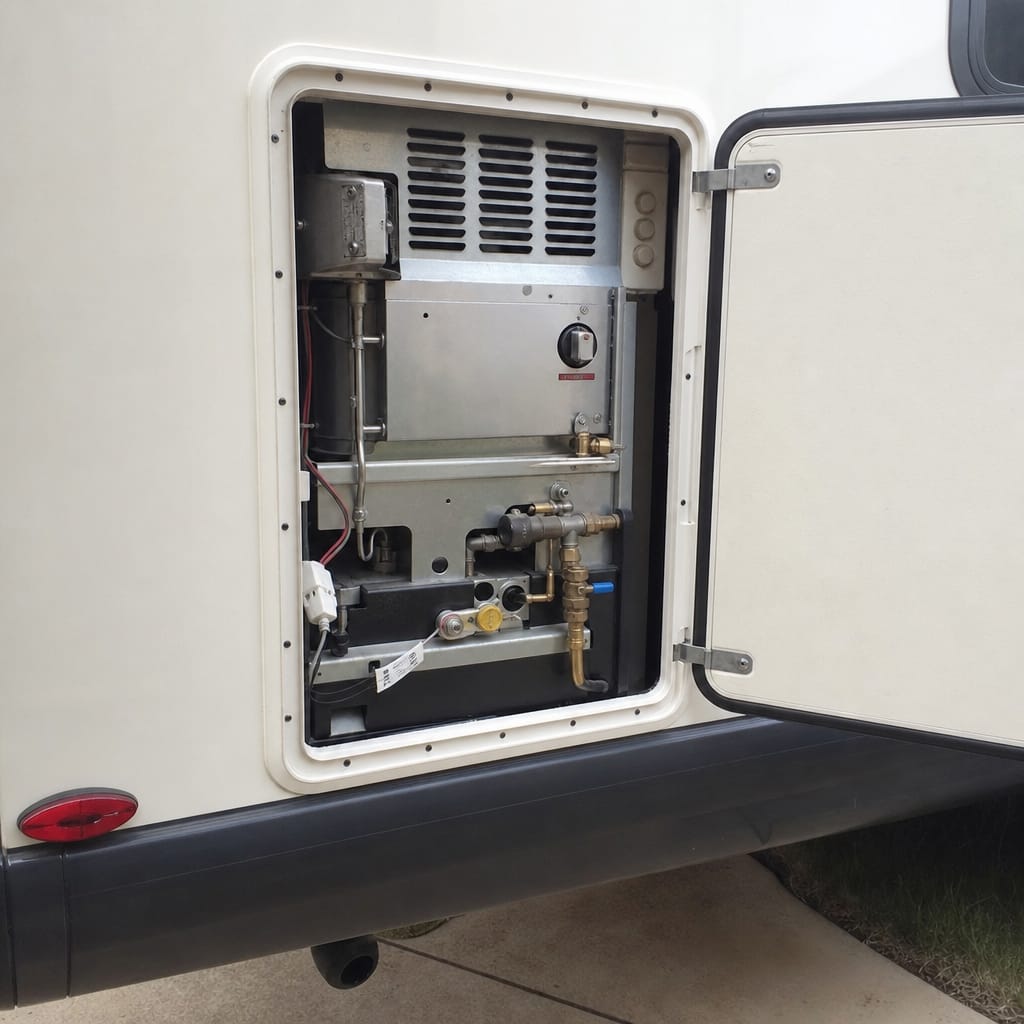
RV water heaters come in a few architectures, and knowing which one you have narrows the diagnosis before you touch anything. Gas-only models heat a small storage tank on propane and need no shore power. Gas-and-electric models add a 120V AC element to the same tank, running on either fuel depending on the model. Electric-only setups depend entirely on shore power or a running generator. Tankless, or on-demand, units heat water as it flows instead of storing it, so a unit that can't keep up shows as inconsistent temperature rather than "runs out."
Knowing which type is installed matters before you replace anything. If you're at that stage rather than troubleshooting an existing unit, see our guide to choosing a replacement RV water heater.
RV Water Heater Specs at a Glance
Every water heater's nameplate lists a gas input, tank capacity, and recovery rate — or a continuous flow rate on a tankless unit — but each manufacturer publishes those figures in its own format. The table below puts common Suburban, Dometic, Girard, and Truma models side by side, sourced from each manufacturer's own documentation, so you can check your nameplate against a real published range instead of guessing.
Diagnose by Symptom
Find the section below that matches what you're actually seeing.
No Hot Water at All
On a gas model, start with what has nothing to do with the heater itself: the propane tank isn't empty, the LP supply valve is fully open, and no other gas appliance is also failing — if the stove or furnace is out too, the problem is upstream. On a gas-and-electric or electric-only model, check the breaker and GFCI for that circuit, and confirm shore power or the generator is actually live.
Past that point, the "safe to check" list ends. Ignition components and gas-line connections are a job for a certified RV or LP gas technician, not a two-minute fix. See our guide to propane-fired RV water heaters for background on how gas units are built.
Not Enough Hot Water, or It Runs Out Fast
The single most common non-obvious cause is the bypass valve left in the winterizing position, which routes water around the tank entirely — the heater can be working perfectly and you'd still get lukewarm or cold water at the tap. Check the valve position before assuming anything is broken. Beyond that, a thermostat set lower than you expect, or simply drawing water faster than the unit can recover it, produces the same symptom without anything being faulty. See our guide to bypass valve kits if yours needs replacing.
Water Heater Cycles On and Off, or Trips a Breaker
A tripped high-limit switch — the ECO, for emergency cutoff — is a real safety device, not a nuisance switch. If it keeps tripping, something is actually overheating the water, and resetting it repeatedly just ignores what triggered it. A faulty thermostat can cause similar cycling; on gas models, so can a degraded gas connection — where a DIY check stops and a technician's job starts.
Water Leaking From the Tank, Valve, or Fittings
The temperature and pressure relief valve vents water under excess pressure — an occasional drip under load may be it doing its job, not failing. A valve that leaks steadily at normal pressure needs replacing. A loose drain plug or fitting is often something you can tighten yourself; a cracked tank is not repairable. See our guides to temperature and pressure relief valves and drain plugs for more on each part.
Rotten-Egg Smell From the Hot Tap
This smell is almost always a chemical reaction between sulfur-reducing bacteria and the tank's magnesium anode rod — not a plumbing problem or contaminated water elsewhere in the RV. Servicing the anode rod is routine maintenance, covered in your owner's manual; our guide to anode rods covers what the job involves.
Error Code on a Digital or Tankless Display
Error codes are manufacturer- and often model-specific: a code that means one thing on one tankless unit can mean something else on another brand's display. Rather than guess from a code table pulled together by a third party, check the code against your unit's own manual or the nameplate inside the access panel — that's the only source that's correct for your model.
Have a Pro Do This
Some of what shows up above is a real "call a pro" situation, worth stating plainly: any gas line or LP connection work, ignition repair, relief valve or tank replacement, and electrical work beyond checking a breaker or GFCI are jobs for a certified RV technician — for gas-line work specifically, a certified LP gas technician. Propane and 120V AC systems are not areas where a wrong guess is a minor inconvenience.
Tools and Products That Help
Most of what's covered here is diagnosis, not parts shopping — but once you know which component is the problem, RV water heater parts covers the components mentioned throughout this guide in one place. Measure and confirm the exact model before ordering anything; components vary by brand and tank size, and there's no universal fit.
Common Mistakes
Mistake 1: Chasing the Electronics First
What it looks like: Assuming a control board or wiring fault before ruling out the simple stuff.
Why it's a problem: Most "no hot water" calls trace back to an empty tank, a tripped breaker, or a misplaced bypass valve — not electronics.
What to do instead: Work through the basics first; treat it as electronics only once gas, power, and valve position check out.
Mistake 2: Resetting the ECO Switch Instead of Diagnosing It
What it looks like: The high-limit switch trips, gets reset, and the cycle repeats every few uses.
Why it's a problem: Something is actually overheating the water. Resetting the switch without finding why just delays the next trip.
What to do instead: Treat a repeatedly tripping ECO switch as a reason to call a technician, not an inconvenience to work around.
Mistake 3: Treating the Rotten-Egg Smell as a Water Problem
What it looks like: Assuming the smell means contaminated water, or a plumbing issue elsewhere in the RV.
Why it's a problem: The smell is almost always the anode rod reacting with bacteria in the tank, not unsafe water.
What to do instead: Check and service the anode rod before assuming a broader water-quality problem.
RV water heater specs at a glance
RV water heaters come in three common architectures — gas-only tank, gas-and-electric tank, and tankless (on-demand) — and each manufacturer publishes its own numbers in its own format, scattered across product pages, spec sheets, and installation manuals. This table puts the gas input, recovery rate or continuous flow, tank capacity, control voltage, and dimensions for common models from Suburban, Dometic, Girard, and Truma side by side, sourced from each manufacturer's own materials, so a reader can check a nameplate number against a real published range instead of a generic 'is this normal?' guess.
| Water heater / model family | Type | Tank capacity | Gas input (BTU/h) | Electric element input | Recovery rate (gas) / continuous flow | Control voltage / current draw | Dimensions (as published) | Source | Source checked |
|---|---|---|---|---|---|---|---|---|---|
| Suburban SW4D / SW4DE | Gas only, or gas + optional electric element (tank) | 4 gal | 9,000 BTU/h | 1,440 W (SW4DE only; optional 120V AC element) | 7.6 gal/hr (gas only); 6.1 gal/hr (electric element only, SW4DE) | 12.69" H x 12.69" W x 19.19" D | Suburban (Airxcel) tank water heater specifications sheet (manufacturer) | 2026-09-25 | |
| Suburban SW6D / SW6DE | Gas only, or gas + optional electric element (tank) | 6 gal | 12,000 BTU/h | 1,440 W (SW6DE and related gas+electric variants only) | 10.1 gal/hr (gas only); 6.1 gal/hr (electric element only) | 12.69" H x 12.69" W x 19.19" D | Suburban (Airxcel) tank water heater specifications sheet (manufacturer) | 2026-09-25 | |
| Suburban SW10D / SW10DE | Gas only, or gas + optional electric element (tank) | 10 gal | 12,000 BTU/h | 1,440 W (SW10DE and related gas+electric variants only) | 10.1 gal/hr (gas only); 6.1 gal/hr (electric element only) | 16.22" H x 16.22" W x 20.50" D | Suburban (Airxcel) tank water heater specifications sheet (manufacturer) | 2026-09-25 | |
| Suburban SW12D / SW12DE | Gas only, or gas + optional electric element (tank) | 12 gal | 12,000 BTU/h | 1,440 W (SW12DE and related gas+electric variants only) | 10.1 gal/hr (gas only); 6.1 gal/hr (electric element only) | 16.22" H x 16.22" W x 22.25" D | Suburban (Airxcel) tank water heater specifications sheet (manufacturer) | 2026-09-25 | |
| Suburban SW16D / SW16DE | Gas only, or gas + optional electric element (tank) | 16 gal | 12,000 BTU/h | 1,440 W (SW16DE and related gas+electric variants only) | 10.1 gal/hr (gas only); 6.1 gal/hr (electric element only) | 16.22" H x 16.22" W x 27.00" D | Suburban (Airxcel) tank water heater specifications sheet (manufacturer) | 2026-09-25 | |
| Dometic WH-6GA | Gas only (tank) | 6 gal | 10,000 BTU input | N/A (gas-only model; no 'E' in model code) | 12V DC (input voltage, per product page); family-wide operating range 10-14 VDC at 10-13 in. W.C. gas pressure (per installation manual) | 12-3/4" H x 12-3/4" W x 19-7/8" D (cut-out, per product page) | Dometic WH-6GA product page (manufacturer) | 2026-09-25 | |
| Dometic WH-6GEA | Gas + electric (tank) | 6 gal | Has a 120V AC electric element (model code 'E' = electric, per manufacturer's own model-numbering key); wattage not stated in the documents checked | 10-14 VDC operating range (same family spec as WH-6GA) | 12.8" (W and H) x 19.0" D; 15.0 lb empty | Dometic L.P. Gas Water Heater installation manual (manufacturer) | 2026-09-25 | ||
| Dometic WH-9GEA | Gas + electric (tank) | 6 gal actual tank (Dometic's own model key lists this unit as '9 gallon effective' — see dataset caveats) | Has a 120V AC electric element (model code 'E'); wattage not stated in the documents checked | 10-14 VDC operating range (same family spec) | 12.8" (W and H) x 23.5" D; 18.0 lb empty | Dometic L.P. Gas Water Heater installation manual (manufacturer) | 2026-09-25 | ||
| Dometic WH-10GEA | Gas + electric (tank) | 10 gal | Has a 120V AC electric element (model code 'E'); wattage not stated in the documents checked | 10-14 VDC operating range (same family spec) | 15.8" (W and H) x 21.0" D; 22.0 lb empty | Dometic L.P. Gas Water Heater installation manual (manufacturer) | 2026-09-25 | ||
| Dometic WH-16GEA | Gas + electric (tank) | 10 gal actual tank (Dometic's own model key lists this unit as '16 gallon effective' — see dataset caveats) | Has a 120V AC electric element (model code 'E'); wattage not stated in the documents checked | 10-14 VDC operating range (same family spec) | 15.8" (W and H) x 25.0" D; 25.0 lb empty | Dometic L.P. Gas Water Heater installation manual (manufacturer) | 2026-09-25 | ||
| Girard GSWH-2 (2GWHAM) | Tankless / on-demand (gas) | N/A (tankless) | 42,000 BTU | N/A (gas-fired; DC control power only, see control voltage column) | 12V DC, less than 3 amps | 12.5" W x 12.5" H x 15.5" D; 22 lb shipping weight | Girard Products GSWH-2 owner's manual, technical data table (manufacturer) | 2026-09-25 | |
| Truma AquaGo Comfort Plus | Tankless / on-demand (gas) | N/A (tankless) | 20,000-60,000 BTU/h (step-less burner management) | N/A (gas-fired; DC control power only, see control voltage column) | Activates above ~0.4 GPM (burner starts automatically once flow exceeds this threshold) | 12V DC; power input <2.5 A running, <0.045 A standby | 12.5" W x 12.5" H x 15.5" D | Truma AquaGo Comfort Plus product page (manufacturer) | 2026-09-25 |
How these numbers were produced: Every figure is quoted or closely paraphrased from the manufacturer's own product page or installation manual, with the exact source line kept in each row. Where a manufacturer's own documents state a figure once for a whole model family (for example, Suburban's electric-element wattage and electric-only recovery rate, published as a single value that applies to every tank size in that family rather than repeated per model), that single value is carried into every row it applies to and the row's source note says so. Gas input (BTU/h) is not directly comparable between tank and tankless designs: a tank model's BTU input and recovery rate together describe how fast the stored tank reheats, while a tankless model's BTU input and flow rate together describe how much continuous flow it can sustain at a given temperature rise. Treat the two groups as answering different questions, not as ranked on the same scale.
- A blank cell means the checked source — the model's own manufacturer product page and installation manual — does not publish that figure, not that the value is unavailable everywhere. Recovery rate for the Dometic gas-and-electric models (WH-6GEA, WH-9GEA, WH-10GEA, WH-16GEA) is left blank for this reason: Dometic's installation manual for this family publishes dimensions, weight, and an operating voltage range, but no BTU input or recovery-rate table. Retailer listings for these models circulate a 10,000 BTU / 1,400 W figure carried over from the gas-only WH-6GA, but that figure could not be confirmed on a Dometic-published page or document for the gas-and-electric models specifically, so it is not reported here.
- Continuous flow rate for the Girard GSWH-2 is left blank for the same reason: Girard's own product page states the BTU rating, control voltage, and temperature range, but does not state a GPM flow figure. Retailer and blog summaries widely quote 1–1.5 GPM for this unit, but that number does not appear on the manufacturer's own page and is not reported here.
- The Truma AquaGo Comfort Plus row reports only the ~0.4 GPM activation threshold for flow, not a maximum continuous flow rate: a '2.4 GPM' figure circulates widely on retailer and forum pages, but does not appear on Truma's own product page or in the 'AquaGo technical data' table of its own Operating Instructions manual, so it is not reported here.
- All figures are manufacturer-published nameplate and spec-sheet numbers, not a guarantee of real-world performance. Actual recovery time and continuous flow depend on incoming water temperature, altitude, gas supply pressure, ambient temperature, battery voltage for the DC control system, and correct installation. A unit performing well below its own published figures is worth investigating; comparing it against a different model's figure on this table is not meaningful, since that model was never the one installed.
- Suburban's electric-element input (1,440 W) and electric-only recovery rate (6.1 gal/hr) apply only to the gas-and-electric variants of each tank size (the model codes containing 'E' — SW4DE, SW6DE, and so on), not to the gas-only base models (SW4D, SW6D, and so on). Both variants share the same gas input and gas-only recovery rate within a given tank size.
- Dometic's own Model Identification key explains the WH-9GEA and WH-16GEA numbers directly: the manual states the WH-9GEA's actual tank capacity is 6 gallons and the '9' is an effective capacity, the calculated gallons of 130°F moderated water the unit can deliver; the WH-16GEA's actual tank capacity is 10 gallons with '16' as the same kind of effective figure. This table's 'Tank capacity' column reports the actual physical tank size for those two models, with the manufacturer's effective-capacity number noted alongside, rather than the single 9-gallon / 16-gallon figure the model name alone would suggest.
- Tankless models have no storage tank and therefore no recovery time in the tank sense; 'N/A (tankless)' in the tank capacity column reflects that design difference, not a missing data point.
Download the data (CSV) · last updated 2026-09-25 · version 1.1 · CC BY 4.0, attribution to RV Field Manual.
FAQ
Why is there no hot water at all in my RV?
Usually one of three failures: no propane supply, no 120V power to an electric element, or an ignition fault. Work through which applies to your model first.
Why does my RV water heater keep tripping the breaker?
Could be a wiring or GFCI issue on the circuit, or a fault inside the heater. If it recurs, both paths end at a technician, not repeated resets.
Why does my hot water smell like rotten eggs?
A reaction between the magnesium anode rod and bacteria in the water, not a water-quality or plumbing issue. See the anode rod section above.
What does an error code on my tankless water heater mean?
It depends on the manufacturer and model. Check the code against your unit's own manual or nameplate — codes aren't standardized across brands.
Can I troubleshoot or replace RV water heater parts myself?
Some checks, yes — breaker status, propane level, bypass valve position. Component replacement, gas lines, and wiring should go to a certified technician.
When should I stop troubleshooting and call an RV technician?
As soon as the cause involves the gas line, ignition system, relief valve, tank replacement, or electrical work beyond a breaker check — the "Have a Pro Do This" boundary above, regardless of how confident you feel.
Sources Reviewed
This guide draws on manufacturer product pages and installation manuals for how gas, electric, and tankless RV water heater systems are built and what their common failure modes are. Recurring patterns from public troubleshooting discussions were used only to decide which symptoms to cover, never as a source for facts, figures, or error-code meanings.
Related Guides
- RV Water Heater Buying Guide
- RV Water Heater Parts and Accessories
- Best RV Water Heater Anode Rods
- RV Water Heater Bypass Valve Kits
- RV Water Heater Heating Elements
- Propane (LP) RV Water Heaters
- RV Water Heater Check Valves