below is the full H1 text, not a separate shorter "SEO title" field.
Published
Disclosure: This article contains affiliate links. If you buy through these links, we may earn a commission at no extra cost to you. We do not claim hands-on testing unless clearly stated.
Your RV furnace's blower runs, or it doesn't. It tries to light and quits, lights and cuts out seconds later, or runs fine and then cycles without warning. Each is a different failure — guessing at parts from the symptom alone swaps a cheap fuse for an expensive control board that wasn't broken.
This guide gives you a four-stage diagnostic for any direct-spark-ignition (DSI) RV furnace — Atwood, Dometic, or Suburban — plus the points where those brand families diverge, plus one tool and two parts referenced only where relevant.
Not covered: gas line, regulator, or LP tank work; furnace sizing or replacement (see RV furnace buying guide); ignition-system service steps — described, not walked through, per "Have a Pro Do This" below.
Quick Answer: Find Your Stage First
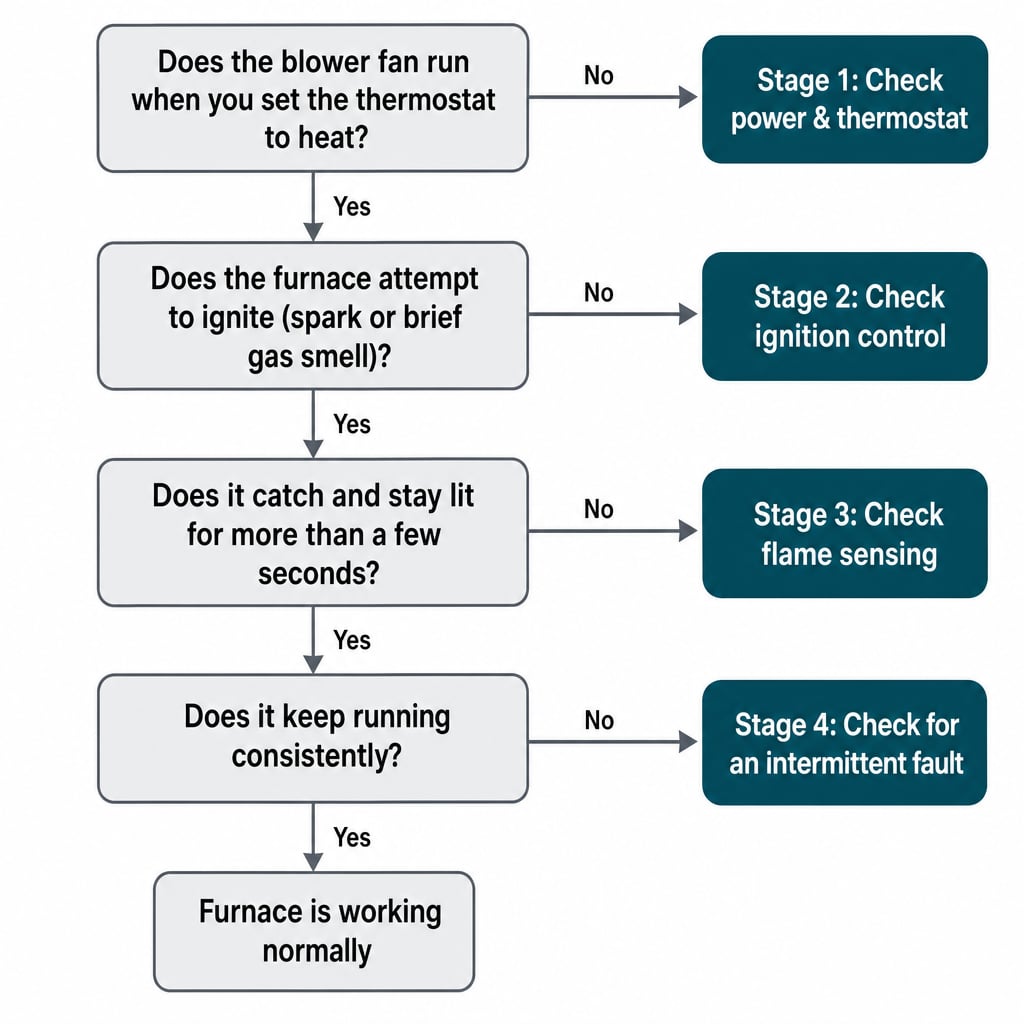
Answer these in order — your first "no" is your stage.
- Does the blower fan run when you set the thermostat to heat? No → Stage 1.
- If the fan runs, does the furnace attempt to ignite — a spark, a click, or a brief gas odor? No → Stage 2.
- If it attempts to ignite, does it catch and stay lit for more than a few seconds? No → Stage 3.
- If it stays lit, does it run consistently, or does it cycle off unexpectedly? Cycles → Stage 4.
Furnace Models Covered in This Guide
A compiled reference of RV forced-air furnace models from Dometic (which sells the former Atwood line under both names) and Suburban (Airxcel), showing each model's ignition system and its manufacturer-rated gas input in BTU/h. Furnace troubleshooting depends entirely on ignition type: a direct-spark-ignition (DSI) furnace has an electronic control board and igniter that can fail in ways a standing-pilot furnace simply does not have. No single manufacturer page compares this across brands, which is why the figures here are pulled separately from each maker's own product pages and operating manuals.
| Brand | Model | Ignition type | Rated gas input (BTU/h) | Voltage | Sources | Source checked |
|---|---|---|---|---|---|---|
| Dometic (Atwood) | DFSAD12111 | DSI — no pilot | 12000 | 12 VDC | Spec — dometic.com Ignition — forestriverinc.com | 2026-09-27 |
| Dometic (Atwood) | DFSD20111 | DSI — no pilot | 18000 | 12 VDC | Spec — dometic.com Ignition — forestriverinc.com | 2026-09-28 |
| Dometic (Atwood) | DFMDH35121 (DF Series family DFMD35) | DSI — no pilot | 35000 | 12 VDC | Spec — dometic.com Ignition — forestriverinc.com | 2026-09-28 |
| Dometic (Atwood) | DFLA40211 (DF Series family DFLA40) | DSI — no pilot | 40000 | 120 VAC | Spec — dometic.com Ignition — forestriverinc.com | 2026-09-28 |
| Suburban (Airxcel) | SF-20FQ (2551A) | DSI — no pilot | 20000 | 12 VDC | Spec — suburbanrv.com Ignition — forestriverinc.com | 2026-09-27 |
| Suburban (Airxcel) | NT-16SEQ (2503ABK/APW) | DSI — no pilot | 16000 | 12 VDC | Spec — suburbanrv.com Ignition — suburbanrv.com | 2026-09-27 |
| Suburban (Airxcel) | NT-20SEQ (2504ABK/APW) | DSI — no pilot | 19000 | 12 VDC | Spec — suburbanrv.com Ignition — suburbanrv.com | 2026-09-27 |
How these numbers were produced: Ignition type and gas input (BTU/h) are taken directly from each manufacturer's published product page or furnace operating/installation manual; no values are derived, converted, or estimated. A model is marked DSI only where the manufacturer's own manual states in its safety section that the furnace has no pilot and lights automatically. Where a model's marketing name and its rated gas input differ (for example, a model number ending in '20' rated at 18,000 or 19,000 BTU/h input rather than 20,000), both the model name and the separately-published input rating are shown so the reader is matching the rating plate, not the model number.
- BTU/h figures are the manufacturer's rated gas input, not delivered heat output. Actual heat delivered depends on altitude, LP regulator pressure, and duct losses — manufacturer-listed figures assume correct installation and an unrestricted duct and return.
- Model numbers are not a reliable BTU indicator on their own: Dometic's DFSD20111 is rated 18,000 BTU/h input despite the '20' in its name, and Suburban's NT-20SEQ carries a 20,000 BTU/h nameplate rating but a 19,000 BTU/h input rating in the same manufacturer's own specification table. Always confirm against the unit's rating plate or the manufacturer's input-rating table, not the model number alone.
- The manufacturer operating/installation manuals cited here list base model codes (for example DFMD35, DFLD40, DFLA40). Current retail listings sometimes add a voltage or kit suffix to the same physical platform (for example DFMDH35121, DFLA40211). Rows here match by base model code, which is the code the manufacturer's own manual uses.
- This table covers the current-production DSI models actually documented in a manufacturer page or manual at the time of writing. It does not cover every RV furnace ever installed — older standing-pilot furnace lines exist in the used-RV market, but no current manufacturer specification could be sourced for a specific pilot-ignition model, so none is listed here rather than guessed. A furnace with no visible circuit board and a continuously burning pilot flame is not a DSI unit and the staged electrical diagnostic in this guide does not apply to it the same way.
Download the data (CSV) · last updated 2026-09-28 · version 1.1 · CC BY 4.0, attribution to RV Field Manual.
The stages below apply to direct-spark-ignition (DSI) furnaces — the type in every current-production Dometic (formerly Atwood) and Suburban model we sourced a spec for. A furnace with a continuous pilot flame and no circuit board isn't DSI; Stages 2–3 don't apply the same way. The table lists ignition type and rated gas input per model, so you can check your model number against a documented source instead of assuming.
The Four-Stage Diagnostic
Each stage isolates a different subsystem, so working through them in order — instead of guessing at the likely part — tells you what actually failed before you spend money: power/thermostat, then ignition control, then flame establishment, then flame maintenance.
Stage 1 — Blower Fan Doesn't Run
What it has to do: 12V power has to reach the furnace, and the thermostat has to call for heat, before anything else can happen.
What to check: battery/converter voltage at the panel, the furnace's fuse, the thermostat's setting and batteries, and whether a reset button has tripped.
Where this one stops: if 12V is confirmed at the furnace and the fan still won't turn, the motor or wiring is suspect — a technician job, not a continuity check. See our furnace thermostat guide for thermostats that flag an actual fault, not just temperature.
Stage 2 — Fan Runs, Furnace Won't Attempt to Ignite
What it has to do: the sail switch has to confirm the blower is moving air, and the board has to see that confirmation before it powers the igniter. Either failing looks identical from outside. This is where Atwood/Dometic and Suburban furnaces diverge most; see the brand sections below.
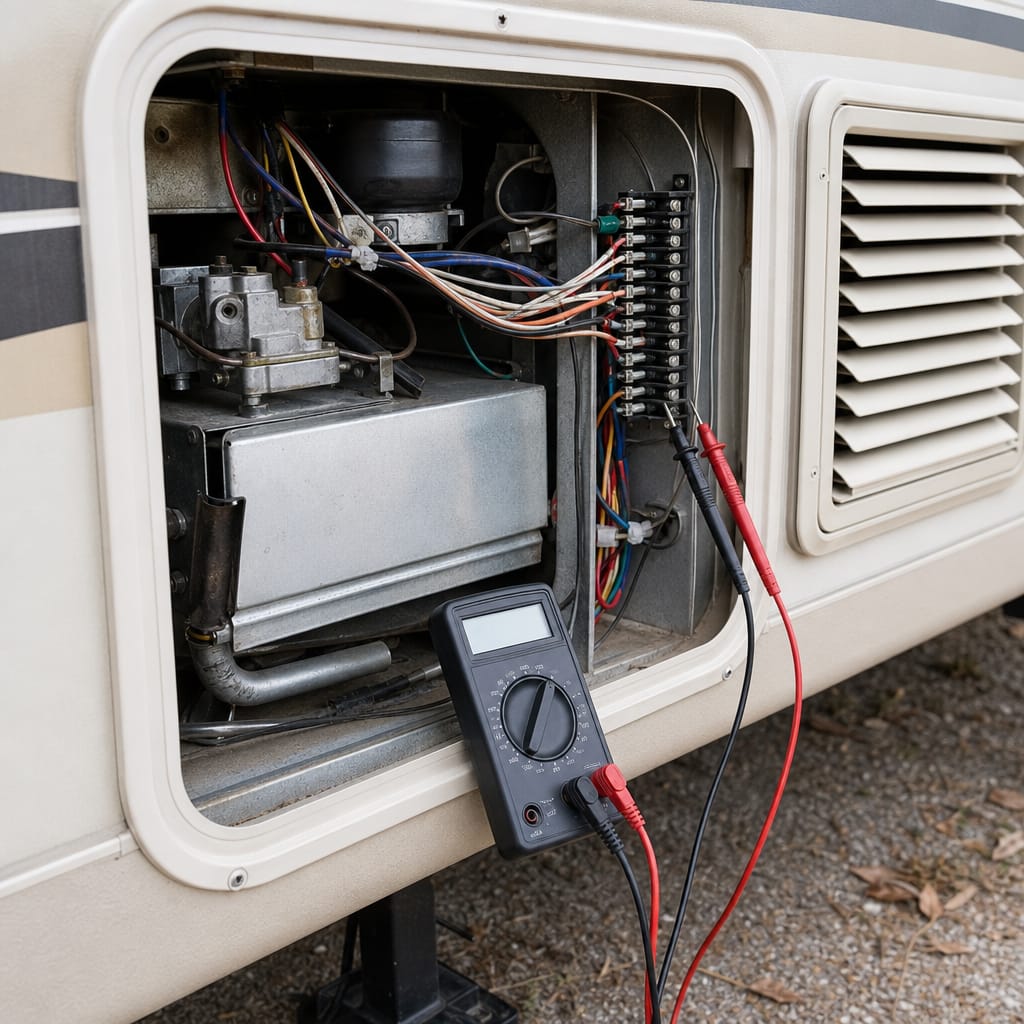
A multimeter confirms whether the sail switch or a board connection is actually open before you replace anything — it checks electrical faults only, not gas-side problems. See "Diagnostic Tool" below, and how a stuck or failed sail switch shows up.
Stage 3 — Furnace Ignites but Doesn't Stay Lit
What it has to do: the board has to sense a flame — usually through the same igniter/electrode that produced the spark — within a few seconds, or it cuts gas flow as a safety measure. That cutoff is working as designed, not a fault itself.
Common cause: a worn, misaligned, or fouled igniter electrode that sparks fine but can't sense the flame it just lit. See how flame sensing works on DSI furnaces.
Stage 4 — Furnace Runs Intermittently
What it has to do: staying lit depends on stable 12V supply, a harness without an intermittent short, and a thermostat that isn't cycling on its own.
The least brand-specific stage, and the hardest to diagnose without patience — if the fault doesn't repeat on demand, it's most likely to end with a technician. See our RV furnace wiring diagrams for tracing an intermittent short.
Atwood and Dometic Furnaces — What's Different
Furnaces built under the Atwood name are now sold under the Dometic brand, and parts and manuals mix both names. Recurring feedback in RV service and owner discussions points to the control board as a common Stage 2 failure point in this family.
The Dometic OEM Control Board Kit 31501 is listed as a genuine replacement: DSI, 12V, with fan control built in.
Before you order: several listings claim overlapping part numbers — 33488, 33727, 35-535911-113 — as "the same board." Match your existing part number before ordering, not just the symptom.
Skip it if: you haven't confirmed the sail switch first — it produces the identical symptom, and ruling it out costs far less than an unneeded board.
See our Atwood furnace models and Dometic furnace models for unit-specific options.
Suburban Furnaces — What's Different
Recurring feedback in RV service and owner discussions points to the igniter electrode as a common cause of Suburban DSI furnaces reaching Stage 3 — igniting but not staying lit.
This igniter electrode with wire assembly is listed as compatible with Suburban's 232286 part number, specified for the SF-20, SF-25, SF-30, and SF-35 series.
Before you order: the listing specifies fitment above serial number 934701426 — a cutoff, not a blanket "fits all SF furnaces" claim. Check your serial number, not just the model line.
See our Suburban furnace models and maintenance that reduces electrode fouling.
Diagnostic Tool: Confirming an Electrical Fault Before You Buy a Part
A Klein Tools MM325 digital multimeter reads continuity and voltage at 12V connections — confirming a suspected switch, fuse, or board circuit is actually open. General-purpose, not furnace-specific: it verifies electrical faults only, nothing about gas-side or combustion faults.
Skip it if: you aren't comfortable working near the furnace's low-voltage wiring — go straight to a technician instead.
Have a Pro Do This
This guide describes what a job involves, not how to do it — RV Field Manual doesn't publish step-by-step service procedures for a furnace's gas or ignition side.
Hand this off to a technician: gas line or regulator work, burner or orifice cleaning, any repair after you've smelled gas, and igniter or board replacement if you can't tell a bad part from a bad connection.
Continuing to self-diagnose is reasonable only for the electrical checks in Stages 1, 2, and 4 — furnace power off before touching any connection.
Common Mistakes
Mistake 1: Ordering a Part Off the Symptom Alone
What it looks like: The furnace won't ignite, so a new control board gets ordered on that symptom alone.
Why it's a problem: A failed sail switch produces the identical symptom, at far less cost.
What to do instead: Confirm continuity at the sail switch and board first.
Mistake 2: Matching the Symptom Instead of the Part Number
What it looks like: Ordering a board or electrode because a listing matches your symptom, without checking the part or serial number against your unit.
Why it's a problem: Both parts ship under overlapping part numbers or serial cutoffs for what look like the same product.
What to do instead: Match your furnace's existing part or serial number, not the failure description.
Mistake 3: Calling One Successful Cycle "Fixed"
What it looks like: The furnace runs once without cutting out, and an intermittent fault (Stage 4) gets treated as resolved.
Why it's a problem: Intermittent faults don't fail every cycle — one clean run doesn't rule it out.
What to do instead: Confirm the fix across several thermostat cycles first.
FAQ
Why does my RV furnace fan run but the furnace doesn't heat?
The fan rules out Stage 1 — the problem is ignition (Stage 2) or flame sensing (Stage 3).
Why does my RV furnace blow cold air before it starts heating?
A brief blower purge is normal on most DSI furnaces. A genuine ignition-delay fault means a much longer wait, or no heat at all.
Can I test my RV furnace myself, or do I need a technician?
Stages 1, 2, and 4 are electrical checks, safe with the furnace's 12V power off. Gas or ignition-service work belongs to a technician — see "Have a Pro Do This." For a furnace that won't ignite, see our dedicated guide.
Is a control board failure common on Atwood/Dometic furnaces specifically?
Recurring feedback in RV service and owner discussions points to the control board as a common cause, but it's not a guaranteed diagnosis — confirm with a continuity check first.
How do I know if my Suburban furnace's igniter electrode is worn out?
Igniting but not staying lit (Stage 3) is the symptom. On an SF-20/25/30/35, also check the serial number against the cutoff above.
Where is the reset button on most RV furnaces?
Location varies by brand and model — see our reset button location guide.
Sources Reviewed
Manufacturer pages for the Klein Tools multimeter, and OEM/fitment claims on the Dometic board and Suburban electrode listings, were checked via the sanctioned verification script at fact-check. The staged framing was informed by patterns across RV service and owner-community sources — not quoted, never the source of a number — used only to decide which failure points deserved a section.
Related Guides
- RV furnace buying guide
- Propane RV furnace roundup
- Atwood furnace roundup
- Dometic furnace roundup
- Suburban furnace roundup
- RV furnace sail switch roundup
- RV furnace maintenance roundup