Replacing an RV Awning: What to Know Before You Buy
Published
Disclosure: This article contains affiliate links. If you buy through these links, we may earn a commission at no extra cost to you. We do not claim hands-on testing unless clearly stated.
"Replacing an RV awning" isn't one job. It can mean a full universal kit, an OEM-matched roller-and-fabric swap, or hardware only — and ordering the wrong one wastes money and a shipping cycle. This guide helps you tell the three paths apart, know what to measure and confirm before you order, and know where the job stops being a part-swap and starts needing a pro. It does not cover fabric-only replacement with an intact frame and hardware, or an awning that still runs but misbehaves — both are separate guides, linked below.
What It Has to Do
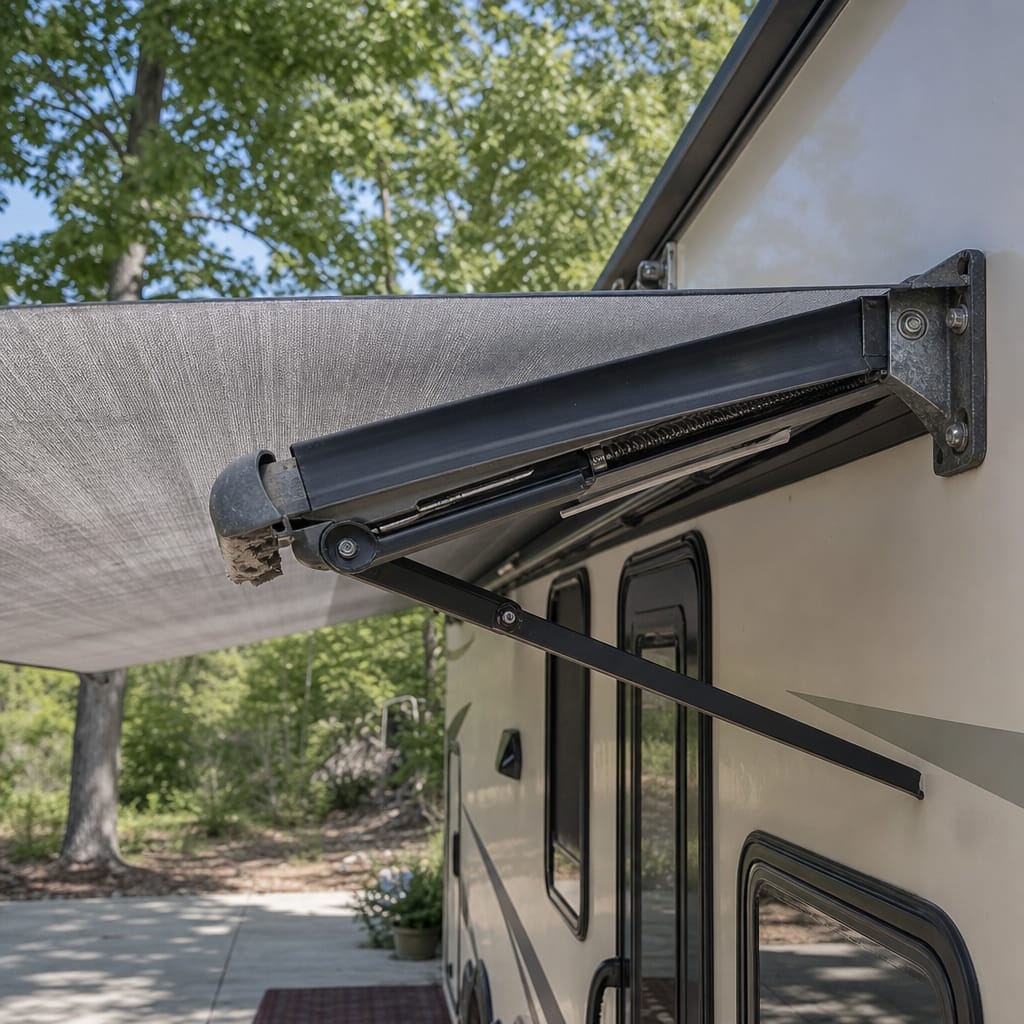
An RV awning's fabric canopy, roller tube, and extending arms work together to shelter the entry or patio area when the RV is parked. "Replacing an awning" can mean swapping any one of those three subsystems or the whole assembly at once. Years of UV exposure and repeated extend-and-retract cycles wear on fabric and roller hardware, which is why one part can fail well before the others. If you haven't picked an awning yet and just want to compare options in general, see our guide to shopping for an RV awning.
Repair or Replace?
Not every awning problem means a replacement. Alignment issues, a motor that runs but responds incorrectly, or an awning that's stuck but otherwise intact are usually repair or diagnostic questions, not replacement ones — and this guide doesn't walk through those steps. If your awning still operates but is misbehaving, start with our troubleshooting and repair guide before you order any parts. The rest of this article assumes something is actually broken, torn, or missing.
Which Kind of Replacement You Need
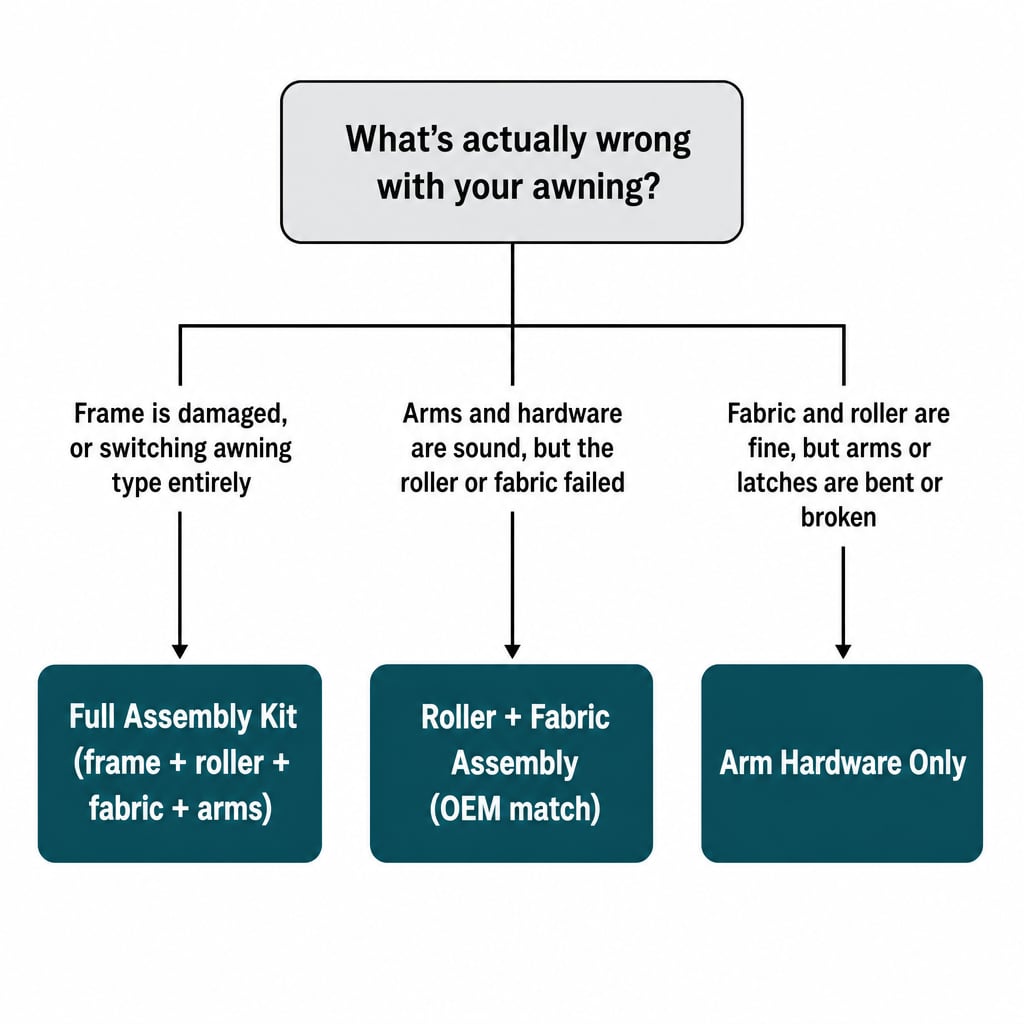
Once you've confirmed the awning genuinely needs replacing, the next question is which part. There are three distinct paths, and they call for different products.
Full Assembly Replacement (universal/aftermarket)
Frame damaged, or switching awning types entirely? You need a complete kit: frame, roller, fabric, and arms together. Universal kits fit most RVs rather than one OEM platform. Decide manual or motorized before buying — see manual awning options and motorized awning options.
Roller + Fabric Assembly Only (OEM match)
Arms and hardware sound, but the roller tube or fabric failed? You need a roller-and-fabric assembly matched to the brand, length, and color already mounted. Lippert's Solera line is the dominant OEM platform on existing RVs. Every Solera roller-assembly listing found on Amazon resolved to a generic category page rather than a single product page, so this guide doesn't name one here — confirm fit directly with an OEM dealer or the manufacturer's site, and don't assume "16 foot" matches the actual fabric cut length.
Arm Hardware Only
Fabric and roller fine, but the arms or latches are bent, corroded, or broken? Hardware-only lines exist for this — Dometic's named line is one example. The catch: the same line comes in roof-pitch and wire-exit variants that aren't interchangeable. Match the variant to your RV, not just the brand. See our awning hardware and parts roundup to compare more than the one pick below.
The table below puts nominal length, fabric cut length, projection, and hardware variant side by side across the VEVOR, Solera, and Dometic families, sourced from each manufacturer's page where reachable — fabric cut length runs shorter than the nominal length by roughly 10 to 11 inches at every size checked, a pattern worth knowing before you order, not a rule to subtract yourself.
Before You Order: What to Measure and Confirm
Measure your existing fabric width and roller length against the hardware currently mounted before ordering anything — don't buy on the nominal "16 foot" or "20 foot" headline number alone, since that number and the actual fabric cut length are two different figures on every family checked for this guide. If you're replacing arms only, confirm the hardware's pitch and wire-exit variant against what's already on your RV; the three Dometic 9100 variants, for example — per the sizing patterns in the table above — differ mainly in how far the awning drops below the mounting point when extended, and that drop is a geometry mismatch if you get it wrong, not a cosmetic one. If you're buying a complete kit, confirm manual versus motorized before you order — the two aren't interchangeable without separate wiring work, covered below. None of these figures are universal across sellers or model years; confirm them against the specific listing you're about to buy.
Tools and Products That Help
For the two replacement paths with a sourced pick, useful products include:
- Universal complete kit — VEVOR Manual RV Awning Complete Kit, aluminum alloy frame. View on Amazon The manufacturer's dedicated 16-foot product page confirms this size's fabric cut length (15'2", in line with the 10-to-11-inch nominal-vs-cut pattern above) and frame height. The Amazon listing itself, though, defaults to showing a 10-foot, gray configuration — don't assume the page you land on already shows the 16-foot, black-fade version described here; actively select that size and color if the listing offers them, and confirm the dimensions match before ordering.
- Hardware only — Dometic 9100 Power Awning Hardware, Standard pitch, bottom wire exit. View on Amazon This is arm hardware, not fabric or a full awning. Confirm it's Standard, not Basement or Reduced Pitch — the three look similar but mount differently.
The roller-and-fabric path has no product pick here, for the reason explained above. Measure first either way.
What the Replacement Job Involves
Removing old hardware, fabric, or a roller tube is typically a two-person job — awnings get unwieldy once extended. Arm hardware is bolted or screwed into the RV's sidewall framing, with sealant required at every fastener to keep water out. Motorized units add a 12-volt DC wiring connection into the RV's own electrical system, a different job than swapping arms. Fastener work that penetrates the RV's exterior skin, and any motor wiring, is where a bad seal or splice causes water intrusion or an electrical fault later, not always obvious at install time. Have a pro do this part: this guide helps you choose and prepare the right part, but stops short of a step-by-step install sequence for exactly that reason.
Common Mistakes
Mistake 1: Ordering by Length Alone
What it looks like: Choosing a kit or assembly based only on the headline "16 foot" or "20 foot" figure.
Why it's a problem: That number is usually the nominal marketed length, not the fabric cut length — the two differ by roughly 10 to 11 inches across the families checked here. Full-assembly and fabric-only listings also surface under similar searches without being interchangeable.
What to do instead: Check the listing's own stated fabric cut length and confirm the product type before ordering.
Mistake 2: Assuming Hardware Variants Are Interchangeable
What it looks like: Buying arm hardware in a known line (Standard, Basement, Reduced Pitch) without checking which variant is currently on the RV.
Why it's a problem: The pitch variant changes the mounting geometry — how far the awning drops when extended — not just the finish. The wrong variant doesn't fit, even in the "right" brand and model line.
What to do instead: Identify your current hardware's exact variant, using manufacturer documentation or the listing's own dimensions, before ordering.
Mistake 3: Treating a Motor Swap as a Simple Parts Job
What it looks like: Assuming a motorized awning's electrical hookup is another bolt-on step, like swapping manual arms.
Why it's a problem: Wiring a motor into the RV's 12-volt system is a separate job from removing old hardware, with its own failure points.
What to do instead: Treat the wiring connection as the "have a pro do this" part of the job, even if you're comfortable with the mechanical fastener work.
Skip It If
- Only the fabric is torn or worn and the roller and arms are otherwise sound — that's fabric-only replacement, not this guide. See our fabric-only replacement guide instead.
- The awning still operates but shows alignment, motor-limit, or electrical-connection symptoms — that's a repair question, already covered above in "Repair or Replace?"
- Yours is a slide-out or slide-topper awning rather than a patio awning — that's a different product family. See slide-out awning options.
- You can't yet identify your current hardware's brand, pitch, or length — confirm that first, using the decision framework above, rather than ordering a guess.
Awning Replacement Sizes and Hardware Variants by Family
A headline length like "16 foot" does not by itself tell you whether that number is the frame/roller length or the fabric's actual cut length, and a hardware line's part number does not say which pitch variant it is. This table separates those numbers across the three awning-replacement paths — a complete universal kit, an OEM-style roller-and-fabric assembly, and arm hardware sold on its own — for the product families covered in this guide, with one source per row and a blank left wherever the cited source does not publish that figure.
| Product family / line | What this part actually is | Nominal length as marketed | Fabric cut length as published | Projection (extension depth) as published | Mount type, hardware fit, or pitch variant | Weight as published | Source | Source checked |
|---|---|---|---|---|---|---|---|---|
| VEVOR Manual RV Awning Complete Kit, Aluminum Alloy Frame (universal/aftermarket) | Complete awning assembly: frame + roller + fabric + arms, manual, universal/aftermarket | 16 ft | 15 ft 2 in (15'2") | 7.7 ft | Manual pull-strap operation (no electricity); switchable installation brackets for RV-wall or ground mounting; frame height 5.6 ft | 88.2 lb / 40 kg (complete kit, including all accessories) | VEVOR, 16' Manual RV Awning Complete Kit product page (manufacturer) | 2026-10-04 |
| VEVOR Manual RV Awning Complete Kit, Aluminum Alloy Frame (universal/aftermarket) | Complete awning assembly: frame + roller + fabric + arms, manual, universal/aftermarket | 20 ft | 19 ft 2 in (19'2") | 7.7 ft | Manual pull-strap operation (no electricity); switchable installation brackets for RV-wall or ground mounting; frame height 5.6 ft | 97.0 lb / 44 kg (complete kit, including all accessories) | VEVOR, 20' Manual RV Awning Complete Kit product page (manufacturer) | 2026-10-04 |
| Solera (Lippert Components) Power & Hybrid RV Awning Roller Assembly | Roller tube + attached fabric only — compatible 18V or Hybrid arm hardware sold separately | 10 ft | 9 ft 1 in (9'1") | 8 ft (standard) | Patio roller type, vinyl fabric with integrated light track; compatible with 18V or Hybrid awning hardware (sold separately); shipping dimensions 120" L x 5" W x 5" H | 28 lb (shipping weight) | Lippert, Solera 10' Power & Hybrid RV Awning Roller Assembly product page (manufacturer) | 2026-10-04 |
| Solera (Lippert Components) Power & Hybrid RV Awning Roller Assembly | Roller tube + attached fabric only — compatible 18V or Hybrid arm hardware sold separately | 16 ft | 15 ft 1 in (15'1") | 8 ft (standard) | Patio roller type, vinyl fabric with integrated light track; compatible with 18V or Hybrid awning hardware (sold separately); shipping dimensions 195" L x 6" W x 6" H | 53 lb (shipping weight) | Lippert, Solera 16' Power & Hybrid RV Awning Roller Assembly product page (manufacturer) | 2026-10-04 |
| Solera (Lippert Components) Power & Hybrid RV Awning Roller Assembly | Roller tube + attached fabric only — compatible 18V or Hybrid arm hardware sold separately | 20 ft | 19 ft 1 in (19'1") | 8 ft (standard) | Patio roller type, vinyl fabric with integrated light track; compatible with 18V or Hybrid awning hardware (sold separately); shipping dimensions 246" L x 6" W x 6" H | 65 lb (shipping weight) | Lippert, Solera 20' Power & Hybrid RV Awning Roller Assembly product page (manufacturer) | 2026-10-04 |
| Dometic 9100 Power Awning Hardware | Arm hardware only (arms + latches) — not fabric, not a roller tube, not a full awning | 91-1/2 in (with awning extended) | Standard pitch, bottom wire exit — 13-1/4 in drop when extended; back channel 65-5/8 in, front channel 64-7/8 in, lower pivot height 30-5/16 in; fits 910, 915 & 917 models | 27 lb | Nomadic Supply Company, Dometic 9100 Power Awning Arm Hardware Kit (Standard) listing (retailer, citing manufacturer dimensions) | 2026-10-04 | ||
| Dometic 9100 Power Awning Hardware | Arm hardware only (arms + latches) — not fabric, not a roller tube, not a full awning | 91-1/2 in (with awning extended) | Basement pitch (shorter arms for RVs with basement storage below the awning) — 31-3/8 in drop when extended; back channel 62-1/8 in, front channel 61-3/8 in, lower pivot height 25-5/16 in; fits 910, 915 & 917 series awning tubes | Panther RV Products, Dometic A&E 8952001.400BL RV 9100 Power Awning Arm Hardware Kit (Basement) listing (retailer, citing manufacturer dimensions) | 2026-10-04 | |||
| Dometic 9100 Power Awning Hardware | Arm hardware only (arms + latches) — not fabric, not a roller tube, not a full awning | 91-1/2 in (with awning extended) | Reduced Pitch (raised pivot point) — only 2 in drop when extended; back channel 65-5/8 in, front channel 64-7/8 in, lower pivot height 33-3/8 in; fits 910, 915 & 917 series awning tubes | Panther RV Products, Dometic A&E 8952003.400UL RV 9100 Power Awning Arm Hardware Kit (Reduced Pitch) listing (retailer, citing manufacturer dimensions) | 2026-10-04 |
How these numbers were produced: Every figure is quoted from the manufacturer's own product page where one was reachable, or from a retailer page that independently republishes the manufacturer's own stated dimensions where the manufacturer's page was not. No figure is derived, estimated, or averaged across sources. "Nominal length" is the marketed size; "fabric cut length" is the actual fabric dimension once installed — these are two different numbers, and a source that gives only one leaves the other blank rather than assuming they match. Hardware-only rows have no fabric or roller length at all; their decision-critical number is the pitch variant and the drop (how far the awning hangs below the mounting point when extended), shown in the mount/variant column.
- A blank cell means the cited source does not publish that figure. No cell on this table is filled with a figure estimated, averaged, or carried over from a similar size or variant in the same product line.
- Across both the VEVOR complete-kit family and the Solera roller-and-fabric family, the fabric cut length runs shorter than the nominal marketed length by roughly 10 to 11 inches at every size checked. That pattern held for every row sourced here, but it is a pattern, not a rule — confirm the fabric cut length on the specific listing you are ordering rather than subtracting a fixed number from the nominal size yourself.
- The three Dometic 9100 hardware variants (Standard, Basement, Reduced Pitch) are not the same hardware in different lengths — they are different geometries for different mounting situations, distinguished mainly by how far the awning drops below the mounting point when extended: about 13-1/4 inches for Standard, about 31-3/8 inches for Basement, and about 2 inches for Reduced Pitch. Fitting the wrong variant to an RV is a mounting-geometry mismatch, not a cosmetic difference. None of these three rows include fabric or a roller tube — hardware only.
- On 2026-10-03, dometic.com's own product pages for all three 9100 hardware variants returned an empty "no results" category listing rather than the product page itself. Every Dometic row on this table is sourced from a retailer page that independently publishes the same dimensions Dometic's own documentation states elsewhere (channel lengths, pivot height, and drop), not from a direct dometic.com product page — flagged here because that changes the source tier for those three rows specifically.
- "Projection" is how far the awning extends outward from the RV once deployed — a separate measurement from length, and the number that determines ground clearance and patio coverage rather than which length to order.
- This table covers marketed length, fabric cut length, projection, and hardware mounting geometry only. It does not cover load or wind rating for any row: no manufacturer or retailer source found for any product checked here publishes a load or wind-resistance figure, so none is shown and no article drawing on this table should assert one.
Download the data (CSV) · last updated 2026-10-04 · version 1.1 · CC BY 4.0, attribution to RV Field Manual.
FAQ
Can I replace an RV awning myself?
Choosing and preparing the right part, yes. The wall-penetrating hardware work, and any motor wiring, fall under "have a pro do this" above — that part isn't a solo weekend project.
What's included in a replacement RV awning kit?
A universal complete kit includes the frame, roller, fabric, and arms together. An OEM roller-and-fabric assembly is narrower — no arm hardware included. See "Which Kind of Replacement You Need" above.
Does Dometic sell awning hardware separately from the fabric?
Yes, as a named hardware-only line. The catch is matching the pitch variant — Standard, Basement, or Reduced Pitch — to what's already on your RV.
How do I know if I need a full kit or just the roller and fabric?
Arms and hardware sound, roller or fabric failed: roller-and-fabric assembly. Frame damaged: full kit. See the decision framework above.
Can a motorized awning kit go where a manual one used to be, or the reverse?
Not as a simple swap. Switching between manual and motorized adds or removes a 12-volt wiring connection — its own job beyond the mechanical fastener work.
Is a universal kit as good as matching my existing OEM hardware?
Depends on the goal. A universal kit replaces the whole assembly; an OEM-matched roller-and-fabric assembly keeps your existing arm hardware. Neither is universally better — it depends on whether that existing hardware is still sound.
Sources Reviewed
Dimensions for the VEVOR kit and the Lippert/Solera roller-and-fabric assemblies came from each manufacturer's own product pages. The Dometic 9100 hardware figures came from retailer pages republishing Dometic's own stated dimensions, since Dometic's own category pages for this hardware returned no results during research — those figures are retailer-sourced, not manufacturer-direct. Recurring patterns from public troubleshooting discussions were used only to decide which questions this guide should address, never as a source for any figure or claim.
Related Guides
- RV Awning Buying Guide
- Replacing Just the Awning Fabric
- RV Awning Fabric Roundup
- RV Awning Troubleshooting and Repair
- RV Awning Hardware and Parts
- Slide-Out and Slide-Topper Awnings