How to Choose RV Leveling Blocks for Your Rig
Disclosure: This article contains affiliate links. If you buy through these links, we may earn a commission at no extra cost to you. We do not claim hands-on testing unless clearly stated.
You pull into a site, the bubble level says you're three inches off on one corner, and every "leveling block" listing on Amazon looks like the same yellow plastic stack with a different brand sticker on it.
This guide covers how leveling-block types differ mechanically, what a manufacturer's weight-capacity and stack-height limits actually mean — they're two separate numbers, not one — and how to match a type to your rig. It doesn't cover powered or hydraulic auto-leveling jacks, a different product category, or step-by-step leveling technique — see our guide to actually using leveling blocks once you've picked a type for that.
Quick Recommendation by Use Case
| Use case | Best product type | Why |
|---|---|---|
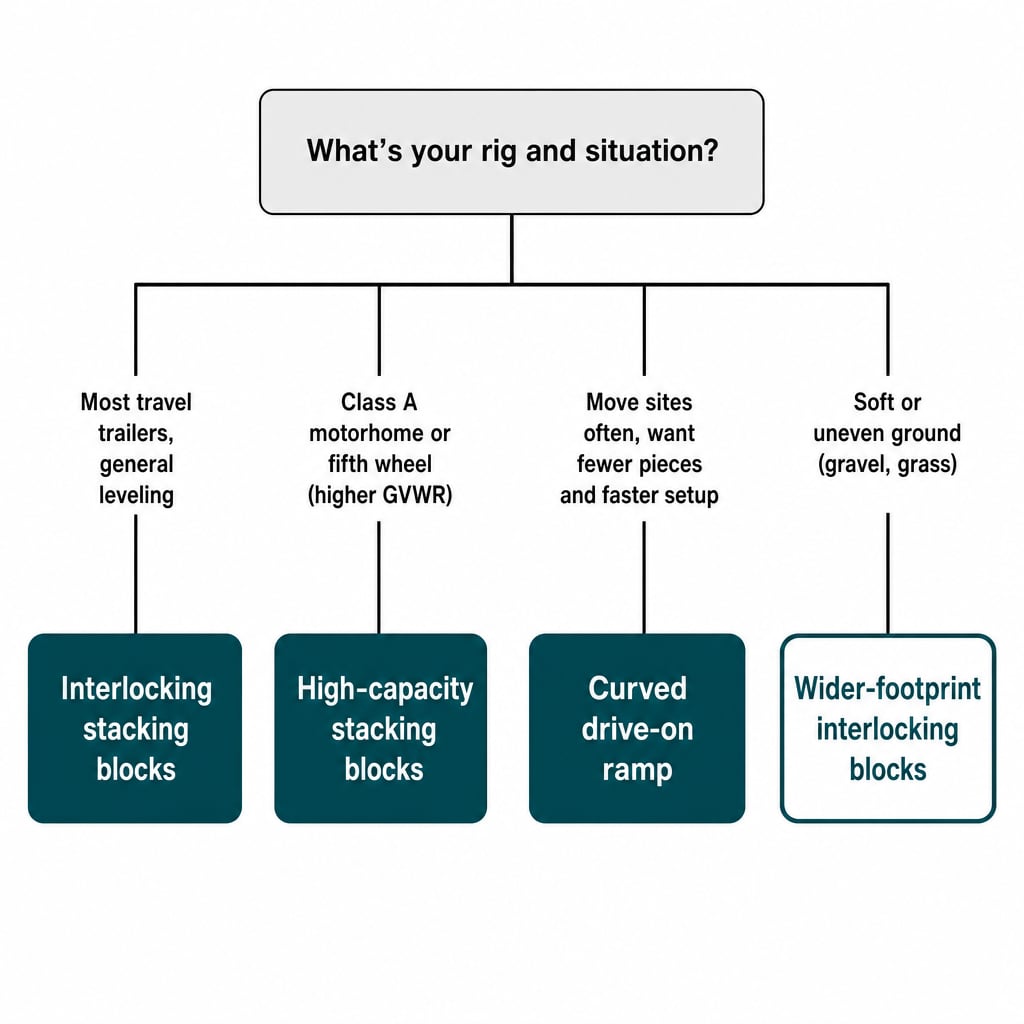
| Most travel trailers, general leveling | Interlocking stacking blocks | Widest fit, lowest cost per corner, no manufacturer-listed capacity assumed unless the listing states one |
| Class A motorhome or fifth wheel (higher GVWR) | High-capacity stacking blocks | Look for a manufacturer-published weight rating in the tens of thousands of lbs — but check the separate max-stack-height figure before assuming it covers your lift |
| Frequent movers who want fewer pieces and faster setup | Curved drive-on ramp | One or two ramps replace a stack per side; confirm what actually ships in the box before you buy |
| Tandem-axle trailer needing both wheels raised evenly | Interlocking or high-capacity blocks, not a single ramp | A ramp levels along the direction of travel; tandem axles usually need the same block height under both tires on a side |
| Soft or uneven ground (gravel, grass) | Wider-footprint interlocking blocks | Reduces point-load sinking; still measure your own ground conditions rather than assuming any product handles every surface |
For a deeper look at one specific brand's lineup across these use cases, see our full roundup of Camco leveling block picks.
Key Factors to Consider
Manufacturer-listed weight capacity — and the separate stack-height limit
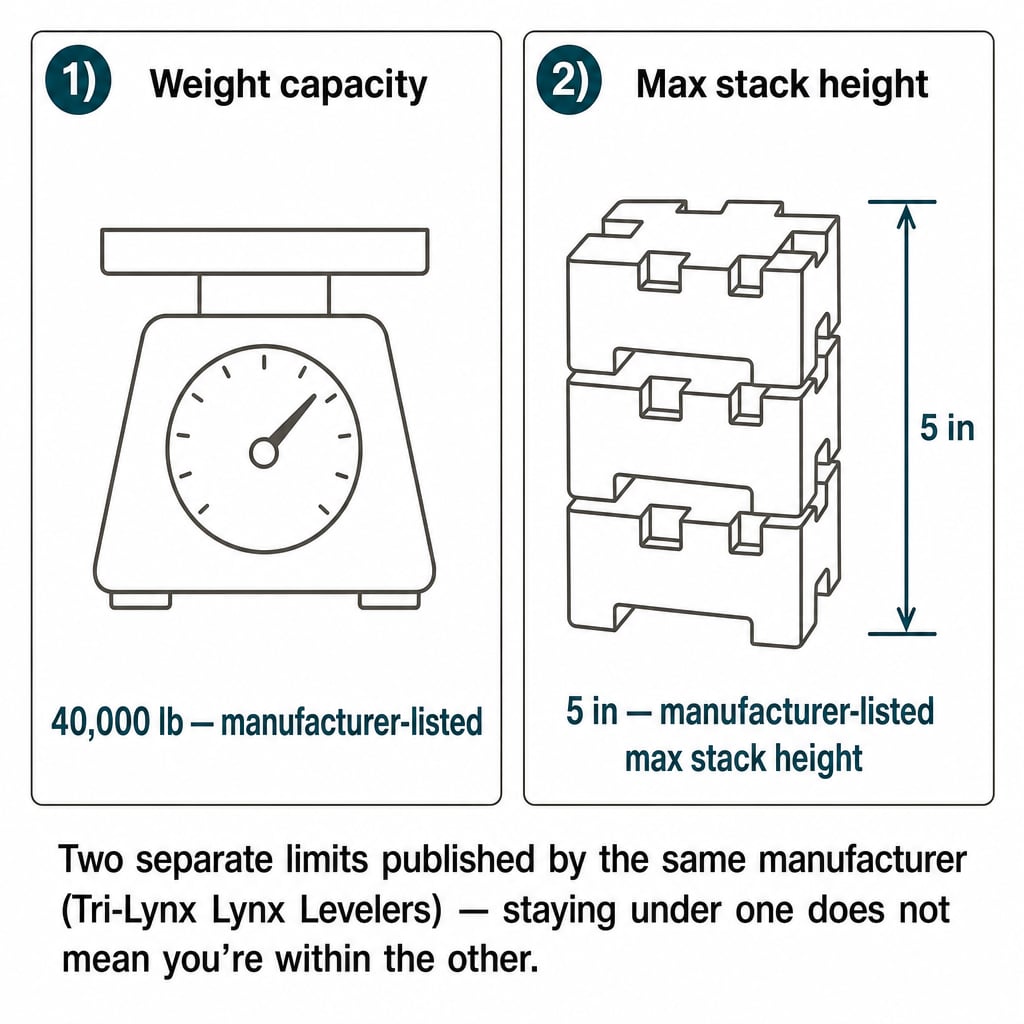
A manufacturer may publish two independent numbers for a stacking block: a total weight capacity, and a maximum stacking height. A block rated for tens of thousands of pounds can still be misused if stacked higher than recommended — the weight rating doesn't override the height limit, and staying under one doesn't mean you're within the other. The diagram below shows one real example of a manufacturer publishing both figures for the same product.
How many you actually need
A single-axle trailer needs at least two corners leveled; a tandem-axle trailer usually needs the same block height under both tires on a side for an even lift. Don't assume a "10-pack" automatically covers a fifth wheel's rear tandem plus front stabilizing jacks without counting your own corners first. For how your hitch setup affects what's riding on those corners, see our guide to matching a weight distribution hitch to your trailer.
Interlocking stacking design vs. drive-on ramp
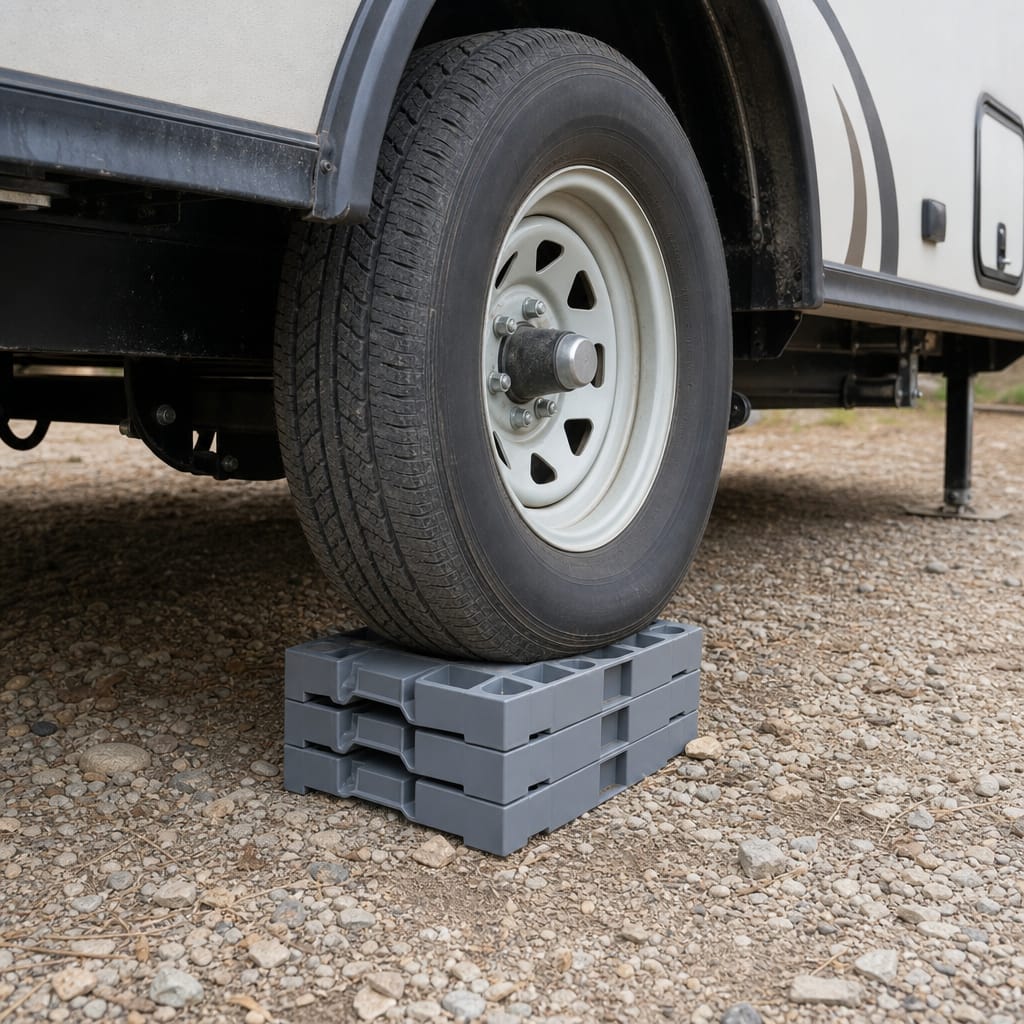
This is a mechanical difference, not just a shape difference. Stacking blocks give you height in fixed increments — one block, two blocks, three — based on how many you interlock. A curved drive-on ramp gives continuous height as you drive up it, but only along the direction you drove; it doesn't help with side-to-side lean the way a stack under one tire can.
Material and footprint
Nearly every product in this category is plastic or a composite resin. Footprint matters more than material for stability: a wider block spreads the load over more ground contact and sinks less on gravel or grass than a narrow one under the same weight. Don't assume any footprint handles every ground type — measure your own typical camping surfaces.
What actually ships in the box
What a listing calls an included accessory doesn't always match how the manufacturer describes the same item. One product in this guide is a live example: the manufacturer's own page describes its 2-pack as two levelers plus two rubber grip mats, while the Amazon listing separately lists chocks and rubber grip mats as what's included — whether those name the same accessory under two different words, or two separate items, isn't resolved as of this writing. Check the current listing's own "what's included" line for the specific accessories you're expecting, rather than assuming either reading.
Wheel chocks are usually a separate purchase
Most stacking-block kits ship as blocks only, with no wheel chock included — check the "what's included" line on the listing rather than assuming one.
Product Types Explained
Interlocking stacking blocks
Individually stackable, tab-and-slot interlocking pieces, typically sold in multi-packs of 8 to 10.
Best for: general-purpose leveling on travel trailers, where you need incremental height adjustment rather than one fixed lift.
Limitations: manufacturer-listed weight capacity isn't always published for a given SKU — treat an unlisted capacity as a real gap, not an oversight you can fill in yourself. Most kits don't include a wheel chock.
What to look for: a manufacturer-published weight capacity (or an honest absence of one), how securely the pieces interlock, and the block's footprint.
High-capacity stacking blocks
The same mechanical family as standard stacking blocks, but marketed and rated for heavier rigs.
Best for: Class A motorhomes, fifth wheels, and other higher-GVWR trailers that need a rating well above what a standard multi-pack states.
Limitations: a high weight rating doesn't remove the separate max-stack-height limit discussed above — a good listing states both numbers, not just the more impressive one.
What to look for: both the weight capacity and the stack-height limit named explicitly by the manufacturer, not inferred from one figure alone.
Curved drive-on ramps
A single molded ramp that the tire drives onto directly, giving continuous height in one motion instead of a stack of discrete pieces. Some ramp kits are sold bundled with a wheel chock, anti-slip mats, and a bubble level rather than as a standalone ramp — OULEME's kit is one example of that bundled format.
Best for: readers who want side-to-side leveling done in fewer pieces, with a faster setup than stacking blocks.
Limitations: a ramp levels primarily along the direction you drove onto it, not side-to-side independent of that. What's actually included in the box — one ramp, a pair, a chock, mats — needs to be confirmed against the specific listing, not assumed from the product name.
What to look for: the manufacturer-stated tire-diameter and rig-weight compatibility, and an explicit list of what's included.
Improvised options: wood scraps and cinder blocks
Worth naming only to explain why this product category exists at all: general-purpose lumber and masonry blocks aren't manufactured or rated for the load path a vehicle tire puts on them when parked. That's a structural mismatch, not a marketing distinction — see Mistakes to Avoid below.
When to Choose Each Type
Start with axle configuration: a single axle needs at minimum two corners handled, while a tandem axle usually needs matching height under both tires on a side. Weight class matters next — if your rig's GVWR pushes toward the higher end, look for a manufacturer-published high-capacity rating rather than assuming a standard stacking block covers it. How often you move sites matters too: a drive-on ramp favors frequent movers who want fewer pieces to handle, while stacking blocks favor occasional use or tight storage space. Ground conditions round it out — soft or uneven ground favors a wider footprint regardless of mechanical type. See the Quick Recommendation table above for how these factors combine.
Measurement Checklist
Before buying, check:
- Your tire width and diameter — some drive-on ramp listings state a maximum tire diameter, and you need to verify it against your actual tire, not your vehicle class. See how tire condition and pressure affect ride height at a site if your lean seems to shift between stops.
- How many inches of lift each corner actually needs, not just "it feels off"
- The ground type at the sites you typically camp on — gravel, grass, and paved pads all behave differently under a point load
- How much storage bay space you have for whatever kit you choose
- The exact model of your current setup if you're only replacing a chock or a single component, not the whole kit
The sourced weight and stack-height figures for the products in this guide are shown above if you want to check a number directly.
Mistakes to Avoid
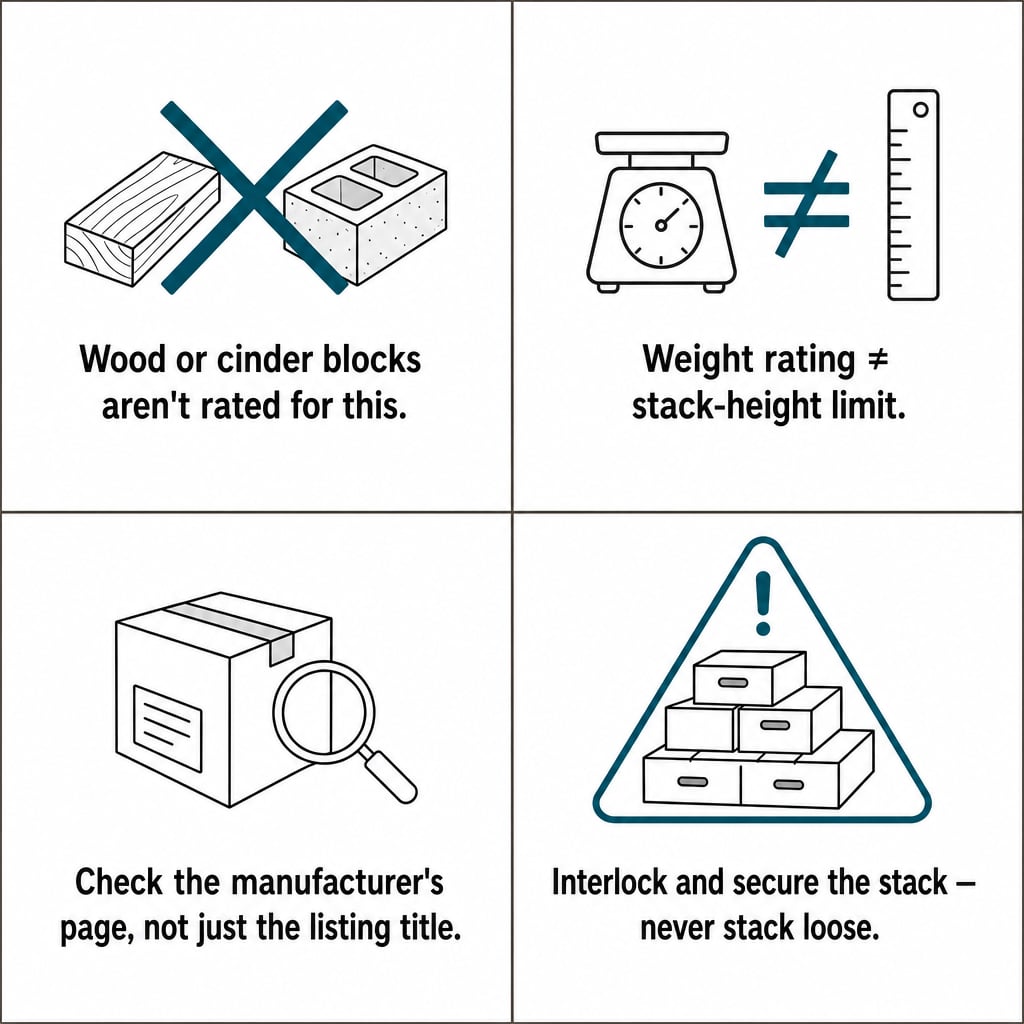
Using wood scraps or cinder/concrete blocks instead of a purpose-rated product. These materials aren't manufactured or rated for the load a parked vehicle tire puts on them — a genuinely different failure mode than "not as convenient," and the reason purpose-built leveling blocks exist as a category at all.
Conflating a weight-capacity number with a stack-height limit. The two are independent limits a manufacturer may publish separately. Tri-Lynx, for instance, lists a 40,000 lb weight limit for its Lynx Levelers alongside a separate recommended maximum stack height of 5 inches — staying under the weight limit doesn't mean you're within the height limit, and vice versa.
Assuming a listing's stated included accessories match the manufacturer's own wording exactly. See "What actually ships in the box" above — check the current listing's own "what's included" section for your exact model before assuming either reading.
Stacking loose blocks without interlocking or securing them. This guide describes what to check on a product, not how to place it — but the general caution holds regardless of brand: an unsecured stack under load is a different risk than a properly interlocked one.
Safety / Installation Notes
This guide describes what to check on a leveling-block or drive-on-ramp product before you buy it — not step-by-step instructions for placing one under a tire. For the actual technique, see our step-by-step guide to using leveling blocks once you've picked a type.
Treat every weight capacity and stack-height figure in this guide as manufacturer-listed, not a guarantee. Manufacturer-listed capacity assumes correct assembly, level ground, and proper weight distribution — real-world performance depends on all three, plus how the blocks are stacked and secured.
Featured Picks
Best overall: Camco FasTen RV Leveling Blocks, 10-Pack (21022)
Made in the USA, 9.08 lb total, 12-month warranty per Camco's product page — but no stated weight capacity for this model. That's a real gap; we're not filling it in with a guess.
Highest manufacturer-listed capacity: Tri-Lynx Lynx Levelers, 10-Pack (00015)
Tri-Lynx states a 40,000 lb total weight limit and, separately, a recommended maximum stack height of 5 inches — both apply, and neither substitutes for the other. Backed by a 10-year warranty upon registration.
Fastest (Drive-On): Beech Lane Camper Leveler, 2-Pack
Beech Lane lists a manufacturer capacity of up to 35,000 lb and a lifetime warranty. For dual-axle trailers, up to 4 inches may need trimming off one leveler depending on tire spacing — measure first. What's included varies by source (see "What actually ships in the box" above); confirm on the current listing before you buy.
For the full lineup of picks in this category, including alternatives to these three, see our full roundup of Camco leveling block picks.
Weight Capacity vs. Stacking and Tire Limits
Every RV leveling block or ramp manufacturer publishes its own weight capacity, but that number is rarely printed next to the separate limit that actually governs how the product can be used safely: a maximum stacking height for interlocking blocks, or a maximum tire diameter and leveling range for a drive-on ramp. This table puts both figures side by side, in the same units, for each product, sourced directly from the manufacturer's own product page wherever one exists for that specific SKU.
| Product | Brand | Type | Weight capacity | Max stack height | Max tire diameter | Leveling range | Source | Source checked |
|---|---|---|---|---|---|---|---|---|
| Camco FasTen RV Leveling Blocks, 10-Pack (21022) | Camco (FasTen line) | Stacking blocks | Not published | Not published | Not applicable | Not applicable | Camco — FasTen 21022 product page | 2026-09-23 |
| Camco FasTen XL RV Leveling Blocks, 10-Pack (21026) | Camco (FasTen line) | Stacking blocks | Not published | Not published | Not applicable | Not applicable | Camco — FasTen XL 21026 product page | 2026-09-23 |
| Camco Heavy Duty RV Leveling Blocks, 10-Pack (44505) | Camco | Stacking blocks | 4,000 lb | Not published | Not applicable | Not applicable | RV Auto Parts (retailer; Camco does not list this SKU on its own site) | 2026-09-23 |
| Andersen Camper Leveler (3604) | Andersen Hitches | Drive-on ramp | 30,000 lb (trailer weight) | Not applicable | 32 in | 0.5–4 in | Andersen Hitches — Camper Leveler product page | 2026-09-23 |
| Tri-Lynx Lynx Levelers, 10-Pack (00015) | Tri-Lynx | Stacking blocks | 40,000 lb | 5 in | Not applicable | Not applicable | Tri-Lynx — Lynx Leveler 10-Pack product page | 2026-09-23 |
| OULEME RV Leveling Blocks, Camper Leveler Kit, 2-Pack | OULEME | Drive-on ramp (kit with chocks, mats, and level) | 35,000 lb (tire weight) | Not applicable | 32 in | 0.5–4 in | OULEME — Camper Leveler Kit product page | 2026-09-23 |
How these numbers were produced: Figures come from each product's manufacturer page, checked directly, or — where no manufacturer page exists for that specific SKU — a retailer's own product page, noted as such in the source column. A figure reads 'Not published' rather than an estimate when neither a manufacturer nor a retailer states it for that exact SKU; a number that appeared only in marketplace listing text and could not be traced to a manufacturer or retailer source was treated the same way and left blank. 'Not applicable' marks a limit that doesn't exist for that product's mechanical type — a drive-on ramp has no stacking height, and a stacking block has no tire-diameter limit.
- These are manufacturer-listed figures, not independent test results. Real-world capacity depends on correct assembly, level and stable ground, and proper weight distribution.
- A weight capacity and a stacking-height or tire-diameter limit are independent constraints published by the manufacturer. Staying under one does not mean a use is within the other.
- Figures apply to the specific pack size and SKU listed, not to a brand's whole product line — the same design sold in a different pack size can carry a different, or unpublished, capacity figure.
- Two products researched for this table (a 12-pack from RVMATE and a 9-pack from Homeon Wheels) are not included: neither has a manufacturer page for the specific SKU, and the only capacity figures found for them in marketplace listings could not be traced to a manufacturer or retailer source. Rather than publish an unverified number, we left them out of this table entirely.
Download the data (CSV) · last updated 2026-09-22 · version 1.0 · CC BY 4.0, attribution to RV Field Manual.
FAQ
Do I actually need RV leveling blocks, or can I skip them?
It depends on whether your rig already has a built-in leveling system. If you have automatic hydraulic or electric leveling jacks, blocks are a backup at most. If you don't, blocks or a drive-on ramp are how you level manually.
How many leveling blocks do I need for my RV?
There's no single universal number — it depends on your axle configuration. A single axle needs at least two corners addressed; a tandem axle usually needs matching height under both tires on a side, which can mean more pieces than a "10-pack" implies once you count all your corners.
What's the difference between leveling blocks and a leveling ramp?
Stacking blocks give height in discrete increments, one interlocked piece at a time. A drive-on ramp gives continuous height in a single motion, but only along the direction you drive onto it.
Can I use wood or cinder blocks instead?
Not safely. General-purpose lumber and masonry aren't manufactured or rated for the load a parked tire places on them — that's a structural difference, not a preference.
What does "manufacturer-listed capacity" actually limit?
It's the maximum load the manufacturer states the product can bear — and for stacking blocks, it's a separate number from the maximum stack height. Check both before assuming either one covers your use.
Do leveling blocks work for both side-to-side and front-to-back leveling?
Generally yes for stacking blocks, since you place them under whichever corner needs lift. A single drive-on ramp placement mostly addresses one axis at a time — you may need to reposition or use a second ramp for the other axis.
Is it safe to leave leveling blocks under the RV for an extended stay?
Treat extended use the same as initial setup: correct assembly, stable ground, and proper weight distribution all still apply. There's no universal yes or no — it depends on your setup and ground conditions, not the product alone.
Sources Reviewed
For this buying guide, we reviewed manufacturer documentation and product pages (Camco, Tri-Lynx, Beech Lane, OULEME), retailer listings where a manufacturer page didn't cover a specific SKU, and recurring patterns in public buyer and forum discussions — used only to identify what readers get confused about, never as a source for a spec. We do not claim hands-on testing.
Related Guides
- our full roundup of Camco leveling block picks
- step-by-step guide to using leveling blocks once you've picked a type
- how tire condition and pressure affect ride height at a site
- matching a weight distribution hitch to your trailer's weight