How to Fix an RV Refrigerator: Diagnose the Real Cause First
Disclosure: This article contains affiliate links. If you buy through these links, we may earn a commission at no extra cost to you. We do not claim hands-on testing unless clearly stated.
The fridge stopped cooling, the groceries are warming up, and it isn't obvious whether that's a cheap fix or a service call. Most troubleshooting content jumps straight to parts — a thermistor here, a control board there — before answering the question that actually narrows things down: power, mode, airflow, a sensor, or the one category that isn't a DIY job.
This guide gives a diagnostic order for absorption RV refrigerators — the propane/electric units Norcold and Dometic both build — before you spend money. It does not cover step-by-step repair, gas line or valve service, sealed-system repair, or wiring inside the control board cabinet. Those get a "have a pro do this" pointer, not instructions.
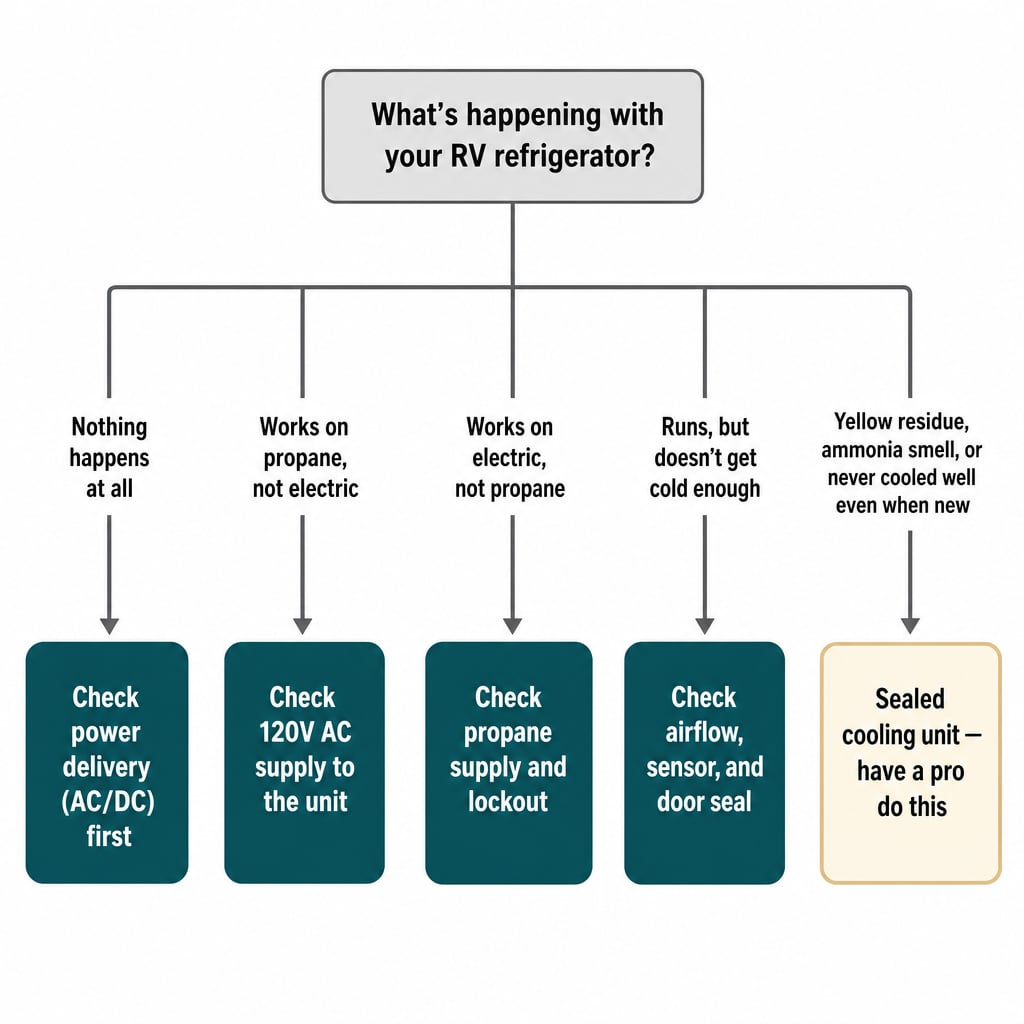
Quick Answer: Where to Start
| Symptom | Check first | Section |
|---|---|---|
| Nothing happens at all | Power delivery (AC/DC) | Won't turn on |
| Works on propane, not electric | 120V AC supply to the unit | Propane-but-not-electric |
| Works on electric, not propane | Propane supply / lockout | Electric-but-not-propane |
| Runs, but doesn't get cold enough | Airflow, sensor, door seal | Not cooling enough |
| Yellow residue, ammonia smell, or the fridge never really cooled even when new | Sealed cooling unit | Cooling unit issues |
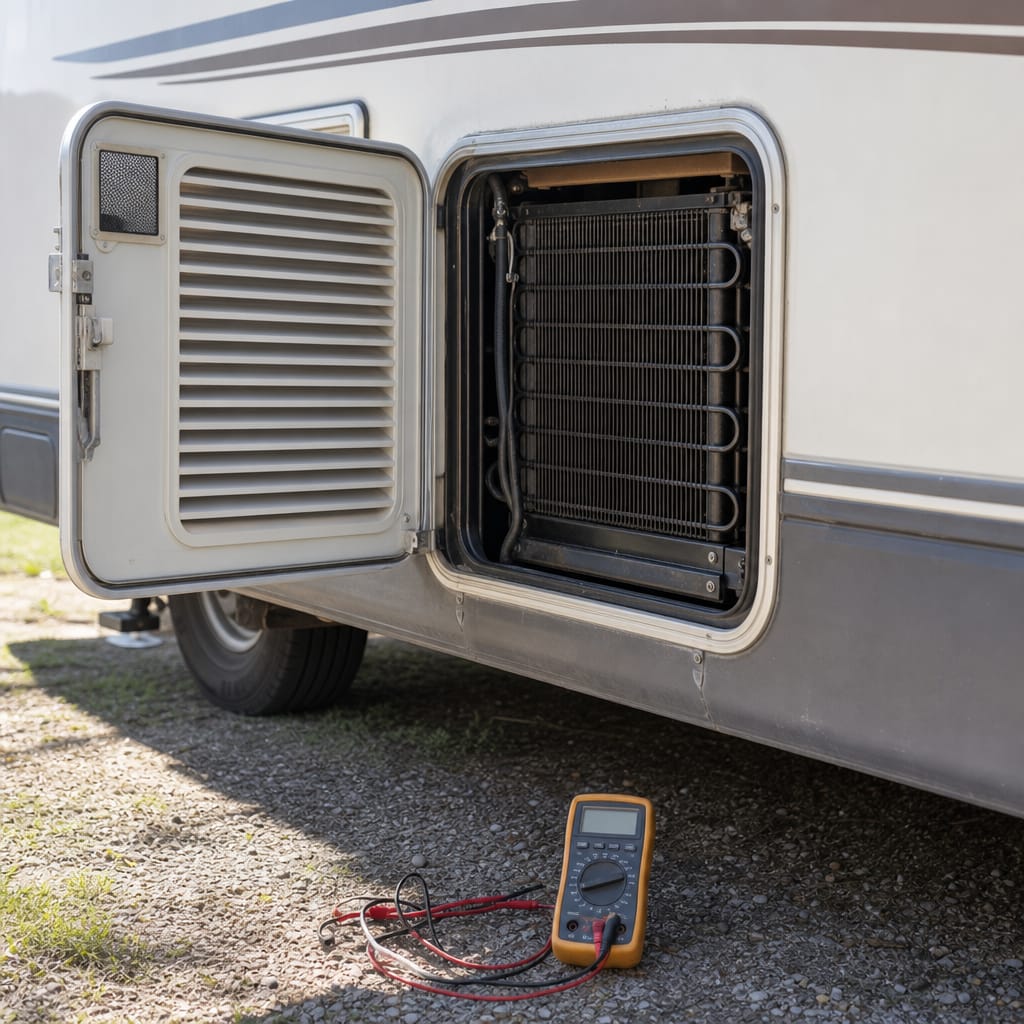
What you'll need for the checks below is generic — a basic multimeter and a way to read surface temperature, nothing brand-specific. Full picks are in Tools That Help You Diagnose, further down.
How to Tell If It's Actually a Cooling Problem
Before assuming the fridge isn't cooling, confirm it's running in the mode you think it's in. Absorption units switch between propane, electric, and often an automatic mode — a unit in the wrong mode looks identical to a broken one.
On propane, the boiler box should start feeling warm shortly after ignition, not stay cold. On electric, the heating element should be drawing power (the multimeter check below confirms this). If neither is happening, you may have a mode problem, not a cooling one.
Diagnose by Symptom
It won't turn on at all (power delivery)
Before assuming a part has failed, check AC power at the outlet or breaker feeding the fridge, and DC voltage at the control board connector — a five-minute check with a basic multimeter (see Tools That Help You Diagnose, below) that rules out replacing a part the unit never needed.
Don't skip this because the rest of the RV has power — the fridge runs on its own circuit and can be dead while everything else works. Manufacturer-published AC/DC amp draw varies by model; the table below gives you a real figure to check your reading against.
Works on propane, not electric (120V AC checks)
Confirm 120V AC is actually reaching the fridge — shore power, an inverter, or past the breaker — not just that the RV "has power" somewhere. Other outlets can work fine while the fridge's specific circuit is tripped or disconnected.
This check stops at the fridge's power inlet. Testing or adjusting anything past that point is wiring work inside the unit, not covered here.
Works on electric, not propane (propane lockout / valve checks)
Many units lock out the igniter after repeated failed attempts, and that's often mistaken for a valve or regulator failure. Before assuming either, confirm there's propane in the tank and the supply valve is open.
Have a pro do this: anything past "is the valve open and is there propane" — regulator, line pressure, orifice, or ignition assembly — is fuel-gas work. See how RV refrigerators use propane, but don't attempt regulator or line work yourself.
Not cooling enough (thermistor, airflow, door seal)
Check these in order:
- Door seal. A worn gasket lets warm air in continuously — check by feel and eye before suspecting anything electronic.
- Airflow behind the cooling fins. A blocked exterior vent is a leading cause of "won't get cold in summer," and it's fixable with a vent fan (below) without touching the sealed system.
- Sensor drift. Confirm with an actual IR-thermometer reading (below) before replacing a low-cost part on a guess.
Norcold's 618548 thermistor (also replacing 621742/629409) and Dometic's 3851210025 kit are the parts most often named here — see thermistor options for Norcold and Dometic units.
Cooling unit / coil issues (when it's not a part at all)
Visible residue on the cooling fins, a new chemical smell, or a fridge that never cooled well even when new can point past any replaceable part.
Have a pro do this: the cooling unit is sealed and pressurized. There are no leak-repair steps here — this is a call-a-technician conversation, often a replace-the-unit one.
Where to Start: Cheapest and Safest Checks First
Power and mode checks cost nothing and rule out the two problems people most often confuse. Airflow and door-seal checks are free or cheap. Sensor and board swaps cost real money and are worth doing once, after a confirmed reading — not before. Propane, sealed-system, and AC wiring work is pro-only regardless of cost.
Replace a part once power is confirmed, mode is correct, and a real reading shows a discrepancy. Go straight to a technician for propane, sealed-system, or wiring issues.
Tools That Help You Diagnose
None of these tools are RV-specific — all three cover the checks above.
Klein Tools MM325 Digital Multimeter — for the power-delivery check. A basic 600V AC/DC manual-ranging multimeter, CAT III 600V rated. The manufacturer lists it as indoor-rated only — a real limit near an exterior vent in wet conditions.
SOVARCATE Infrared Thermometer — for confirming a real temperature discrepancy before assuming the thermistor is bad. Any comparable IR thermometer works; its accuracy spec isn't independently confirmed. Point it at the cooling fins and interior air for a before-and-after reading.
TITAN TTC-SC60(A) Ventilation Cooling Fan — for the airflow cause. The manufacturer lists auto mode as off below 68°F and max speed at 113°F — manufacturer-listed, not a guarantee for your vent layout. Read "easy installation" skeptically: it's still exterior vent housing work.
Two board-level parts come up constantly and are worth naming without a card, since replacing either means opening the cabinet. Dinosaur Electronics makes a replacement board for Norcold (61716822) and a separate one for Dometic (the Micro P-711) — confirm your Dometic board's part number starts with "293" first, since the manufacturer states the Micro P-711 fits "293"-prefix boards and cannot replace a "385"-prefix Black Box board, not the reverse. See Norcold-specific replacement parts and Dometic control board options.
A worn door gasket is also a genuine, often-overlooked cause here. For airflow fixes, see ventilation fans for RV fridges.
Have a Pro Do This
Three situations here are outside DIY territory:
- Propane line, regulator, valve, or ignition work beyond confirming the valve is open and the tank has propane.
- Any sign of a sealed cooling-unit leak — residue or a new smell. This is a replace-the-unit conversation with a technician, not a repair.
- Wiring inside the control board cabinet, AC or DC — not covered here.
If your symptom lands in one of these three, this guide's job is confirming that's where you are, not walking you through the next step.
Where This One Stops
No service manual content, wiring diagrams, gas-line procedures, or leak-repair steps here. Past the checks above, the manufacturer's service documentation and a licensed technician are the next step. If you're weighing whether repairs still make sense, see when replacing the fridge makes more sense than repairing it. Routine maintenance — a clear vent, a periodic seal check, correct leveling — prevents a lot of these calls; see routine maintenance that prevents this.
Common Mistakes
Mistake 1: Replacing a part before confirming power and mode
What it looks like: The fridge isn't cooling, so a thermistor or board gets ordered and swapped in.
Why it's a problem: If the real issue was power or mode, the new part fixes nothing, and it may not be returnable.
What to do instead: Run the power and mode checks first, and only replace a part once both are confirmed.
Mistake 2: Treating "not cooling enough" and "won't turn on" the same
What it looks like: Any complaint gets the same troubleshooting steps.
Why it's a problem: A dead fridge is a power or wiring issue; one that runs but won't get cold is airflow, seal, or sensor. The checks differ.
What to do instead: Use the symptom table at the top to route yourself to the right section.
Mistake 3: Assuming a propane lockout is a valve problem
What it looks like: The fridge works on electric but not propane, so the valve gets blamed immediately.
Why it's a problem: Units often lock out the igniter after failed attempts — a safety feature, not a failure — and it looks identical to a supply problem.
What to do instead: Confirm propane in the tank and the valve open first. If both check out, that's a technician conversation.
RV refrigerator specs at a glance
Norcold and Dometic absorption refrigerators run on some combination of 120V AC, 12V DC, and LP gas, and each brand — often each individual model's own listing — publishes its power-draw and capacity figures in its own format, scattered across product pages and parts listings rather than gathered in one place. This table puts the capacity, LP gas input, AC and DC amp draw, dimensions, and weight for a starting set of Norcold and Dometic absorption models side by side, sourced from each listing's own published specifications, so a reader checking their unit's actual draw against a nameplate figure has a real number to check it against instead of a guess.
| Refrigerator / model | Type | Capacity | LP gas input (BTU/h) | AC input | DC input | Dimensions (as published) | Net weight | Source | Source checked |
|---|---|---|---|---|---|---|---|---|---|
| Norcold N4150 | 3-way absorption (120V AC / 12V DC / LP gas) | 5.3 cu. ft. | 2.5 A (120V AC) | 17.6 A (12V DC) | 49-3/16" H x 20-3/4" W x 22-11/16" to 22-25/32" D | 85 lbs. | RV Fridge Guys product page for the Norcold N4150 (retailer listing republishing Norcold's own unit specifications) | 2026-09-26 | |
| Norcold N8XF (N8LXF) | 2-way absorption (120V AC / LP gas) | 8 cu. ft. | 3 A (120V AC) | 1.2 A (12V DC) | 59-7/8" H x 23-1/2" W x 24" D | 142 lbs. | RV Fridge Guys product page for the Norcold N8XF / N8LXF (retailer listing republishing Norcold's own unit specifications) | 2026-09-26 | |
| Dometic RML8330 | 3-way absorption (12V DC / 120V AC / LP gas, per source) | 4.8 cu. ft. | 50.94" x 16.56" x 23.56" (axis order not labeled on source) | United RV Parts product page for the Dometic RML8330 (retailer listing republishing Dometic's own unit specifications) | 2026-09-26 | ||||
| Dometic Americana II DM2872RB1 | 2-way absorption (120V AC / LP gas) | 7.31 cu. ft. total; published alongside separate component figures of 5.6 cu. ft. fresh food and 1.7 cu. ft. freezer (see caveats — these do not sum to exactly 7.31); sold as an "8 cu. ft." model | 1,500 BTU/h | 2.7 A / 440 W (120V AC) | 24-7/8" W x 26" D x 60-13/16" H | 124 lbs. | Camping World product page for the Dometic Americana II DM2872RB1 (retailer listing republishing Dometic's own unit specifications) | 2026-09-26 |
How these numbers were produced: Every figure is quoted or closely paraphrased from the source page's own stated specifications for that exact model, with the source line kept in each row. Where a manufacturer's own product page did not expose a structured specification table to this tool, the figure is sourced instead from a parts or retail listing that republishes the manufacturer's stated specifications for that model; each row's source label says which. AC and DC amp-draw figures are reported exactly as published for the voltage stated on the source page and are not converted, combined, or re-derived. LP gas input (BTU/h) is left blank wherever the checked source did not publish a figure for that specific model, which is common: several listings state AC and DC draw in detail but omit a BTU rating entirely.
- A blank cell means the checked source for that model does not publish that figure, not that the value doesn't exist anywhere. LP gas input (BTU/h) is blank for the Norcold N4150 and N8XF and for the Dometic RML8330 for this reason — each source publishes AC and/or DC amp draw but not a BTU rating for that specific model.
- This is a starting set, not full coverage of either product line: two Norcold absorption models and two Dometic absorption models, chosen to represent common 2-way and 3-way configurations in the capacity range these units typically come in. Norcold and Dometic each sell more absorption models, plus separate 12V DC-compressor lines (Norcold's Polar/N2000-series, Dometic's NRX/NRXD-series) that are out of scope for this version.
- Dometic's Americana II DM2872RB1 is sold and commonly listed as an "8 cu. ft." model; its own spec listing states 7.31 cu. ft. of total storage volume, plus separate component figures of 5.6 cu. ft. fresh food and 1.7 cu. ft. freezer. All three figures are reported as published rather than reconciled: the two components add to 7.3 cu. ft., 0.01 short of the stated 7.31 cu. ft. total, most likely from rounding on the source's own page.
- The Dometic RML8330's source lists a single "Load Amps: 2-4 Amps" figure without stating which voltage it applies to. Rather than assign an unlabeled figure to either the AC or DC column, it is left out of both and noted on the row instead.
- The Norcold N8XF/N8LXF source page states its net weight only as an unlabeled number ("142.0000"); it is reported here as pounds on the strength of consistency with every other weight figure on the same page, not because the source itself labels the unit.
- The Norcold N4150 source page's metric (cm) conversion for depth does not agree with its own inch figure for the same dimension. The inch figure is reported here; the metric conversion is not, since the two didn't agree and no manufacturer figure was available to re-derive the correct conversion from.
- All figures are manufacturer-listed nameplate and spec-page numbers, not a guarantee of real-world performance or of what a specific installed unit will draw. Actual draw and cooling performance depend on ambient temperature, ventilation, correct leveling, LP supply pressure, and battery/charging system condition. A unit reading well outside its own published figures is worth investigating against that model's own number — not against a different model's number on this table.
Download the data (CSV) · last updated 2026-09-26 · version 1.0 · CC BY 4.0, attribution to RV Field Manual.
FAQ
Why does my RV fridge work on propane but not electric?
Most often a 120V AC supply problem — shore power, an inverter, or a tripped breaker — not a part failure. Confirm AC is reaching the unit first.
Why does my RV fridge work on electric but not propane?
Check for a propane lockout: tank has propane, valve open. If both check out and it still won't ignite, that's a technician job.
How do I know if my RV refrigerator's thermistor is bad?
Confirm with an actual reading first, rather than replacing on a guess. A real discrepancy is what justifies replacement.
Can I fix an RV refrigerator cooling unit leak myself?
No. It's a sealed, pressurized system with no safe DIY repair. Residue or a new smell point to a technician visit and likely a replacement.
Does an unlevel RV really affect the refrigerator?
Absorption refrigerators are more level-sensitive than a household fridge, which is why manufacturers publish leveling guidance. Follow your manufacturer's specific instructions rather than a general rule of thumb.
Related Guides
- RV refrigerator buying guide
- When replacing the fridge makes more sense than repairing it
- Norcold-specific replacement parts
- Dometic-specific replacement parts
- Thermistor options for Norcold and Dometic units
- Ventilation fans for RV fridges