Replacing RV Awning Fabric: What the Job Involves and What to Check First
Published
Disclosure: This article contains affiliate links. If you buy through these links, we may earn a commission at no extra cost to you. We do not claim hands-on testing unless clearly stated.
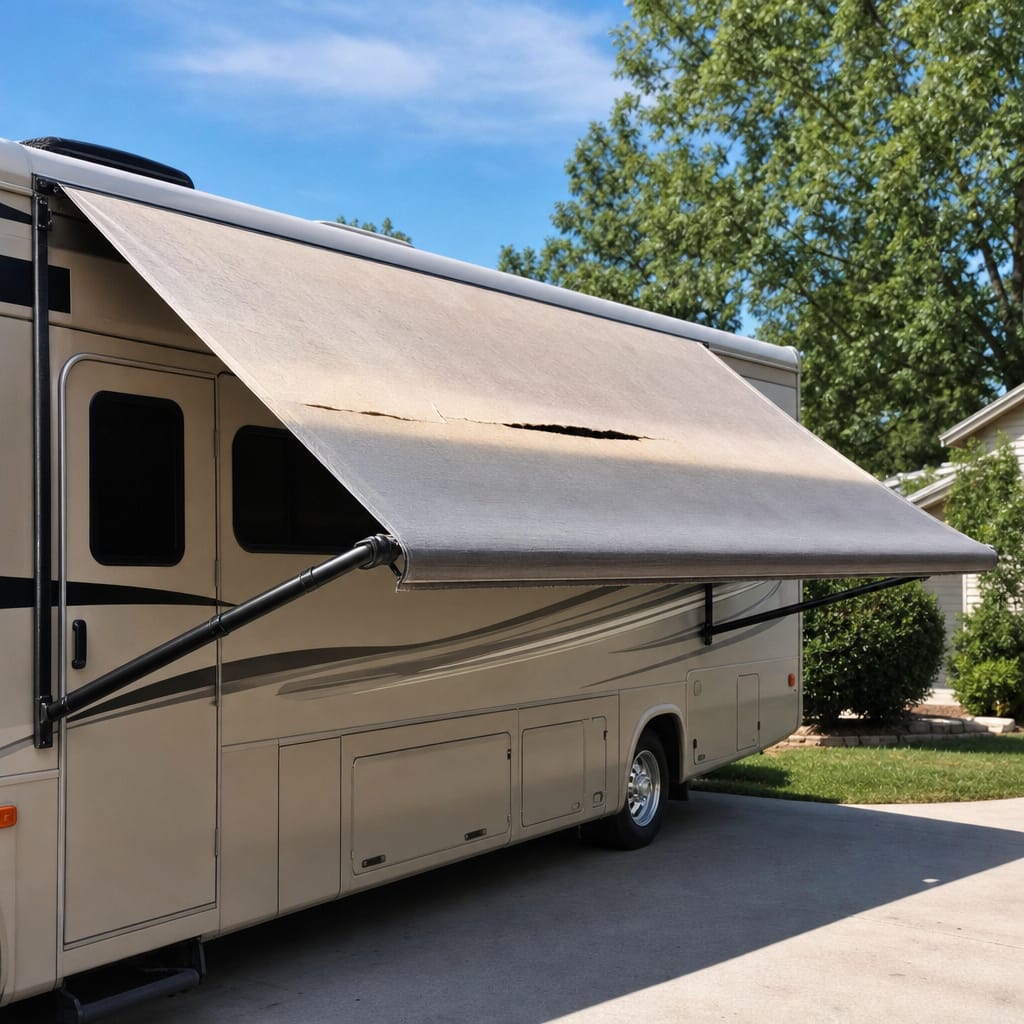
A torn, sun-rotted, or mildewed awning fabric panel is usually a fabric problem, not a whole-assembly problem — the frame, roller tube, and arms underneath it can be perfectly sound. What you can order to fix it, though, depends on hardware details most fabric listings don't lead with: whether your roller has a metal cover, whether your awning is manual or motorized, and the fabric's actual cut length versus the length printed on the listing. This guide covers what to check before ordering, three sourced fabric options, and when this stops being a DIY job. It skips step-by-step instructions — that's a manufacturer's job, not an editorial one — and whole-assembly replacement, covered separately.
What It Has to Do
The fabric panel's job is simple: a UV and weather barrier, stretched taut across the roller tube and pulled out on the extending arms. It isn't structural — the frame, roller tube, and arms do that work — which is why fabric usually wears out first, as sun exposure and extend-and-retract cycles break down the coating and stitching. That's also why "replace the fabric" is usually the right scope: if your arms, roller tube, and motor (if you have one) still work, you don't need the whole assembly. If you're not sure the problem is the fabric and not the frame, see our guide to how RV awnings are built first.
Before You Order: What Actually Determines Fit
Nominal length isn't fabric length
An awning's marketed size — "16 foot," "18 foot" — isn't the fabric's actual cut length. Two unrelated product families confirm the gap: VEVOR's 16-foot manual kit ships with fabric cut to 15'2", and Lippert's Solera 16-foot roller-and-fabric assembly ships at 15'1" — both roughly 10 to 11 inches shorter than nominal, both figures from each manufacturer's own page. The gap held at every size checked, but it's a pattern, not a rule: don't subtract 10 or 11 inches yourself and assume you've got the right number.
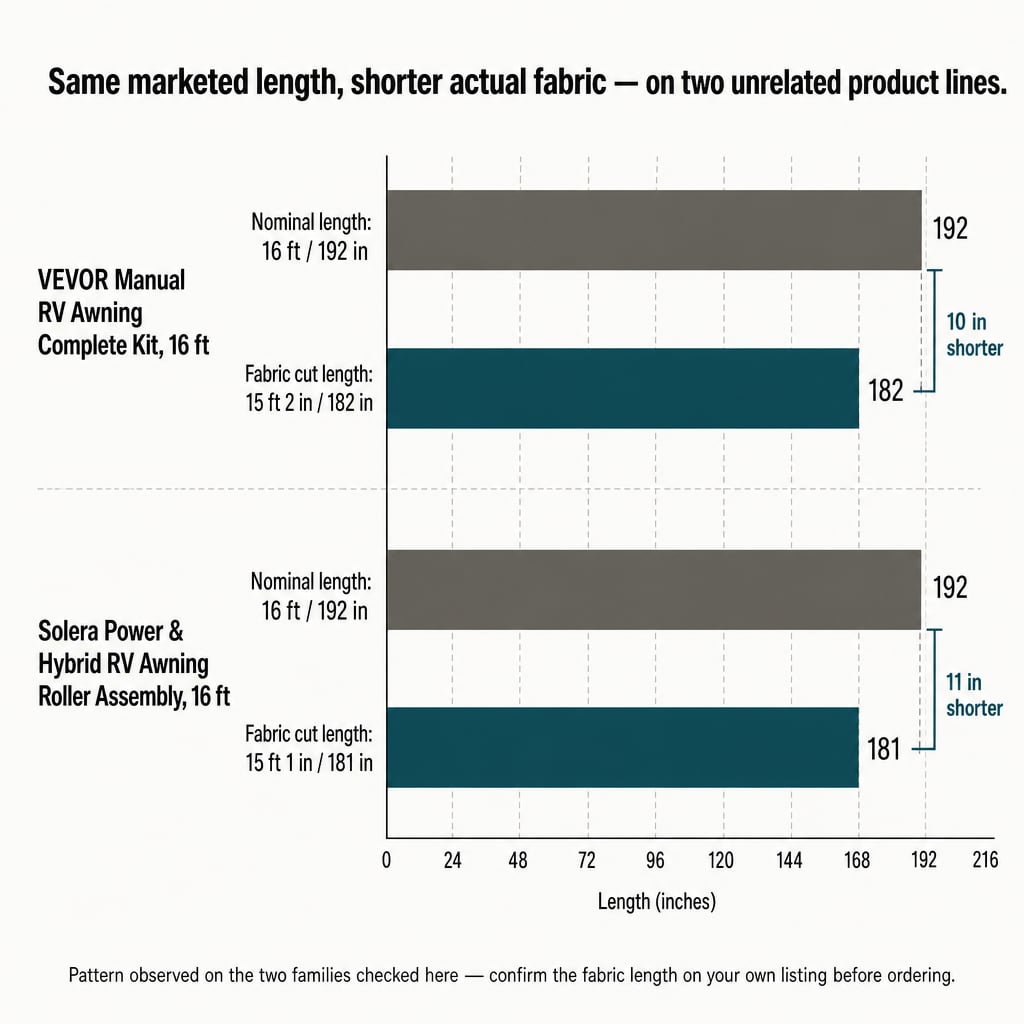
Measure the roller-tube-to-roller-tube span on your own rig — not the frame's advertised length — before you order. For the full process, see our guide to measuring your awning correctly.
Manual vs. electric changes what you can buy
Electric (motorized) awnings add a motor and limit-switch assembly at the roller tube that manual units don't have. Swapping fabric on an electric unit means working around that hardware, not just lifting fabric off a bare roller — a different job than a manual swap. If you're not sure which category your awning falls into, compare manual awning hardware and electric awning hardware before ordering.
Standard roller vs. metal roller cover
Some hardware — Dometic-style awnings are the common example — uses a metal cover over the roller tube instead of a bare tube. Fabric cut for a bare tube does not fit metal-cover hardware, and mixing the two up is probably the single most common ordering mistake in this category: a listing that looks right on brand and length can still be the wrong cut. Check for a metal roller cover before you buy — see the FAQ below.
Fabric Options Worth Knowing About
The three sourced options below cover the three hardware situations above. Measure and confirm your hardware match before choosing any of them.
ShadePro Heavy Duty Weatherproof Vinyl is built for a bare 3-inch roller tube with no metal cover. The manufacturer lists it as 15 oz, 3-ply vinyl, cold-crack tested to -20°F — confirmed on both the manufacturer's page and the Amazon listing, stronger sourcing than most fabric listings get. ShadePro also sells "Premium" and "Standard" grades, and this SKU's page doesn't say those share the same oz/ply, so don't generalize the spec beyond it. The warning that matters most: bare-tube hardware only — a metal roller cover means the wrong cut.
RecPro Heavy Duty 16 oz. Weatherproof Vinyl is sold in 1-foot increments across 15 sizes, a workable match for OEM-style runs longer than ShadePro's listing covers. The manufacturer lists 140 lbs. psi tensile strength and heat-welded seams. The same nominal-vs-cut-length gap applies here: RecPro's own page confirms the actual width runs about 10 inches shorter than nominal at every size. Measure your roller-tube span before picking a size off the nominal number.
Carefree of Colorado OEM Replacement Fabric is the closest match if Carefree is already the factory-fitted brand on your RV — it's the dominant OEM awning brand on travel trailers and motorhomes. Carefree's manufacturer page lists its Premium-tier fabric at 15 oz antimicrobial vinyl, 1000 denier, double-stitched with Gore® Tenara® thread, with a 10-year warranty — but the Amazon listing for this product couldn't be loaded directly, so whether this listing is Premium or a different grade hasn't been confirmed. Read the spec as describing Premium fabric generally, not this listing, until checked. Carefree matches fabric to roller-tube diameter — 3¼" here, per a secondary source rather than a direct read.
For arm, end-cap, or roller-tube hardware that also needs attention, see our guide to awning hardware and parts.
Where This Stops Being a Buy-and-Swap Job
The arms on an RV awning are spring-loaded under tension even when fully retracted. Releasing that tension the wrong way is a real injury and property-damage risk, not a formality — the main reason this isn't a pure buy-and-swap job for everyone. Electric units add another step: the motor and wiring have to be disconnected before the fabric can come off.
Have a pro do this part if you're not already comfortable with spring-loaded arm hardware or 12-volt wiring. What the job generally involves — releasing arm tension, freeing the fabric from the roller and arm tracks, then fitting and tensioning the replacement — is described here only at that level, on purpose; this guide doesn't walk you through the sequence step by step.
Skip the buy-and-swap approach if the frame, arms, or roller tube show damage beyond the fabric — that's a hardware repair question, not a fabric swap. See our guide to awning repair options short of a full fabric swap.
Common Mistakes
Mistake 1: Ordering Off the Marketed Length
What it looks like: Choosing fabric size based only on the "16 foot" or "18 foot" headline figure.
Why it's a problem: That's the nominal length, not the fabric's actual cut length — the two differ by roughly 10 to 11 inches on the families checked here.
What to do instead: Measure the roller-tube-to-roller-tube span on your own awning and check the listing's stated fabric length.
Mistake 2: Skipping the Metal-Roller-Cover Check
What it looks like: Buying bare-roller-tube fabric without checking whether the awning has a metal roller cover.
Why it's a problem: Fabric cut for a bare tube doesn't fit metal-cover hardware, even when brand and length look right.
What to do instead: Confirm whether your roller has a metal cover — common on Dometic-style hardware — before ordering.
Mistake 3: Treating an Electric Swap Like a Manual One
What it looks like: Assuming an electric awning's fabric swap is identical to a manual one, just with a motor nearby.
Why it's a problem: The motor and limit-switch assembly has to be worked around, and in part disconnected, first — work a manual awning doesn't need.
What to do instead: Confirm manual or electric before assuming the job looks the same either way.
Mistake 4: Assuming a Load or Wind Rating Exists
What it looks like: Expecting a fabric's material weight (15 oz, 16 oz) to imply a published load or wind-resistance figure.
Why it's a problem: No source checked for this guide publishes a load or wind-resistance figure for any of these products.
What to do instead: Don't infer a capacity figure from material weight. If a rating isn't published, treat it as not published.
Awning Replacement Sizes and Hardware Variants by Family
A headline length like "16 foot" does not by itself tell you whether that number is the frame/roller length or the fabric's actual cut length, and a hardware line's part number does not say which pitch variant it is. This table separates those numbers across the three awning-replacement paths — a complete universal kit, an OEM-style roller-and-fabric assembly, and arm hardware sold on its own — for the product families covered in this guide, with one source per row and a blank left wherever the cited source does not publish that figure.
| Product family / line | What this part actually is | Nominal length as marketed | Fabric cut length as published | Projection (extension depth) as published | Mount type, hardware fit, or pitch variant | Weight as published | Source | Source checked |
|---|---|---|---|---|---|---|---|---|
| VEVOR Manual RV Awning Complete Kit, Aluminum Alloy Frame (universal/aftermarket) | Complete awning assembly: frame + roller + fabric + arms, manual, universal/aftermarket | 16 ft | 15 ft 2 in (15'2") | 7.7 ft | Manual pull-strap operation (no electricity); switchable installation brackets for RV-wall or ground mounting; frame height 5.6 ft | 88.2 lb / 40 kg (complete kit, including all accessories) | VEVOR, 16' Manual RV Awning Complete Kit product page (manufacturer) | 2026-10-04 |
| VEVOR Manual RV Awning Complete Kit, Aluminum Alloy Frame (universal/aftermarket) | Complete awning assembly: frame + roller + fabric + arms, manual, universal/aftermarket | 20 ft | 19 ft 2 in (19'2") | 7.7 ft | Manual pull-strap operation (no electricity); switchable installation brackets for RV-wall or ground mounting; frame height 5.6 ft | 97.0 lb / 44 kg (complete kit, including all accessories) | VEVOR, 20' Manual RV Awning Complete Kit product page (manufacturer) | 2026-10-04 |
| Solera (Lippert Components) Power & Hybrid RV Awning Roller Assembly | Roller tube + attached fabric only — compatible 18V or Hybrid arm hardware sold separately | 10 ft | 9 ft 1 in (9'1") | 8 ft (standard) | Patio roller type, vinyl fabric with integrated light track; compatible with 18V or Hybrid awning hardware (sold separately); shipping dimensions 120" L x 5" W x 5" H | 28 lb (shipping weight) | Lippert, Solera 10' Power & Hybrid RV Awning Roller Assembly product page (manufacturer) | 2026-10-04 |
| Solera (Lippert Components) Power & Hybrid RV Awning Roller Assembly | Roller tube + attached fabric only — compatible 18V or Hybrid arm hardware sold separately | 16 ft | 15 ft 1 in (15'1") | 8 ft (standard) | Patio roller type, vinyl fabric with integrated light track; compatible with 18V or Hybrid awning hardware (sold separately); shipping dimensions 195" L x 6" W x 6" H | 53 lb (shipping weight) | Lippert, Solera 16' Power & Hybrid RV Awning Roller Assembly product page (manufacturer) | 2026-10-04 |
How these numbers were produced: Every figure is quoted from the manufacturer's own product page where one was reachable, or from a retailer page that independently republishes the manufacturer's own stated dimensions where the manufacturer's page was not. No figure is derived, estimated, or averaged across sources. "Nominal length" is the marketed size; "fabric cut length" is the actual fabric dimension once installed — these are two different numbers, and a source that gives only one leaves the other blank rather than assuming they match. Hardware-only rows have no fabric or roller length at all; their decision-critical number is the pitch variant and the drop (how far the awning hangs below the mounting point when extended), shown in the mount/variant column.
- A blank cell means the cited source does not publish that figure. No cell on this table is filled with a figure estimated, averaged, or carried over from a similar size or variant in the same product line.
- Across both the VEVOR complete-kit family and the Solera roller-and-fabric family, the fabric cut length runs shorter than the nominal marketed length by roughly 10 to 11 inches at every size checked. That pattern held for every row sourced here, but it is a pattern, not a rule — confirm the fabric cut length on the specific listing you are ordering rather than subtracting a fixed number from the nominal size yourself.
- The three Dometic 9100 hardware variants (Standard, Basement, Reduced Pitch) are not the same hardware in different lengths — they are different geometries for different mounting situations, distinguished mainly by how far the awning drops below the mounting point when extended: about 13-1/4 inches for Standard, about 31-3/8 inches for Basement, and about 2 inches for Reduced Pitch. Fitting the wrong variant to an RV is a mounting-geometry mismatch, not a cosmetic difference. None of these three rows include fabric or a roller tube — hardware only.
- On 2026-10-03, dometic.com's own product pages for all three 9100 hardware variants returned an empty "no results" category listing rather than the product page itself. Every Dometic row on this table is sourced from a retailer page that independently publishes the same dimensions Dometic's own documentation states elsewhere (channel lengths, pivot height, and drop), not from a direct dometic.com product page — flagged here because that changes the source tier for those three rows specifically.
- "Projection" is how far the awning extends outward from the RV once deployed — a separate measurement from length, and the number that determines ground clearance and patio coverage rather than which length to order.
- This table covers marketed length, fabric cut length, projection, and hardware mounting geometry only. It does not cover load or wind rating for any row: no manufacturer or retailer source found for any product checked here publishes a load or wind-resistance figure, so none is shown and no article drawing on this table should assert one.
These are the entries that matter for this guide. The full table, with every row and its source, is in our complete guide.
FAQ
Do I need to replace the whole awning, or just the fabric?
Just the fabric, if the frame, roller tube, and arms are still sound. If the frame or hardware is also damaged, see replacing the whole awning assembly instead.
How do I know what size fabric to order for my RV awning?
Measure the roller-tube-to-roller-tube span yourself — don't order off the nominal "16-foot" or "18-foot" number on the listing. See "Nominal length isn't fabric length" above.
Is replacing fabric different for an electric awning than a manual one?
Yes. An electric awning's motor and limit-switch assembly sits at the roller tube and has to be worked around, and in part disconnected, before the fabric can come off. A manual roller has no such hardware in the way.
Will ShadePro fabric fit any RV awning?
No. The listing featured above is cut for a bare 3-inch roller tube without a metal cover. A metal roller cover — common on Dometic-style hardware — needs a different cut.
Does RecPro fabric come in the exact length my awning needs?
RecPro sells this line in 1-foot increments across 15 sizes, so there's likely a matching nominal size — but the actual fabric width runs shorter than nominal at every size. Confirm the published fabric length on the specific listing before ordering.
Can I buy Dometic-branded replacement fabric directly?
There's a Dometic-branded option, but Dometic's own support content steers buyers toward a service partner rather than a DIY swap — consistent with treating metal-roller-cover hardware as a "confirm before you buy" flag here, not a featured pick.
Sources Reviewed
ShadePro's spec and roller-tube fit came from both the manufacturer's page and the Amazon listing, which agree. RecPro's tensile-strength figure and nominal-vs-cut-length pattern came from RecPro's own page. Carefree's spec came from the manufacturer's Premium-tier page; the Amazon listing featured here could not be loaded directly, so its tier is unconfirmed, and its 3¼" roller-tube-diameter figure is a secondary-source figure, not a direct read. The diagram's nominal-vs-cut-length pattern comes from VEVOR's and Lippert/Solera's own pages — two families, not the three brands featured here. No load or wind-resistance figure is published by any source checked, for any product.
Related Guides
- RV Awning Buying Guide
- Replacing the Whole Awning Assembly
- RV Awning Repair and Troubleshooting
- RV Awning Hardware and Parts
- Manual RV Awning Options
- Electric RV Awning Options
- Measuring Your RV Awning Correctly