How to Choose an RV Cover (By RV Type and Length)
Published
Disclosure: This article contains affiliate links. If you buy through these links, we may earn a commission at no extra cost to you. We do not claim hands-on testing unless clearly stated.
A cover bought by body-style label alone is one of the most common reasons RV owners say they had to return one — the label never says whether "fits Class C" means bumper-to-windshield or bumper-to-hitch, and it never says whether the cover clears a roof-mounted AC unit.
This guide covers how to identify your RV's cover category, what to measure before you order, and three well-documented starting picks: fifth wheel, Class C, and pop-up/folding trailer. It does not cover a full pick for every body style — see our roundup of RV covers for that — or accessory covers for AC units, spare tires, or interior furniture, which are separate product categories with their own guides.
Quick Recommendation by Use Case
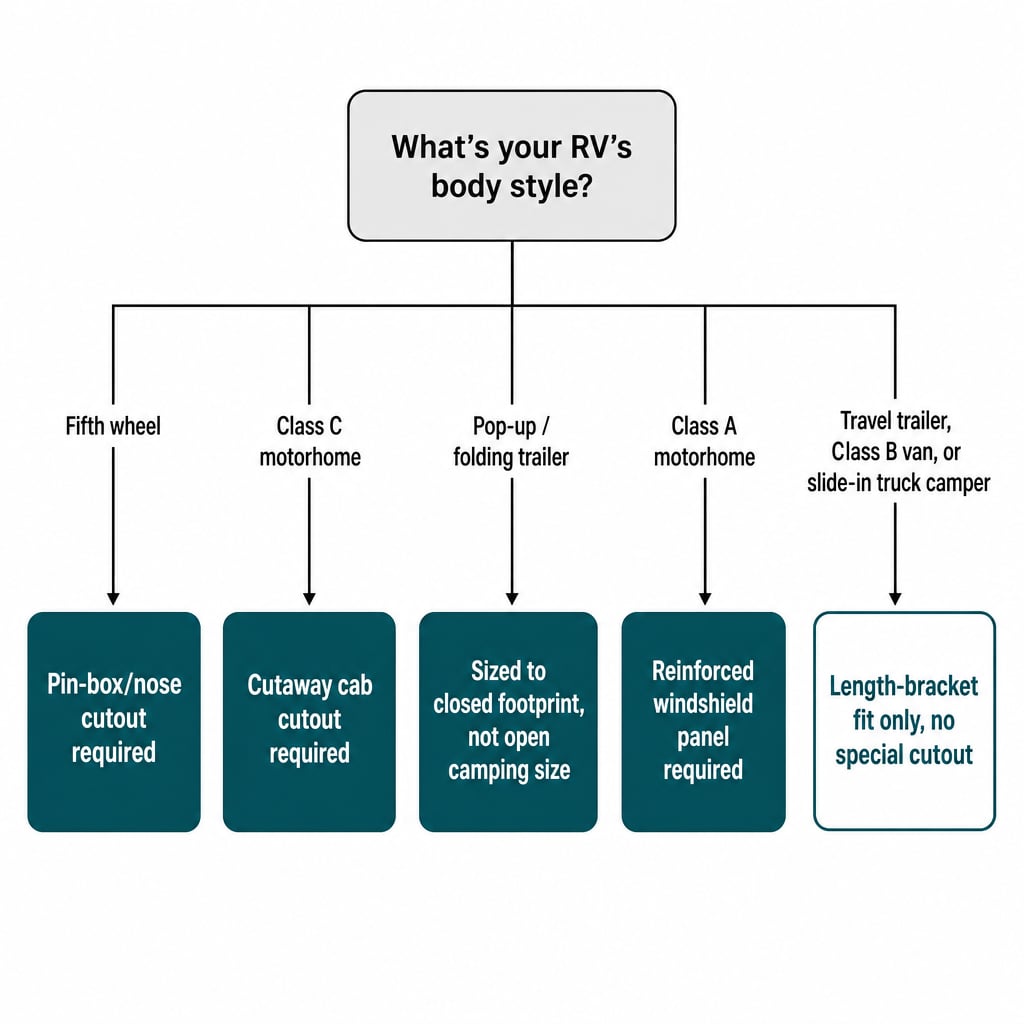
Match your RV's body style to what a correct-fit cover actually needs before you start comparing listings.
| RV type | What a correct-fit cover needs | Why |
|---|---|---|
| Fifth wheel, 28'–31' | Custom-fit profile with a pin-box/nose cutout | Generic covers don't account for the raised front section |
| Class C motorhome | Cutout for the cab/cutaway section | Standard covers assume a flat front, not a cab |
| Pop-up / folding trailer | Sized to the trailer's closed footprint | Folding trailers measure nothing like their open camping size |
| Class A motorhome | Full-length reinforced windshield panel | Windshield area needs separate UV/opaque protection |
| Travel trailer | Length-bracket fit, no cab/pin-box cutout | Most size-differentiated category — brackets matter more than shape |
| Class B / camper van | Universal van-profile or dedicated conversion cover | Vans vary less in profile than towables |
| Slide-in truck camper | Sized to the camper footprint, not the truck bed | Truck bed length doesn't equal camper footprint |
Key Factors to Consider
Fabric type
Covers split broadly into breathable (moisture-permeable, lets trapped humidity escape) and fully waterproof (blocks rain and moisture from either direction). The trade-off is real: fully waterproof fabric can trap condensation against the RV's roof and sidewalls if there's no ventilation built into the design. See our breathable RV cover fabrics compared and fully waterproof RV cover options guides for the deeper comparison.
Length-bracket precision
Listings state a length range, like "28'1"–31'," and that range only works if you've measured your own rig rather than assumed it based on RV class. A cover sized for the wrong bracket either won't reach the ends or will billow with excess slack.
UV/fade resistance
Manufacturer-listed UV protection ratings vary by product line. Check whether the listing states a specific fabric weight or UV-treatment method, not just "UV-resistant" as an unsupported claim.
Roof clearance for AC units and vents
A cover has to clear every roof-mounted feature — AC units, vents, satellite domes, antennas — without stretching tight over them. See our dedicated RV air conditioner covers guide if you're covering the AC unit itself rather than the whole rig.
Strap and wind-tie-down system
Wind resistance depends heavily on how the cover secures underneath the rig, not just the fabric. Look for a listing that specifies its strap or buckle system, not just "included straps" with no detail.
Installation difficulty
Fitting a cover over a tall Class A or fifth wheel is frequently a two-person job, especially reaching the roof center. A listing that doesn't mention installation method at all is a listing that hasn't thought about the buyer's actual experience putting it on.
Door/step zipper access panels
If you need to get into the RV while it's covered — checking on it during storage, grabbing something from inside — a zippered door or step panel matters. Not every cover has one; confirm before buying if this is a requirement for you.
Product Types Explained
Fifth Wheel
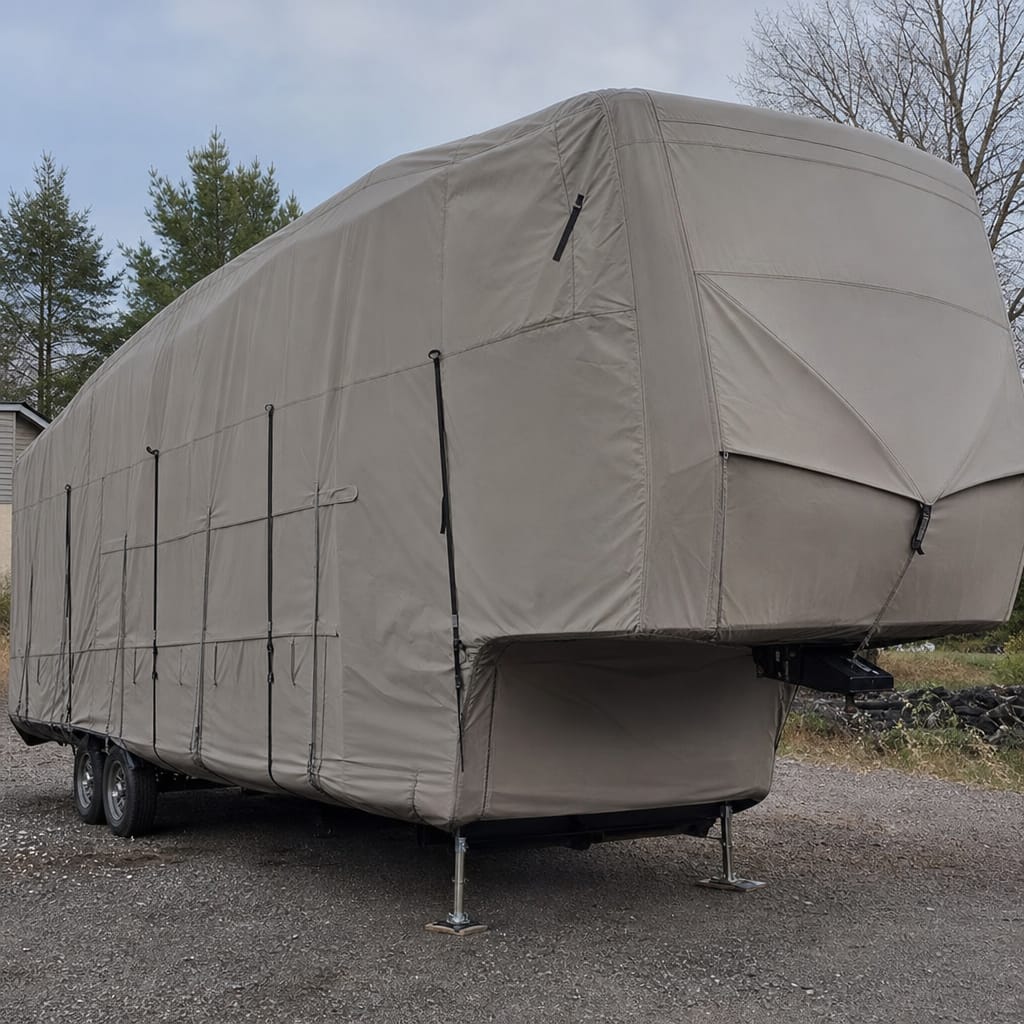
A fifth wheel's raised front section and pin box mean a generic cover won't fit cleanly — it needs a cutout shaped to that nose profile.
Best for: fifth wheels stored outdoors or between long trips.
Limitations: custom-profile covers are less forgiving of a wrong length bracket than flatter body styles.
What to look for: a nose cutout specifically described for pin-box or kingpin hitches, not a generic "fits all fifth wheels" claim. See the fifth-wheel pick below in Featured Picks.
Class C Motorhome
Class C motorhomes have a cutaway cab section at the front that a flat-front cover simply won't accommodate.
Best for: Class C owners storing the rig between trips or over a season.
Limitations: several length variants exist within the Class C line; the wrong bracket leaves slack at the cab or doesn't reach the rear.
What to look for: a cab/cutaway cutout described explicitly on the listing. Classic Accessories also sells a PermaPRO version of this cover — lighter and solo-install-oriented, with a longer stated 5-year warranty — worth checking if you install and remove the cover by yourself. See our Class C RV cover picks roundup and the Class C pick below in Featured Picks.
Pop-Up / Folding Trailer
Folding trailers measure by their closed, towing footprint — not their open camping dimensions — which trips up buyers who size by the trailer's "camping" length instead of its collapsed one.
Best for: owners storing a folding trailer between camping seasons.
Limitations: the closed-footprint sizing means you can't estimate fit from the open-camping spec sheet.
What to look for: a listing that explicitly states its closed/towing dimensions, not just the trailer's advertised sleeping capacity. See our pop-up and folding trailer cover picks roundup and the pop-up pick below in Featured Picks.
Class A Motorhome
The large windshield area on a Class A needs separate reinforced, often opaque protection — a plain body cover that treats the windshield like any other panel won't hold up to UV exposure the same way.
Best for: Class A owners in sun-heavy storage locations.
Limitations: windshield-panel coverage adds cost and complexity versus a single-panel cover.
What to look for: an explicit windshield panel described in the listing, not assumed from photos alone.
Travel Trailer
Travel trailers are the most size-differentiated body style in this category — there's no cab or pin-box shape to account for, so length-bracket accuracy carries almost the entire fit decision.
Best for: any towable travel trailer without a fifth-wheel hitch.
Limitations: because shape isn't a factor, a wrong length bracket is the single most common fit failure here.
What to look for: the exact bumper-to-hitch length range stated on the listing, measured against your own trailer, not the model's advertised length.
Class B / Camper Van
Camper vans vary less in body profile than towable RVs, so a universal van-profile cover often works, though dedicated van-conversion covers exist for specific roof configurations.
Best for: camper van owners without unusual roof-mounted equipment.
Limitations: raised roofs, roof racks, or solar arrays may need a cover built for that specific configuration rather than a universal van cover.
What to look for: whether the listing accounts for any raised-roof or roof-rack configuration your van has.
Slide-In Truck Camper
Don't size a slide-in camper cover by your truck's bed length — the camper's own footprint, which can overhang the bed on both ends, is what the cover needs to match.
Best for: slide-in truck campers stored on or off the truck.
Limitations: this is a smaller, less standardized product category with fewer well-documented listings than the other body styles here.
What to look for: dimensions stated for the camper itself, confirmed against your specific model — not inferred from your truck's bed size or model name.
When to Choose Each Type
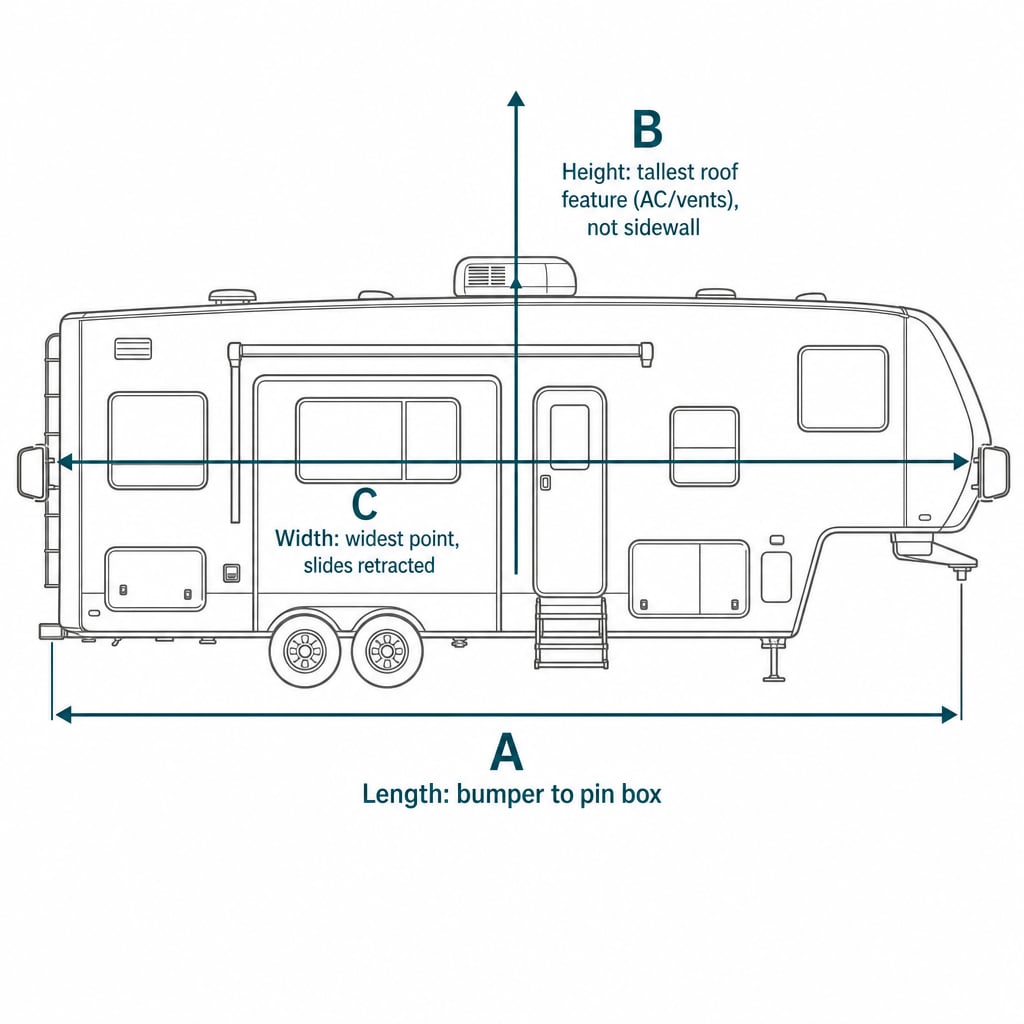
Don't start from the marketing label ("Class C cover," "fifth wheel cover"). Start from three measurements on your own rig: overall length bumper-to-hitch (or bumper-to-pin-box for a fifth wheel), height at the tallest roof feature, and width at the widest point with slide-outs retracted.
A trustworthy cover listing states four things clearly: the exact length range it fits, whether AC or vent cutouts are included, hitch or pin-box style compatibility, and fabric weight or type. If a listing is silent on any of these four, treat that as a red flag, not an assumption you fill in yourself.
If you're covering the RV for months rather than weeks between trips, see our long-term RV storage covers guide — storage duration changes which trade-offs (breathability especially) matter most.
Measurement Checklist
Measure your own rig before you order — not the RV class name, not the truck bed, not the trailer's advertised camping size.
Before buying, measure:
- Overall length, bumper to hitch (travel trailer) or bumper to pin box/kingpin (fifth wheel)
- Height at the tallest point — roof AC unit, vents, antennas — not the sidewall
- Width at the widest point — mirrors in, slide-outs retracted
- Pin box/hitch style, for fifth wheels specifically, since it affects the nose cutout
- Number and position of roof AC units and vents, since it determines whether cutouts are needed
- Awning arm position, if the awning will stay mounted under the cover
Measuring roof height safely means not climbing onto the roof alone — use a ladder from the ground, or have someone spot you.
Mistakes to Avoid
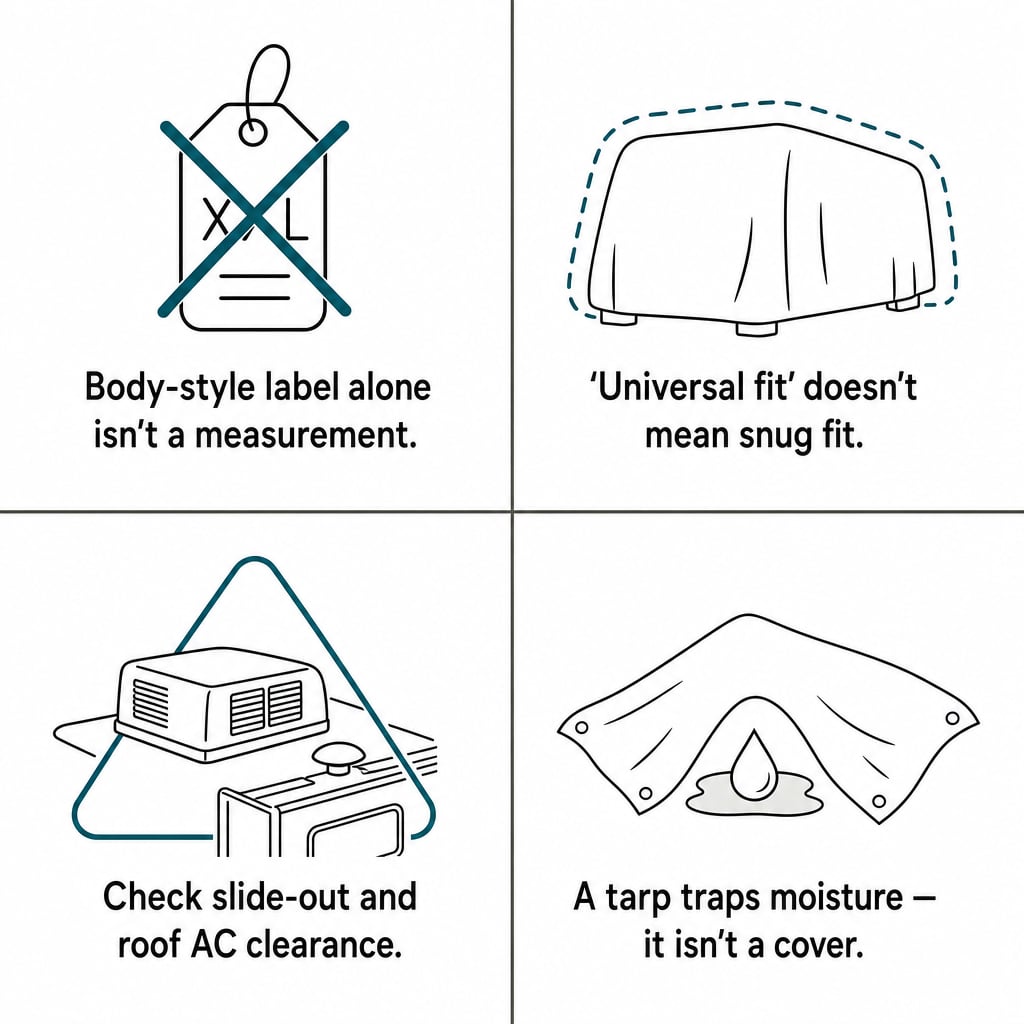
- Buying by body-style label alone, without an exact length measurement of your own rig.
- Assuming "universal fit" guarantees a snug fit within the stated bracket — it guarantees the bracket range fits, not that the fit is snug.
- Not accounting for slide-out overhang or roof AC height when checking clearance against the listing.
- Substituting a generic tarp for a fitted cover. A tarp traps moisture against the roof membrane instead of shedding it the way a fitted, ventilated cover does — see why a tarp isn't a substitute for a fitted cover for the full explanation.
- Not securing straps properly. A cover that flaps in wind accelerates fabric wear well before the manufacturer's expected lifespan.
- Driving with the cover installed. RV covers are storage and parked-use products; check your specific cover's instructions before assuming it's rated for highway use.
Safety / Installation Notes
This category doesn't involve propane, electrical systems, or towing weight ratings, so it doesn't hit this site's mandatory "have a pro do this" boundary. The one real caution is roof-adjacent work: measuring roof height or fitting a cover over a tall RV means working near or above head height. Use a ladder from the ground rather than climbing onto the roof, unless the manufacturer's own instructions explicitly describe that method.
Featured Picks
These three picks anchor the guide in real, documented products — they aren't a substitute for the measurements above.
Best for fifth wheels: ADCO Designer Series UV Hydro 5th Wheel Cover, 28'1"–31'
Two independent sources agree on this cover's full dimensions and a manufacturer-stated 3-year warranty, making it the best-documented fifth-wheel candidate found for this guide. Multiple ADCO UV Hydro length variants exist for the fifth-wheel line — confirm your exact length bracket before ordering; this specific listing covers 28'1" to 31' only.
Best for Class C motorhomes: Classic Accessories Over Drive PolyPRO 3 Deluxe Class C RV Cover, 23'–26'
This is the only Class C candidate found with a manufacturer page confirming its specs directly, rather than reconstructed from retailer listings alone. Several length variants exist in this product line, from 20'-23' through 29'-32' — measure bumper-to-windshield on your own rig, not just "Class C," before ordering.
Best for pop-up/folding trailers: Camco ULTRAGuard Pop-Up Camper RV Cover, 14'–16'
Dimensions for this cover are corroborated independently across multiple sources. The listing states this cover includes a storage bag for stowing it when not in use — confirm this is still current on the listing before assuming it for your order.
For the full list of picks across every RV type, see our roundup of RV covers.
RV roof vent lid sizes by family
Vent lid listings describe themselves as "14 inch" or "universal" without saying whether that number is the roof opening or the lid's own outer footprint, and without saying which hinge style or vent generation the lid is built for. This table separates those three things — the opening size, the lid's own outer dimensions, and the mount/hinge style — for the vent-lid families most commonly sold as replacements, with one source per figure and a blank left wherever the cited source does not publish that number.
| Vent lid family | Nominal opening size | Lid outer dimensions as published | Mount / hinge style | Source | Source checked |
|---|---|---|---|---|---|
| Standard 14×14 aftermarket dome cover (Camco 40433, screws over an existing vent frame — not a hinge-rail replacement lid) | 14 in x 14 in (existing roof vent opening the cover mounts over) | Non-hinged cover, permanently screw-mounted over the existing vent lid/frame through base flanges; not a hinge-rail replacement lid | RV Upgrade Store, Camco 40433 product listing (dealer) | 2026-09-29 | |
| Ventline pre-2008 (V2094) / Elixir 1994-and-up rounded-dome family — OEM hinge-rail replacement lid | 14-1/4 in x 14-1/4 in | 15 in x 15 in | Continuous metal hinge, rounded dome shape, hinge-rail replacement lid | Hanna Trailer Supply, Ventline (by Dexter) BV0554-01 listing (dealer) | 2026-09-29 |
| Camco 40155 — aftermarket lid keyed to the same Ventline pre-'08 / Elixir '94-up family as the row above (independent second manufacturer naming the same generation split) | Replacement lid (white); page does not describe hinge type | Camco Outdoors, product page for SKU 40155 (manufacturer) | 2026-09-29 | ||
| Heng's 90114-C1 / 7-Series universal metal lid — marketed as cross-compatible with Elixir and Ventline bases | Metal lid, standard mount; manufacturer states interchangeable with Elixir and Ventline hardware but does not itemize a generation cutoff | Heng's Industries, vents product category page (manufacturer) | 2026-09-29 |
How these numbers were produced: Every figure is quoted from the cited source and never derived, estimated, or averaged across conflicting sources. 'Nominal opening size' is the roof cutout the vent base sits in; 'lid outer dimensions' is the footprint of the replacement lid itself once installed — these are two different numbers and a source that gives only one of them leaves the other blank rather than assuming they match. Where two independently sourced pages state different lid outer dimensions for the same product, neither is picked as correct: the cell is left blank and both figures are named in the caveats.
- A blank cell means the cited source does not publish that figure, or that two sources disagreed and neither could be confirmed against the other. No cell on this table is filled with a figure estimated, averaged, or carried over from a similar product.
- Camco's 40433 replacement cover: dealer pages that quote Camco's own listing state the outer dimensions as 19-5/16" L x 19" W x 8-11/16" H (rvupgradestore.com, and matched independently by mccoys.com and dbsupply.com). A separate dealer page (camperid.com) states 18.5" x 18" x 8.5" for the same SKU. The two figures do not round to each other and neither source corrects or references the other, so this table leaves the outer-dimension cell blank rather than choosing one. Measure your own lid or opening rather than ordering against either number.
- Heng's 90114-C1 is described on the manufacturer's own site as fitting Elixir and Ventline vents interchangeably and fitting "all rough openings," but that page does not publish an outer dimension, a rough-opening dimension in inches, or a stated cutoff year for which Ventline/Elixir generation it fits — at the time this was checked the page was itself marked incomplete ("Coming Soon"). A manufacturer's compatibility claim is not the same as a published dimension; treat "universal" as a hinge/mount compatibility claim, not a size guarantee, until a specific dimension is confirmed.
- This table covers lid size and mount/hinge style only. It does not cover roof membrane material (EPDM/rubber vs. TPO/fiberglass), which governs which tape or sealant to use during installation, not which lid fits — that is a separate question from the ones this table answers.
- None of this replaces measuring the reader's own vent opening and inspecting the existing lid's mount style (screw-down cover vs. hinge-rail replacement) before ordering. Vent bases are not universal across brands or model years even where a listing says so.
These are the entries that matter for this guide. The full table, with every row and its source, is in our How to Replace an RV Roof Vent Cover.
FAQ
Do RV covers cause mold or trap moisture against the roof?
It depends on fabric breathability and correct fit, not on whether a cover is used at all. A poorly fitted or non-breathable cover trapped against a wet roof is the actual risk — see Fabric type above.
Is it safe to leave the cover on while driving or towing?
RV covers are parked and storage products. Check your specific cover's manufacturer instructions before assuming it's rated for highway use.
Are RV covers actually worth it for occasional or seasonal storage?
Weigh the cost of a cover against the cost of UV and weather damage to your specific storage situation — sun exposure, precipitation, and storage duration all affect the calculation differently for every rig.
Will a "universal fit" cover really fit any RV of my body style?
No — a universal-fit cover guarantees it spans the stated length bracket, not that it fits snugly. See Mistakes to Avoid above.
What's the difference between a fifth wheel cover and a travel trailer cover?
A fifth-wheel cover is cut with a pin-box/nose cutout for the raised front section; a travel trailer cover assumes a flatter front and relies on length-bracket fit alone.
Do I need a separate cover for my spare tire or roof AC unit?
Yes — those are separate product categories. See our spare tire covers and AC covers guides.
How do I find my RV's exact length bracket if I don't know it?
Measure it yourself, bumper to hitch or bumper to pin box — don't rely on the model name or RV class to tell you the bracket. See Measurement Checklist above.
Sources Reviewed
For this guide, we reviewed manufacturer documentation from ADCO (a division of Covercraft Industries), Classic Accessories, and Camco, retailer product pages where a manufacturer page wasn't available, and recurring patterns in public buyer discussions about RV covers. We do not claim hands-on testing.
Related Guides
- Full roundup of the best RV covers
- Pop-up and folding trailer cover picks
- Class C RV cover picks
- Long-term RV storage covers
- Fully waterproof RV cover options
- RV air conditioner covers