AGM vs Lead-Acid Batteries for RVs: Which One Fits Your Rig?
Disclosure: This article contains affiliate links. If you buy through these links, we may earn a commission at no extra cost to you. We do not claim hands-on testing unless clearly stated.
The battery under your RV's step or in its front compartment discharges and recharges in a completely different pattern than the one that starts your tow vehicle — and that's the comparison that actually matters here, not the automotive one most "AGM vs lead-acid" articles are really about.
This article covers AGM vs. flooded/wet lead-acid for RV house-battery use — what each chemistry has to do, where each stops, and manufacturer-listed specs for two AGM picks and one flooded pick on Amazon. It does not cover lithium (LiFePO4) — see Related Guides — or installation and wiring procedures.
Quick Answer
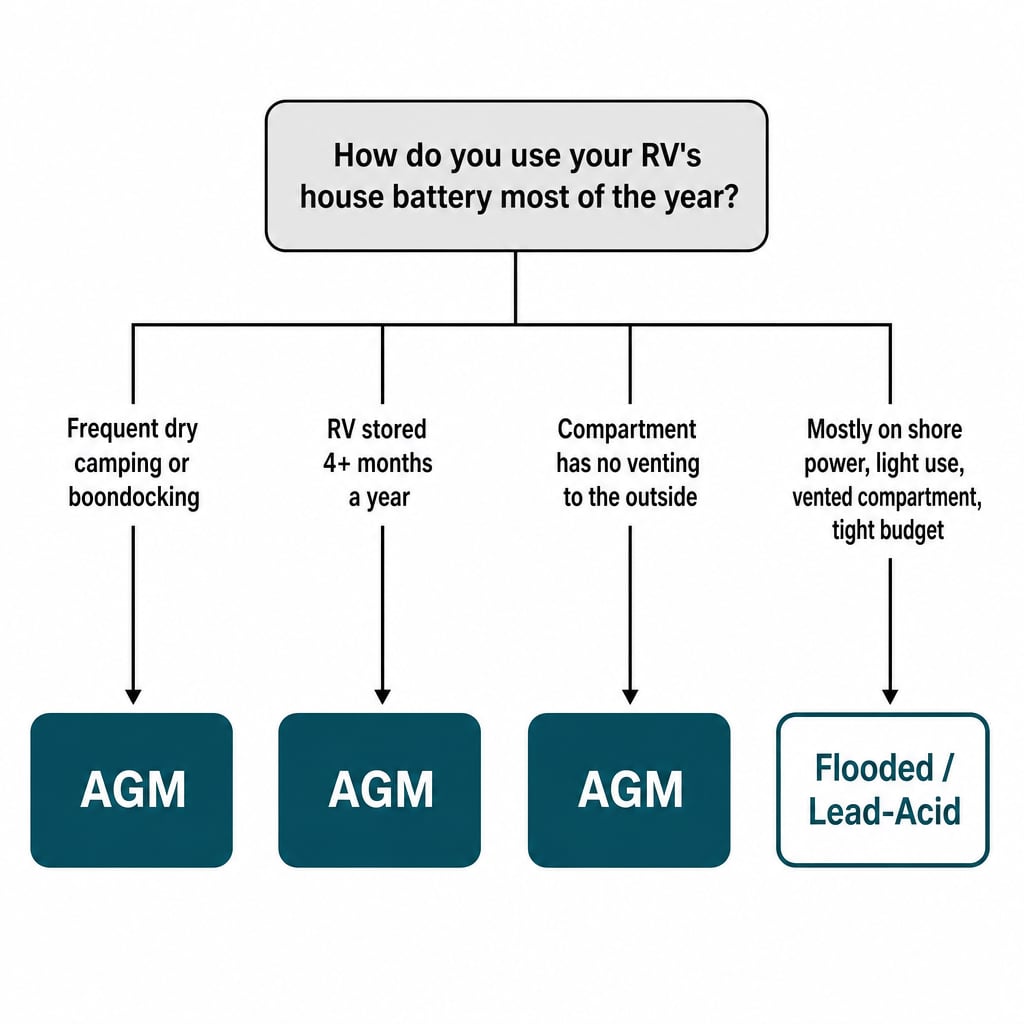
For most RVers who dry-camp regularly or store the rig for months at a time, AGM is usually the better fit: it tolerates deeper discharge and sits sealed in storage without maintenance. For RVers who cycle lightly, keep it on shore power most of the year, and want the lowest cost per amp-hour, flooded/lead-acid usually fits better, provided the compartment is vented. It comes down to how often you deep-cycle, how much maintenance you'll do, and a practical constraint worth stating plainly: flooded RV-format batteries are harder to find on Amazon right now than AGM ones. Of the flooded candidates researched, only one had a confirmed listing and chemistry — sold as a 4-pack of 6V units, not a single 12V battery.
Best Choice by Situation
| Situation | Better choice | Why |
|---|---|---|
| Frequent dry camping / boondocking | AGM | Tolerates deeper, more frequent discharge cycles per manufacturer specs |
| RV stored 4+ months a year | AGM | Sealed, no watering, lower self-discharge per manufacturer data |
| Battery compartment has no venting to the outside | AGM | Flooded off-gasses during charging and needs a vented compartment |
| Tight budget, battery gets light use, mostly on shore power | Flooded / lead-acid | Lower cost per amp-hour when duty cycle is light |
| Rig is towed off-road or on rough roads often | AGM | Glass-mat construction tolerates vibration better structurally |
| Want a single drop-in 12V unit, not a multi-battery bank | AGM | Both current AGM picks are single 12V units; the only confirmed flooded pick is a 4-pack of 6V units, not a single-battery swap |
AGM Batteries
What it has to do
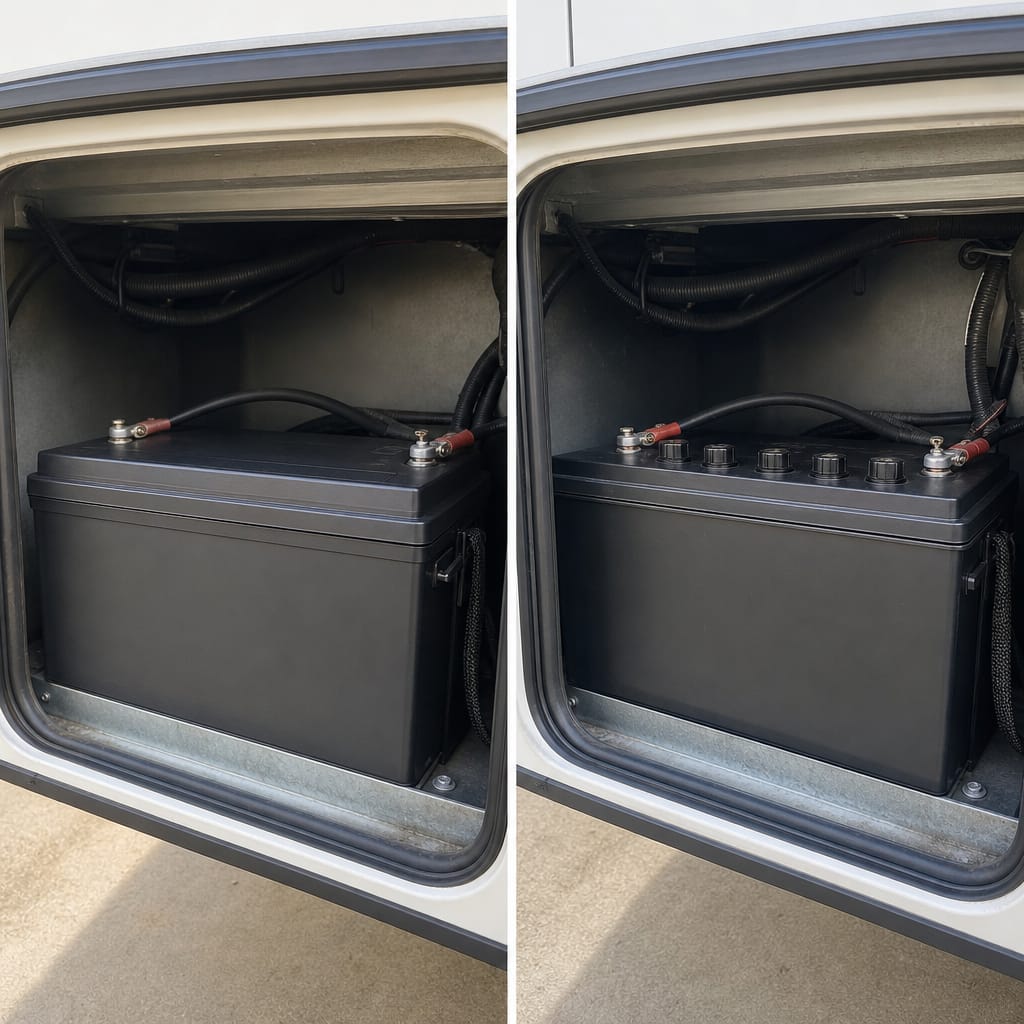
AGM stands for absorbed glass mat: a sealed, valve-regulated lead-acid battery where the electrolyte sits in glass-mat separators instead of free liquid. Nothing to spill, nothing to top off — that's the structural difference from flooded, before any spec number enters the picture.
Where it works best
- Boondocking or dry camping with daily deep discharge-recharge cycles
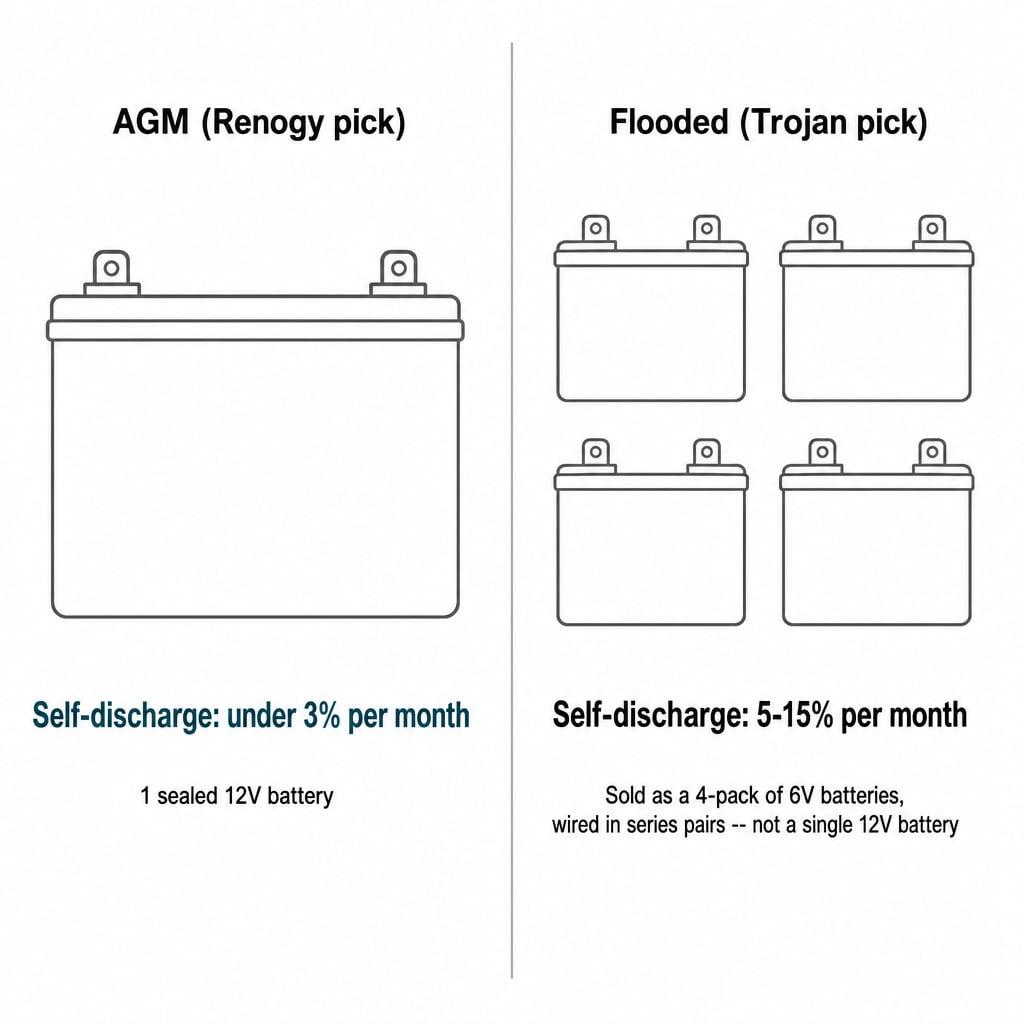
- Long off-season storage — the Renogy pick's manufacturer page states under 3% self-discharge per month at 77°F/25°C
- Compartments with limited or no outside ventilation
- Rough-road towing, where glass-mat construction structurally tolerates vibration better than a liquid-filled cell — not a published spec figure for either pick here
Where this one stops
AGM costs more per amp-hour than flooded for comparable capacity — a relative statement, not a price figure — and needs a charger or converter set to an AGM charge profile, not just "any 12V charger." Manufacturer-listed capacity, cycle life, and self-discharge figures assume the manufacturer's own test conditions; real-world results depend on ambient temperature, your actual charge pattern, and battery age.
If lithium is also on your list, see how AGM compares to lithium instead — a different cost and weight trade-off.
What manufacturers and retailers typically specify
A complete AGM page should state capacity (Ah) and its discharge-rate basis, cycle life at a stated depth of discharge, charge voltage range, operating temperature, and dimensions/weight/terminal type. Renogy's page states all of these; the ACDelco listing states capacity, dimensions, and BCI group size, but not cycle life, self-discharge, or charge voltage.
Buyer warnings specific to AGM
Confirm the Renogy pick's dimensions against your own battery box before ordering — its linked PDF datasheet returned a different, 200Ah variant's numbers on two prior fetch attempts, though the product page's own spec table gives 13.1 x 6.9 x 8.6 in and 63.9 lb for this 100Ah model.
The ACDelco M31AGM's figures trace to a RockAuto listing built on the manufacturer's own part data, since ACDelco's and GM Parts' pages returned errors on direct fetch. Dimensions are reliable, matched to this exact part number, but weight, cycle life, self-discharge, and charge voltage aren't published anywhere reached during sourcing.
Flooded / Lead-Acid Batteries
What it has to do
Flooded lead-acid uses liquid electrolyte in a vented case and needs periodic water top-off on most models. It's the lowest-cost lead-acid chemistry, with the longest manufacturing history.
Where it works best
- Light, infrequent cycling — mostly on shore power, with occasional boondocking
- Owners willing to check and top off electrolyte on a schedule
- Budget-constrained replacements where duty cycle doesn't demand AGM's deeper-cycle tolerance
Where this one stops
Flooded batteries off-gas hydrogen during charging, which is why they need a vented compartment — check your own before choosing this option. They can also spill if the case is damaged or the RV sits at a steep angle. The Trojan T605's data sheet lists 5-15% self-discharge per month depending on storage temperature, notably higher than Renogy's sub-3%.
For the gel side of this chemistry family, see how flooded lead-acid compares against gel.
What manufacturers and retailers typically specify
Same benchmark as AGM, plus a watering schedule and venting requirement, both flooded-specific. Trojan's T605 sheet states capacity at four discharge rates, charge voltage, operating temperature, self-discharge, and dimensions/weight — the fullest of the three picks — though it has no text-form cycle-life figure, showing a capacity-vs-temperature chart instead.
Buyer warnings specific to flooded/lead-acid
The only confirmed flooded pick, the Trojan T605, is sold on Amazon as a 4-pack of 6V, 210Ah batteries, wired in series pairs to build 12V banks — not a single 12V battery, and not a drop-in replacement for one AGM unit. Every figure quoted for it here describes one 6V unit, not the pack.
Availability is itself a buyer consideration: only the Trojan T605 had both a confirmed listing and confirmed chemistry among flooded candidates researched. A single-12V flooded alternative to AGM is a genuinely thin search on Amazon right now.
Side-by-Side Comparison
| Attribute | AGM | Flooded / Lead-Acid |
|---|---|---|
| Maintenance (watering required?) | No — sealed, no watering (both AGM picks) | Yes — Trojan T605 uses a HydroLink single-point watering system |
| Compartment ventilation requirement | Not required by the chemistry | Needs outside venting — off-gasses hydrogen during charging |
| Cycle life at stated DOD | Renogy: 500 cycles at 50% DOD. ACDelco: not published | Not published (Trojan shows a temperature chart, not a text figure) |
| Self-discharge rate in storage | Renogy: under 3%/month at 77°F. ACDelco: not published | 5-15%/month, temperature-dependent (Trojan, per 6V unit) |
| Vibration / rough-road tolerance | Glass-mat construction structurally tolerates vibration better | Liquid electrolyte moves more under vibration — structural, not a spec figure |
| Charge profile sensitivity | Renogy: 14.4-14.8V cycle-use / 13.5-13.8V float. ACDelco's not published | Trojan: 7.41V bulk / 6.75V float / 8.10V equalize (per 6V unit); flooded needs periodic equalization that AGM doesn't |
| Amazon availability, RV single-unit format | 2 of 6 AGM candidates had a confirmed single-ASIN listing | 1 of 5 flooded candidates confirmed — and it's a 4-pack, not a single unit |
Battery specification comparison
Every AGM or flooded lead-acid battery's spec sheet lists capacity, cycle life, self-discharge rate, and charge voltage, but each manufacturer publishes them in a different format, at a different discharge rate, and often on a different kind of page entirely. This table pulls those figures directly from each battery's own manufacturer page, official data sheet, or parts listing for the AGM and flooded picks in this comparison, normalized side by side so the numbers can be compared directly instead of hunted down across three separate product pages.
| Battery | Chemistry | Capacity (Ah, at rate shown) | Cycle life | Self-discharge rate | Charge voltage | Operating temperature | Dimensions L x W x H (in) | Weight (lb) | Maintenance | Source | Source checked |
|---|---|---|---|---|---|---|---|---|---|---|---|
| Renogy Deep Cycle AGM Battery 12V 100Ah | AGM | 100 Ah (10-hour rate to 10.5V) | 500 cycles at 50% depth of discharge | <3% per month at 77°F/25°C | Cycle use 14.4-14.8V; float 13.5-13.8V (12V system) | Charge 32-122°F (0-50°C); discharge -4-140°F (-20-60°C) | 13.1 x 6.9 x 8.6 | 63.9 | Sealed, valve-regulated AGM - no watering | Renogy product page (manufacturer) | 2026-09-17 |
| ACDelco Gold M31AGM (88866289), Professional Voyager AGM | AGM | 100 Ah (20-hour rate) | 13.1 x 6.8 x 9.1 | Sealed AGM (Absorbed Glass Mat) - no watering | RockAuto parts listing (retailer, built on manufacturer part data) | 2026-09-17 | |||||
| Trojan T605 6V 210Ah Flooded Deep-Cycle (sold as a 4-pack) | Flooded (wet lead-acid) | 210 Ah (20-hour rate); also rated 175 Ah (5-hour) and 232 Ah (100-hour) - per single 6V unit | 5-15% per month, depending on storage temperature | Bulk 7.41V; float 6.75V; equalize 8.10V, at 77°F/25°C (per 6V unit) | -4°F to 113°F (-20°C to 45°C); below 32°F (0°C), maintain state of charge above 60% | 10.30 x 7.13 x 11.15 | 58 | Vented flooded cell - requires periodic watering; HydroLink single-point watering system | Trojan Battery official data sheet (PDF) | 2026-09-17 |
How these numbers were produced: Every figure was read directly from the battery's own manufacturer product page or official PDF data sheet, except the ACDelco M31AGM row, whose figures come from a RockAuto parts listing built on the manufacturer's own part data (ACDelco's and its parent GM Parts distributor's own pages returned 403/500 to a direct fetch). Capacity is quoted at the discharge rate each source itself states, not converted to a common rate: Renogy publishes a 10-hour rate, while ACDelco and Trojan publish a 20-hour rate (among others). Nothing is derived or estimated beyond the unit conversions the source itself already prints in parentheses (for example, inches to millimeters, pounds to kilograms).
- A blank cell means the source checked for that battery does not publish that figure. No number was estimated, averaged from a similar model, or carried over from a different product to fill a gap.
- Capacity (Ah) is shown at the discharge rate each manufacturer itself publishes, not a single standardized rate. Renogy states a 10-hour rate; ACDelco and Trojan state a 20-hour rate (among others each also lists). Comparing two Ah figures without checking the rate behind each one is a genuine source of confusion, not a technicality — the same physical battery reads as a different Ah number depending on which rate is quoted.
- Cycle life is blank for the ACDelco and Trojan rows because neither source publishes a simple cycle-count-at-a-stated-depth-of-discharge figure for these specific models. Trojan's own data sheet shows a capacity-vs-temperature chart instead of a text cycle-life figure, and the RockAuto listing used for the ACDelco model does not carry a cycle-life field at all.
- The Trojan T605 is sold on Amazon as a 4-pack of 6V batteries wired in series pairs to build a 12V bank, not as a single 12V battery. Every figure in the Trojan row (voltage, capacity, charge voltage) describes one 6V unit, not the pack.
- These figures describe the three specific battery models used as picks in this comparison, not AGM or flooded lead-acid chemistry in general. A different AGM or flooded battery from a different manufacturer can publish different numbers.
- All three sources were checked directly on 2026-09-17. A manufacturer can revise a data sheet, or a retailer can delist a part page, after that date.
Download the data (CSV) · last updated 2026-09-17 · version 1.0 · CC BY 4.0, attribution to RV Field Manual.
How to Decide for Your Rig
How often you deep-cycle, how long the rig sits in storage, and whether your compartment is vented decide this — not brand loyalty. Before you order, confirm:
- Compartment BCI group size and footprint against actual dimensions — not assumed from "12V" or "31" in the product name
- Your charger has, or can be set to, an AGM profile if you're buying AGM — a flooded-only charger undercharges AGM over time
- Your compartment is vented if you're buying flooded/lead-acid
- Terminal type and orientation match your existing cable runs
- Room and a wiring plan for four 6V units, not one 12V unit, if you're considering the Trojan 4-pack
Have a pro do this: wiring multiple 6V batteries in series to build a 12V bank is DC electrical work. If you're not confident confirming polarity and connection order yourself, have an RV technician do it.
Sizing a solar setup to keep whichever battery you choose charged? See pairing your battery bank with a solar setup.
Common Mistakes
Mistake: Using a flooded-only charge profile on an AGM battery. Undercharges it over time and shortens its life — confirm your charger has an AGM setting; Renogy specifies 14.4-14.8V cycle-use for this reason.
Mistake: Treating the Trojan T605 4-pack as a single 12V drop-in replacement. It's four 6V, 210Ah units wired in series pairs — a different product and a different install, not an upgrade path from a single 12V battery.
Mistake: Installing a flooded battery in a sealed, unvented compartment. Flooded cells off-gas hydrogen during charging; a compartment without outside venting is a real hazard, not a technicality.
Mistake: Comparing amp-hour numbers without checking the discharge-rate basis. Renogy's figure is a 10-hour rate; ACDelco's and Trojan's are 20-hour rates. The same physical battery reads as a different Ah number depending on which rate is quoted.
For how AGM stacks up against a broader category, see how AGM compares to deep-cycle batteries generally.
Recommended Products for Each Side
For AGM (primary pick): Renogy Deep Cycle AGM Battery 12V 100Ah
The fullest spec sheet here — capacity, cycle life, self-discharge, charge voltage, dimensions, and weight all come from Renogy's product page. Confirm dimensions against your own battery box; the linked PDF datasheet has returned a different variant's numbers during sourcing.
For AGM (mainstream alternative): ACDelco Gold M31AGM (88866289)
A second AGM option from a globally recognized automotive manufacturer rather than a solar/RV specialist brand. Dimensions and BCI group size (31) are confirmed; cycle life, self-discharge, charge voltage, and weight aren't published in the source reached.
For Flooded/Lead-Acid (only confirmed option): Trojan T605 6V 210Ah, sold as a 4-pack
The only flooded candidate with both a clean Amazon listing and confirmed chemistry. Remember: four 6V batteries wired in series pairs, not one 12V unit — plan compartment space and wiring accordingly, not as a like-for-like swap for AGM.
If lithium is also on your shortlist, our RV lithium battery buying guide covers that option separately.
FAQ
What's the actual difference between an AGM battery and a flooded lead-acid battery?
Structural: AGM holds electrolyte in sealed glass-mat separators with nothing to spill, while flooded uses a vented case with liquid electrolyte needing periodic watering.
Can I replace an AGM battery with a flooded/lead-acid battery in my RV?
Often yes physically if the BCI group size matches — but check your charger's charge profile and confirm your compartment is vented first.
Do AGM batteries really need less maintenance than flooded ones?
Yes, structurally — sealed construction means no watering, one of the few claims here that doesn't depend on a manufacturer number.
Does a flooded/lead-acid battery need a vented compartment in an RV?
Yes — flooded cells off-gas hydrogen while charging, a real requirement for this chemistry, not an optional precaution.
Can I mix an AGM and a flooded battery in the same bank?
No. Different charge profiles and discharge characteristics — a real mistake, not a hypothetical one.
Which chemistry holds up better through winter storage?
AGM, mainly because of its lower self-discharge rate — Renogy's page states under 3%/month at 77°F, versus Trojan's stated 5-15%/month.
Sources Reviewed
For this comparison, we reviewed manufacturer pages and retailer specifications for AGM and flooded/lead-acid RV batteries, product listings, and RV-owner discussions where dry campers and full-timers described choosing between these chemistries for a house battery bank. Battery figures are sourced from Renogy's own product page, a RockAuto listing built on ACDelco's manufacturer part data, and Trojan Battery's official data sheet — all checked 2026-09-17.
Related Guides
- RV lithium battery buying guide
- AGM vs. lithium
- AGM vs. gel
- Flooded lead-acid vs. gel
- AGM vs. deep-cycle
- RV solar panel buying guide