below is the full H1 text, not a separate shorter "SEO title" field.
Published
Disclosure: This article contains affiliate links. If you buy through these links, we may earn a commission at no extra cost to you. We do not claim hands-on testing unless clearly stated.
"Lithium is better" gets repeated constantly across RV forums and buying guides, but it's a blanket claim standing in for a question that's actually about your rig, not about chemistry in the abstract. This article compares lithium (LiFePO4) and AGM lead-acid batteries on the differences that actually change a buying decision: weight, cycle life, charge behavior, cold-weather handling, and cost. It includes a situation-by-situation decision table, one manufacturer-sourced pick per chemistry, and what to check on your own rig before buying either one.
It doesn't cover step-by-step installation, BMS programming, or converter reprogramming — that's a job for a qualified RV electrician or dealer, not a measurement task (see "Have a Pro Do This" below). It also doesn't cover 6V golf-cart or marine-specific chemistry variants, which get their own comparisons elsewhere on this site.
Quick Answer
AGM and lithium (LiFePO4) solve different problems rather than competing on the same one at different price points. AGM wins on upfront cost and charging simplicity — it works with the charger your RV probably already has. Lithium wins on weight and cycle life, but only if your charger, converter, and solar controller are documented as lithium-compatible, and only if the battery won't sit unheated below freezing. Rather than declare one chemistry a universal winner, match your own situation to the table below.
Best Choice by Situation
Before the detailed breakdown, match your own situation to a starting recommendation:
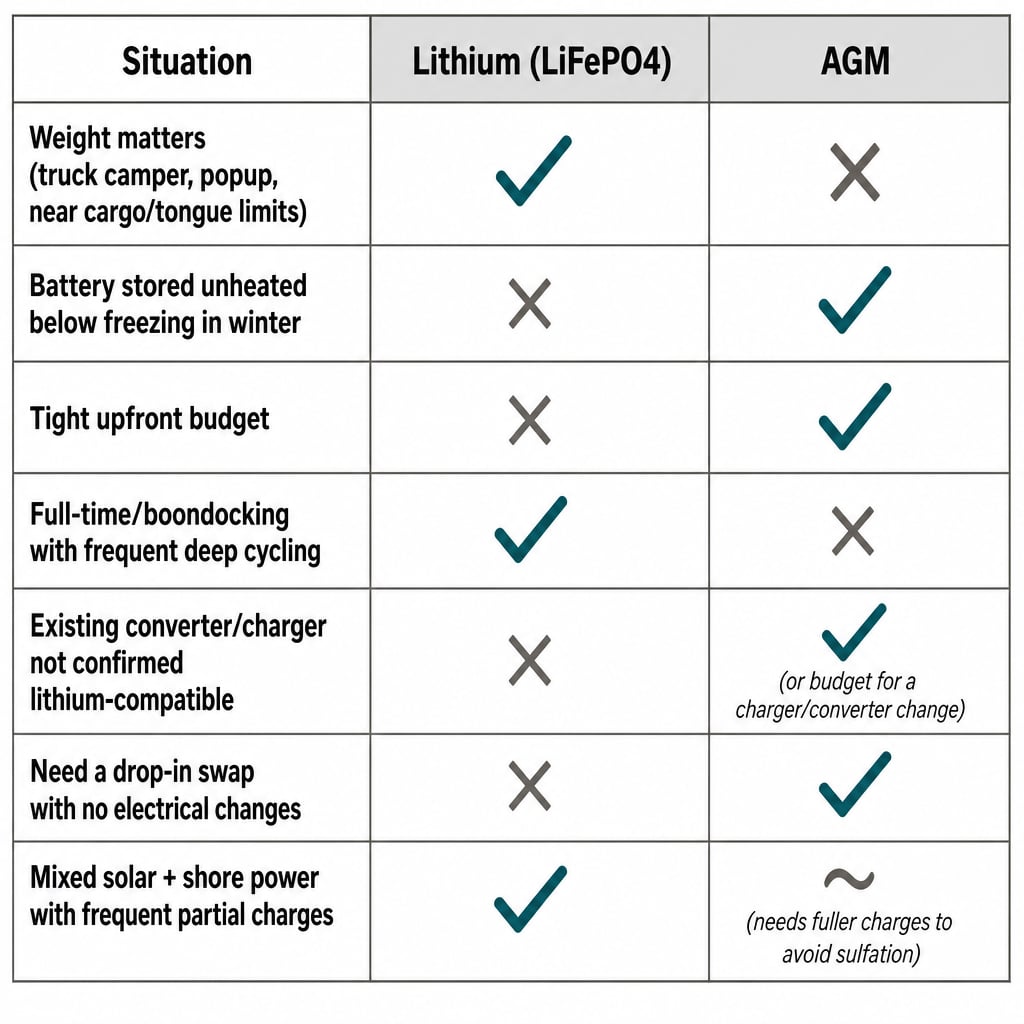
| Situation | Better choice | Why |
|---|---|---|
| Weight matters (truck camper, popup, near cargo/tongue weight limits) | Lithium | About 62% lighter at the same rated 100Ah — see Side-by-Side Comparison below |
| Battery stored unheated below freezing in winter | AGM | LiFePO4 packs carry a manufacturer-stated minimum charge temperature; AGM does not |
| Tight upfront budget | AGM | Lower cost per amp-hour at purchase (relative statement, no live prices quoted here) |
| Full-time/boondocking with frequent deep cycling | Lithium | Manufacturer-listed cycle life is well above AGM's — see Side-by-Side Comparison below |
| Existing converter/charger not confirmed lithium-compatible | AGM, or budget for a charger/converter change | Charging lithium on an AGM-profiled charger is the central risk this article covers |
| Need a drop-in swap with no electrical changes | AGM | Matches most legacy RV converters' charge profile; lithium usually needs a different one |
| Mixed solar + shore power with frequent partial charges | Lithium | Tolerates partial-state-of-charge cycling better; AGM needs fuller recharges to avoid sulfation |
AGM — What It Has to Do, Where It Works, Where It Stops
What it has to do
AGM (absorbed glass mat) is a sealed, valve-regulated lead-acid design: the electrolyte sits absorbed in glass-fiber separator mats instead of moving as a free liquid. That construction is what makes it spill-proof and mountable in more orientations than a vented flooded battery, without the cost or weight of a lithium pack.
Where it works best
- Drop-in replacement for an existing lead-acid system, no converter change required
- Cold-weather storage or use without a heated compartment
- Budget-constrained upgrades where cost per amp-hour matters more than weight
Where this one stops
- Heavier per amp-hour than lithium — see the weight row in the Side-by-Side Comparison below
- Lower manufacturer-listed cycle life than LiFePO4 — Renogy states 500 cycles at 50% depth of discharge, well below what lithium chemistry typically claims
- Needs fuller recharge cycles to avoid sulfation, per manufacturer guidance, rather than tolerating the frequent partial-state-of-charge cycling lithium handles better
If flooded lead-acid, not just AGM, is the chemistry you're actually comparing, see how AGM compares to flooded lead-acid batteries instead.
What manufacturers and retailers typically specify
A complete AGM spec sheet states capacity at a named discharge rate, cycle life at a stated depth of discharge, charge voltage for both cyclic and float stages, operating temperature, and dimensions and weight. Renogy's own product page states all of these for the pick below: 100Ah at a 10-hour discharge rate, 500 cycles at 50% depth of discharge, a 14.4–14.8V cyclic / 13.5–13.8V float charge window, and a 32–122°F charge temperature range. That 10-hour rate matters — the same physical battery reads as a different Ah number depending on which rate a manufacturer quotes it at, so comparing two Ah figures from different brands without checking the rate behind each one compares numbers that aren't actually equivalent. For a look at how AGM's sealed construction compares against another sealed chemistry's own charge-voltage quirks, see AGM vs. gel sealed battery.
Buyer warnings specific to AGM
AGM and LiFePO4 use different charge-voltage profiles, and they behave differently in the cold: AGM's usable capacity drops at low temperature, but it still accepts a charge — LiFePO4 without internal heating typically can't be charged at all below freezing (see the Lithium section below for why that matters). A charger or converter profiled for one chemistry is not a safe default for the other. Manufacturer-listed capacity, cycle life, and charge-voltage figures assume the manufacturer's own test conditions; real-world results depend on ambient temperature, your actual charge pattern, and battery age.
Lithium (LiFePO4) — What It Has to Do, Where It Works, Where It Stops
What it has to do
Lithium iron phosphate (LiFePO4) batteries store energy in a different cell chemistry than lead-acid, with no liquid or gelled electrolyte to maintain. A built-in battery management system (BMS) manages charging, discharging, and cell balancing automatically — and it's also what imposes the chemistry's main limitation, covered below.
Where it works best
- Weight-sensitive installations: truck campers, pop-ups, anything near a cargo or tongue weight limit
- Full-time or frequent-cycling use patterns, where cycle life matters over years of ownership
- Solar-heavy setups that leave the battery at a partial state of charge for long stretches
If you're shopping lithium on its own terms rather than against AGM specifically, the RV lithium battery buying guide covers that decision in more depth.
Where this one stops
- Will not charge safely below freezing without internal or external heating, per the BMS's low-temperature cutoff — standard behavior across consumer LiFePO4 packs; confirm the exact figure for your specific model directly with the manufacturer
- Typically requires a charger, converter, or solar controller documented as lithium-compatible — an AGM-profiled charging source is not a safe default
- Higher upfront cost than AGM at equivalent rated capacity (no price stated here; framed qualitatively only)
What manufacturers and retailers typically specify
The same sourcing discipline applies on the lithium side: a trustworthy LiFePO4 listing states its BMS specs, usable depth of discharge, cycle count at a stated discharge condition, and warranty term. LiTime's own product page states 100Ah at 12.8V nominal (1,280Wh) without naming a discharge-rate basis the way Renogy's AGM page does — worth confirming directly with LiTime if the exact rate matters for your own math. For a broader set of LiFePO4 options at this capacity, see the top LiFePO4 batteries for RVs.
Buyer warnings specific to lithium
The central thing to check before switching chemistries: a charger, converter, or solar controller profiled for AGM or flooded lead-acid is not automatically safe for lithium.
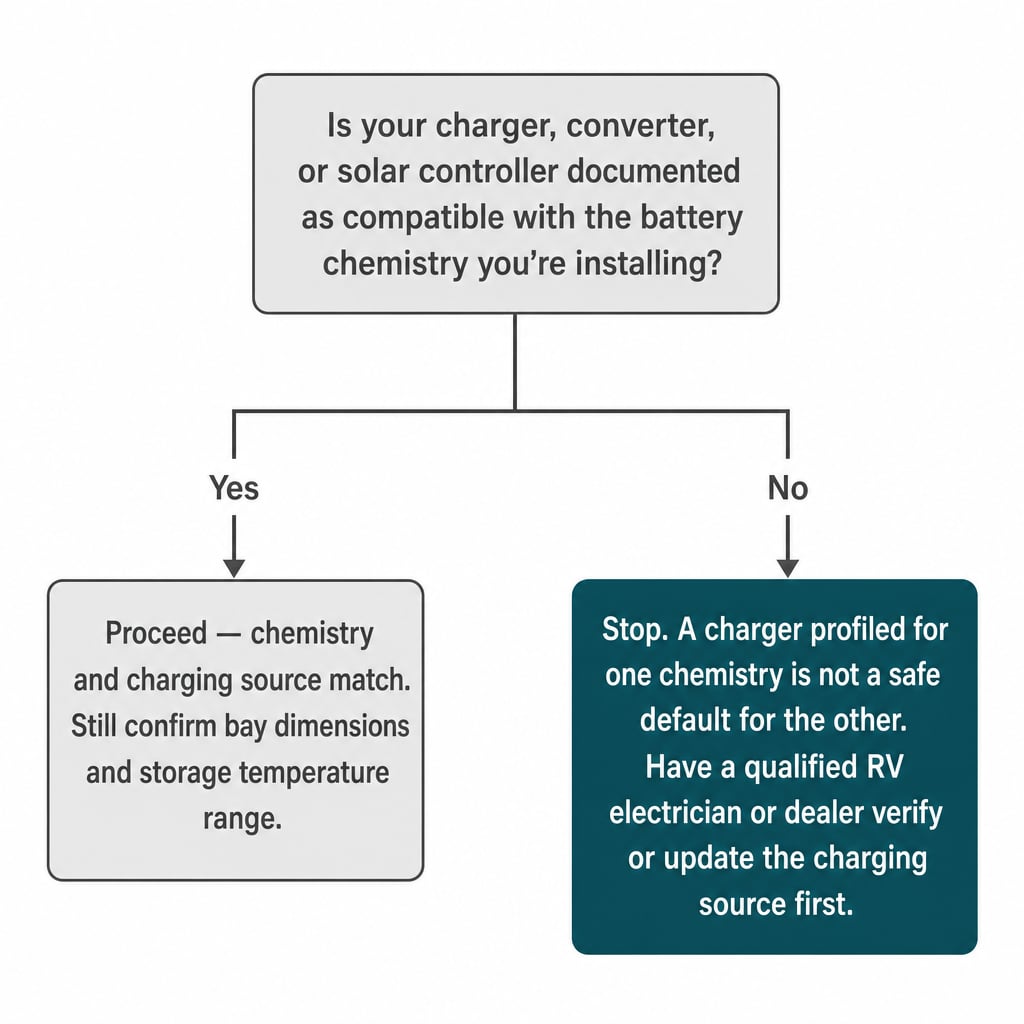
Lead-acid chargers commonly use charge voltages and absorption/float stages tuned for that chemistry; feeding the same profile to a LiFePO4 pack can undercharge it or repeatedly trip the BMS's protections without ever reaching a full charge. Confirm your charging source is documented by its own manufacturer as lithium-compatible before you buy the battery, not after. The cold-charging restriction above has the same character: a manufacturer-stated limit, not a universal pass/fail you can eyeball.
LiTime's own manufacturer page states 4,000+ cycles at 100% depth of discharge with a 10+ year lifetime for this model — the figure used throughout this article. The Amazon listing for that same confirmed ASIN advertises a higher "15,000 cycles" figure; that's the manufacturer's own page disagreeing with its retail listing for one product, not a different or adjacent SKU, and it's a clean example of the marketing-inflation pattern this site's sourcing standard exists to catch. The manufacturer figure is the one published here.
Side-by-Side Comparison
The two picks below are both rated at 100Ah, which makes this a closer matched comparison than some chemistry articles on this site can manage — but a couple of lithium-side fields are still left blank below rather than filled with an unresolved or unsourced number.
| Spec | Renogy AGM 100Ah | LiTime LiFePO4 100Ah |
|---|---|---|
| Chemistry | AGM (sealed lead-acid) | LiFePO4 (lithium iron phosphate) |
| Capacity | 100 Ah (10-hour rate to 10.5V) | 100 Ah / 1,280Wh at 12.8V nominal (manufacturer page does not state a discharge-rate basis) |
| Cycle life | 500 cycles at 50% depth of discharge | 4,000+ cycles at 100% depth of discharge, 10+ year lifetime (manufacturer-listed) |
| Charge voltage | Cycle use 14.4–14.8V; float 13.5–13.8V | Not stated in the sourced figures for this model — confirm directly with LiTime or your BMS documentation |
| Low-temperature charging | Charge range 32–122°F per manufacturer; discharge rated to −4°F | Not stated in the sourced figures for this model — standard LiFePO4 packs specify a minimum charge temperature in their own BMS documentation; confirm your unit's cutoff before use below freezing |
| Dimensions | 13.1 x 6.9 x 8.6 in | 13 x 6.77 x 8.43 in |
| Weight | 63.9 lb | 24.25 lb |
| Maintenance | Sealed, no watering — manufacturer states no free-flowing electrolyte | Sealed, no watering — solid-cathode chemistry, no liquid electrolyte to maintain |
| Source | Renogy product page (manufacturer), checked 2026-09-17 | LiTime product page (manufacturer) |
A blank or qualified cell above means the source checked for that figure doesn't publish it, or two sources disagree — nothing here is estimated or carried over from a different product to fill the gap.
How to Decide for Your RV
What decides this isn't brand loyalty — it's your own equipment. In order:
- Check your converter's, charger's, or solar controller's documentation for a confirmed lithium-specific charge profile, not just "12V compatible"
- Measure your battery bay against both candidates' manufacturer-listed dimensions; don't assume either fits because the rated capacity matches
- Be honest about your storage temperature — an unheated bay in a freezing climate rules out lithium unless the pack has internal heating
- Weigh cost against your actual cycling pattern; occasional weekend use rarely recovers lithium's price premium the way full-time boondocking does
Common Mistakes
Mistake: Charging a non-heated LiFePO4 battery below freezing without checking the BMS's documented low-temperature cutoff. Storage alone usually isn't the failure mode — charging below the cutoff is. See the buyer warning above for why this matters.
Mistake: Assuming an AGM-profiled charger or converter is a safe default for a lithium replacement. This is the voltage-profile mismatch covered above, and it's the single most consequential check in this entire comparison — confirm compatibility before ordering the battery, not after it's already installed.
Mistake: Comparing two Ah numbers from different manufacturers as equivalent without checking the discharge rate each one is stated at. Renogy's AGM page states its rate (10-hour); LiTime's page doesn't state one at all — see "What manufacturers and retailers typically specify" above.
Mistake: Swapping chemistries without re-checking battery bay dimensions and weight distribution. A lighter lithium battery can shift a trailer's balance just as a heavier AGM swap can affect tongue weight — re-verify weight distribution after the swap, not just electrical compatibility. See also AGM vs. deep-cycle battery basics for what "deep cycle" itself promises.
Recommended Products for Each Side
For AGM: Renogy Deep Cycle AGM Battery 12V 100Ah
The lowest-friction drop-in AGM pick here — every spec field above is manufacturer-sourced, and it's the most cross-article-verified ASIN in this site's battery coverage. The straightforward choice if your charger only has a flooded/AGM profile.
For Lithium: LiTime 12V 100Ah LiFePO4 (Classic), Group 31
The only lithium candidate in this comparison seeded from a sibling-verified Amazon listing rather than a title-match search hit alone. Confirm your charging system's lithium compatibility before ordering — and note that the manufacturer's own 4,000+ cycle figure, not the higher number advertised on the Amazon listing for the same battery, is the one used throughout this article.
Have a Pro Do This
Switching from AGM to lithium (or the reverse) can require reprogramming or replacing the converter, charger, or solar controller, and confirming the BMS's low-temperature charging behavior against your own climate. That's electrical work — verifying and matching charge profiles across every charging source feeding the battery — not a measurement task you can complete with a tape measure. If you're not certain your system is already lithium-compatible, have a qualified RV electrician or dealer verify or update the charging source before you install either battery.
FAQ
Can you just swap an AGM battery for a lithium one in the same spot?
Not automatically. Dimensions and weight differ between models, and — more importantly — your charging system needs to be confirmed compatible with the new chemistry before you treat this as a physical swap.
Is lithium worth the extra cost for occasional RV use?
Usually not, going by the table above: lithium's cost premium pays off mainly through cycle life and weight savings, which matter most with frequent deep cycling or tight weight budgets — not light, occasional use.
Does a lithium battery need a special charger or converter?
Often yes — see the buyer warning above on why an AGM-profiled charger isn't a safe default for lithium.
Can a lithium battery be damaged by cold during winter storage?
Storage alone typically isn't the issue — charging is. See "Where this one stops" above for the BMS cutoff behavior.
Which weighs less, AGM or lithium, for the same rated capacity?
Lithium, by a wide margin for the two picks compared here — see the weight row in the Side-by-Side Comparison above.
How long does each battery type typically last before replacement?
Renogy's AGM pick is manufacturer-listed at 500 cycles at 50% depth of discharge. LiTime's manufacturer page lists its LiFePO4 pick at 4,000+ cycles at 100% depth of discharge with a 10+ year lifetime — well above the AGM figure, though the Amazon listing for the same battery advertises a higher "15,000 cycles" number that this article doesn't use.
Sources Reviewed
For this comparison, we reviewed manufacturer product pages for the Renogy AGM and LiTime LiFePO4 picks, plus RV-owner forum threads where dry campers and full-timers described choosing between the two chemistries. AGM figures come from Renogy's own product page, checked 2026-09-17 (also part of this site's shared battery-chemistry-specs dataset); lithium figures come from LiTime's own product page, including the 4,000+ cycle, 100%-depth-of-discharge figure used throughout this article — the Amazon listing for the same confirmed ASIN advertises a higher "15,000 cycles" figure that is not used here, per this site's manufacturer-precedence sourcing rule. No figure in this article comes from forum content; forum discussion was used only to confirm which questions real buyers ask.
Related Guides
- AGM vs. flooded lead-acid battery
- AGM vs. gel sealed battery
- RV lithium battery buying guide
- Top LiFePO4 batteries for RVs
- AGM vs. deep-cycle battery basics