Gel vs. AGM Battery: Which One Fits Your RV?
Disclosure: This article contains affiliate links. If you buy through these links, we may earn a commission at no extra cost to you. We do not claim hands-on testing unless clearly stated.
Both battery types are sold as sealed, maintenance-free, and spill-proof — the marketing language on the box is nearly identical, so you can't tell from the listing alone which one your charger or converter actually supports. That's the practical problem this comparison exists to solve.
This article covers gel vs. AGM (absorbed glass mat) for RV house-battery use: what's physically different about how each stores electrolyte, why that difference forces a different charge voltage, and manufacturer-listed specs for one representative pick per chemistry. It doesn't cover lithium iron phosphate as a third option — see Related Guides — or step-by-step installation.
Quick Answer
For most RV house banks charged by a standard multi-stage flooded/AGM charger, AGM is usually the simpler and less expensive choice — it doesn't need a dedicated charge profile most converters already lack. Gel is usually the better fit when the battery will see deep, repeated cycling in hot climates or sits somewhere vibration is a real concern, provided your charger has a selectable gel profile. The decision mostly comes down to what your charger or converter can actually output: a charger without a gel setting will overcharge a gel battery over time, and that's a real failure mode, not a technicality.
Best Choice by Situation
Before comparing the two chemistries in detail, match your own situation to a starting recommendation:
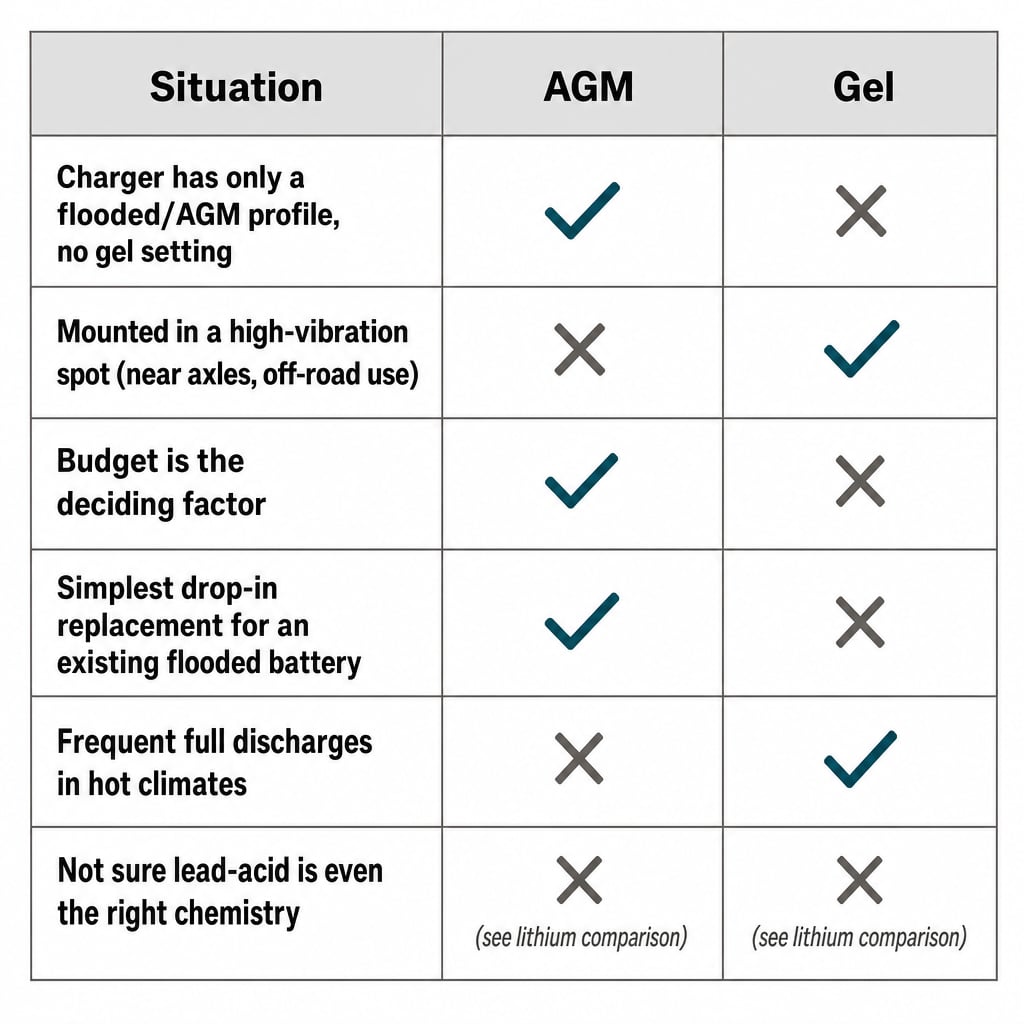
| Situation | Better choice | Why |
|---|---|---|
| Charger/converter only has a flooded/AGM profile, no gel setting | AGM | Charging on the wrong profile is a common cause of premature gel-battery failure |
| Battery mounts in a high-vibration spot (near axles, off-road use) | Gel | Gelled electrolyte has no free liquid to slosh, which manufacturers cite as a vibration-tolerance advantage |
| Budget is the deciding factor | AGM | AGM is typically the lower cost per amp-hour of the two sealed chemistries |
| You want the simplest drop-in replacement for an existing flooded battery on the same charger | AGM | AGM charge voltage windows sit closer to standard flooded/AGM charger defaults than gel's tighter ceiling |
| Battery sees frequent full discharges in hot climates | Gel | Gel construction is commonly cited for better high-temperature cycling tolerance than AGM |
| Not sure lead-acid is even the right chemistry category | Neither | See the lithium vs. AGM battery comparison before committing to either sealed lead-acid option |
AGM — Pros, Cons, Best Use Cases
What it is
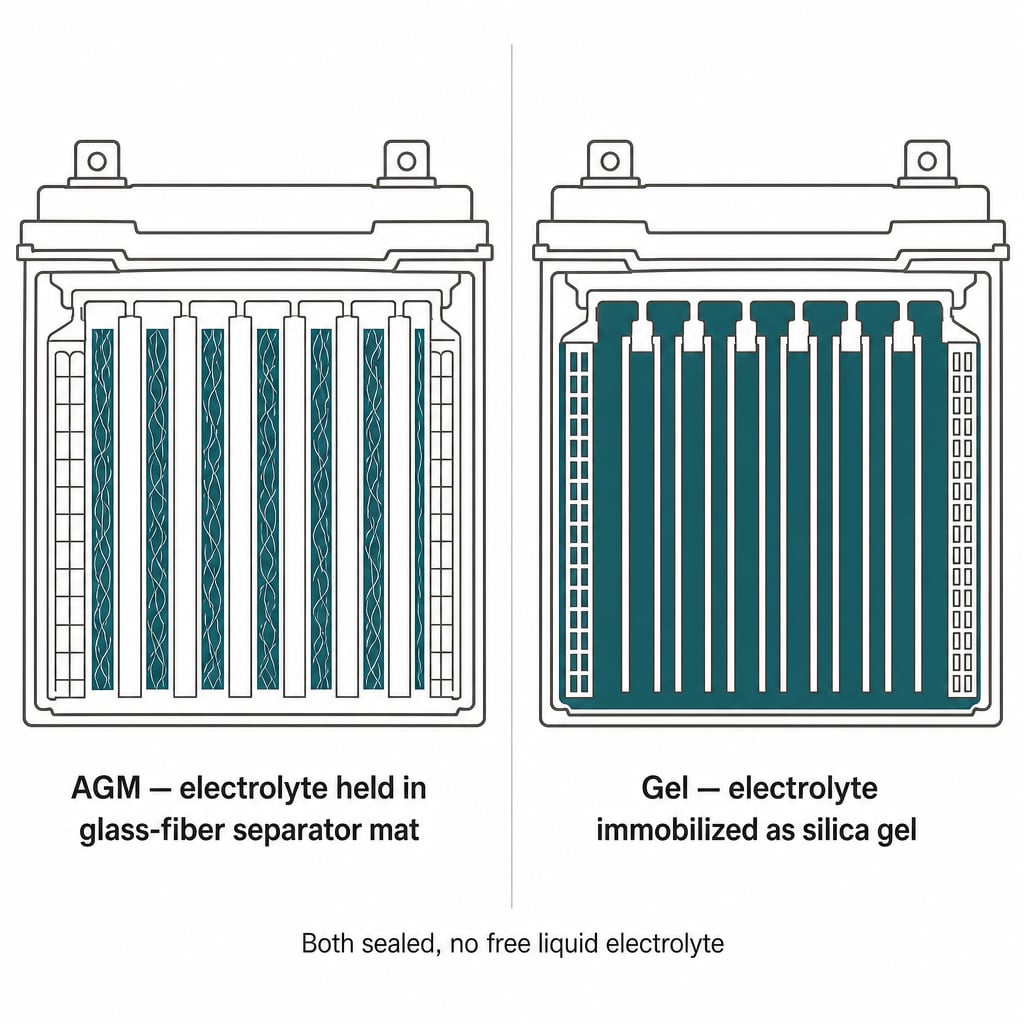
The Renogy Deep Cycle AGM Battery 12V 100Ah (RNG-BATT-AGM12-100) is an absorbed glass mat battery: a sealed, valve-regulated lead-acid design where the electrolyte sits in glass-fiber separator mats instead of moving as a free liquid. Renogy's product page states the battery is maintenance-free and spill-proof by design, with nothing to top off.
Where it works best
- Standard multi-stage RV converters and chargers already tuned for AGM/flooded profiles
- Budget-conscious house-bank replacements
- Moderate cycling rather than daily deep discharge to near-empty
Where it falls short
Renogy's page lists 500 cycles at 50% depth of discharge — a manufacturer-stated figure, not a universal AGM ranking, and lower than some gel and lithium products claim. The charge voltage window (14.4–14.8V cyclic, 13.5–13.8V float) is specific to this model; a charger tuned for gel's lower ceiling will undercharge it over time. If lead-acid chemistry generally, not just gel, is the comparison you actually want, see how AGM compares to flooded lead-acid instead.
What manufacturers and retailers typically specify
A complete AGM product page states capacity (Ah) and its discharge-rate basis, cycle life at a stated depth of discharge, a charge voltage range broken out by cyclic and float use, and an operating temperature range for both charge and discharge — Renogy's page states all of these for this model.
Buyer warnings specific to AGM
Manufacturer-listed capacity, cycle life, and charge-voltage figures assume the manufacturer's own test conditions; real-world results depend on ambient temperature, your actual charge pattern, and battery age. Confirm your charger or converter has a matching AGM voltage profile before you order, not after — this is the single most consequential compatibility check for either chemistry in this comparison.
Gel — Pros, Cons, Best Use Cases
What it is
The ExpertPower EXP200-GEL is a 12V 200Ah gel deep-cycle battery. ExpertPower's product page lists the chemistry as "VRLA Gel": electrolyte immobilized as a silica gel rather than held in a glass-fiber mat, still sealed and valve-regulated.
Where it works best
- Higher-vibration mounting locations
- Chargers or converters with a selectable gel charge profile
- Larger house-bank capacity needs — this pick is rated 200Ah against the AGM pick's 100Ah, a difference between the two representative products, not a difference the chemistries themselves require
Where it falls short
Gel batteries generally tolerate a narrower charge-voltage window than AGM, and ExpertPower's own page doesn't publish a charge-voltage figure for this specific model to compare directly — treat that gap as a reason to confirm with the manufacturer before buying, not as evidence the spec doesn't exist. For the charging-profile differences between the two chemistries in more depth, see AGM and gel charging profile differences.
What manufacturers and retailers typically specify
A good gel product page states the exact recommended charge voltage ceiling, not just "use a gel charger," plus cycle life at a stated depth of discharge and dimensions/weight from the same source. ExpertPower's page states cycle life (1,900–2,100 cycles at 30% depth of discharge) and standby life (3–6 years) directly, but not charge voltage, self-discharge rate, or operating temperature range.
Buyer warnings specific to gel
ExpertPower's own product page lists 127.87 lb for this battery; a separate retailer listing for the same model gives 133 lb. That's most likely a shipping-weight-versus-unit-weight difference, not confirmed either way — verify actual shipping weight before planning how you'll lift and mount it. And to be direct about a question that comes up in owner forums: no, "gel" isn't just a marketing name for AGM. The two use physically different electrolyte constructions, which is why they need different charge voltages in the first place.
Side-by-Side Comparison
The two picks here differ in more than chemistry — the AGM pick is a 100Ah battery and the gel pick is 200Ah, so treat this as a comparison of representative picks per chemistry, not a matched, like-for-like spec comparison.
| Spec | Renogy AGM 100Ah | ExpertPower Gel 200Ah |
|---|---|---|
| Chemistry / construction | AGM — electrolyte held in glass-fiber separator mat | VRLA Gel — electrolyte immobilized as silica gel |
| Capacity | 100 Ah (10-hour rate to 10.5V) | 200 Ah (discharge-rate basis not stated on the manufacturer page) |
| Cycle life | 500 cycles at 50% depth of discharge | 1,900–2,100 cycles at 30% depth of discharge |
| Charge voltage | Cycle use 14.4–14.8V; float 13.5–13.8V | Not stated on ExpertPower's product page |
| Self-discharge rate | Under 3% per month at 77°F/25°C | Not stated on ExpertPower's product page |
| Operating temperature | Charge 32–122°F; discharge −4–140°F | Not stated on ExpertPower's product page |
| Dimensions | 13.1 x 6.9 x 8.6 in | 20.55 x 9.4 x 8.54 in |
| Weight | 63.9 lb | 127.87 lb per manufacturer page (a separate retailer listing states 133 lb, unresolved) |
| Source | Renogy product page (manufacturer), checked 2026-09-17 | ExpertPower product page (manufacturer), checked 2026-09-23 |
Different cycle-life figures also carry different depth-of-discharge assumptions — 50% for the AGM pick, 30% for the gel pick — so a battery cycled less deeply per cycle typically reports a higher cycle count. The two numbers aren't directly comparable without accounting for that.
How to Decide for Your RV
What decides this isn't brand loyalty — it's your own equipment. Before you order:
- Check your charger's or converter's manual for a gel-specific profile before assuming it has one; "smart" or multi-stage doesn't guarantee it
- Consider your mounting location and how much vibration it actually sees
- Be honest about how deep and how often you actually cycle the bank — light, mostly-shore-power use and daily deep boondocking cycles point in different directions
- Weigh budget per amp-hour against the capacity you actually need, not just the lowest sticker figure
If lithium is also on your list because of the weight or cycle-life difference, see how lithium compares to AGM battery before you decide between these two. And if you're not sure lead-acid is the right category at all, the RV lithium battery buying guide covers that option on its own terms.
Common Mistakes
Mistake: Assuming any "smart" or multi-stage charger auto-detects gel vs. AGM. Many don't. The profile has to be selected manually, or the charger has to be gel-rated by its own manufacturer — check before you buy the battery, not after.
Mistake: Comparing the two chemistries' cycle-life numbers without checking the depth of discharge each one is quoted at. A 500-cycle figure at 50% DoD and a 2,000-cycle figure at 30% DoD describe different use patterns, not a straightforward "one lasts four times longer" claim.
Mistake: Treating "sealed" and "maintenance-free" as proof the two chemistries are interchangeable. Both terms are true of both AGM and gel, and neither says anything about charge-voltage compatibility. For a broader look at where AGM sits against gel and standard flooded batteries together, see standard vs. AGM vs. gel battery.
Mistake: Assuming gel is a strict upgrade over AGM because it usually costs more. The manufacturer specs for these two picks don't support a universal "gel is better" claim — only different tradeoffs in vibration tolerance, charge-voltage sensitivity, and cost.
Recommended Products for Each Side
For AGM: Renogy Deep Cycle AGM Battery 12V 100Ah
The fullest spec sheet of the two picks here — capacity, cycle life, self-discharge, charge voltage, dimensions, and weight all come from Renogy's own product page. It's the straightforward choice if your charger only has a flooded/AGM profile.
For Gel: ExpertPower EXP200-GEL 12V 200Ah
A higher-capacity pick from a manufacturer with a clean, model-specific product page. Confirm your charger has a genuine gel profile before ordering, and verify the shipping weight directly with the seller given the manufacturer-vs-retailer discrepancy noted above.
FAQ
Is a gel battery just a marketing name for AGM?
No — construction differs. AGM holds electrolyte in glass-fiber separator mats; gel immobilizes it as a silica gel. That structural difference is why the two need different charge voltages.
Can I use an AGM charger on a gel battery?
Only if the charger has a gel-rated profile. Using a standard AGM/flooded profile risks overcharging a gel battery over time.
Which lasts longer, gel or AGM?
It depends on the specific models and the depth of discharge each manufacturer quotes cycle life at. The ExpertPower gel pick here states a higher cycle count than the Renogy AGM pick, but at a shallower depth of discharge — don't generalize past these two models.
Is gel better for cold weather?
Renogy states an operating temperature range for the AGM pick; ExpertPower's page doesn't publish one for this gel model. Without a comparable figure for both, this comparison can't answer that generally.
Do gel and AGM batteries need different mounting?
Both are sealed and spill-proof per their manufacturers, but orientation flexibility should be checked per model rather than assumed from the chemistry alone.
Why is the gel battery in this comparison rated at 200Ah and the AGM at 100Ah — shouldn't these be matched?
These are representative picks per chemistry, not a matched-capacity pair. The construction and charging differences discussed here apply regardless of which capacity you actually need.
Sources Reviewed
For this comparison, we reviewed manufacturer product pages and specification sheets for AGM and gel deep-cycle batteries, plus recurring patterns in public buyer and forum discussions about choosing between the two chemistries — used only to identify which questions and mistakes readers actually run into, never as a source for any spec. AGM figures are sourced from Renogy's own product page (checked 2026-09-17); gel figures are sourced from ExpertPower's own product page (checked 2026-09-23). Some ExpertPower fields — material, self-discharge rate, and charge voltage — weren't published on the page reached and are noted as such above rather than estimated.
Related Guides
- AGM vs. flooded lead-acid battery
- AGM vs. gel charging profile differences
- Lithium vs. AGM battery
- RV lithium battery buying guide
- Standard vs. AGM vs. gel battery
- Flooded lead-acid vs. gel battery