Lead-Acid vs. Lithium-Ion (LiFePO4) Batteries: Which Is Better for Your RV House Bank?
Disclosure: This article contains affiliate links. If you buy through these links, we may earn a commission at no extra cost to you. We do not claim hands-on testing unless clearly stated.
Every "lithium vs. lead-acid" RV battery comparison online reads like it was written by whichever chemistry's manufacturer paid for it. Lithium sellers imply lead-acid is obsolete; lead-acid vendors lean on decades of track record and a lower sticker price. Neither framing holds up once you put manufacturer-listed specs side by side.
This article compares two lead-acid subtypes — sealed/AGM and flooded — against two LiFePO4 subtypes — a premium US-assembled brand and a value brand — on capacity, cycle life, weight, self-discharge, and charging needs. It does not cover other lithium chemistries (NMC isn't used in RV house banks for good reason) or step-by-step wiring instructions — see the "Have a pro do this" note below for that boundary.
Quick Answer
For boondockers who deep-cycle daily, tow near their weight limit, or want the longest lifespan before replacement, LiFePO4 usually wins on usable capacity, weight, and cycle life. For a low-upfront-cost swap that keeps an existing lead-acid-tuned charging system untouched, AGM or flooded lead-acid remains a reasonable choice. The decision comes down to how deep and how often the battery gets discharged, how much weight you can spare, and whether you're willing to check — and possibly change — your charging system.
Best Choice by Situation
| Situation | Better choice | Why |
|---|---|---|
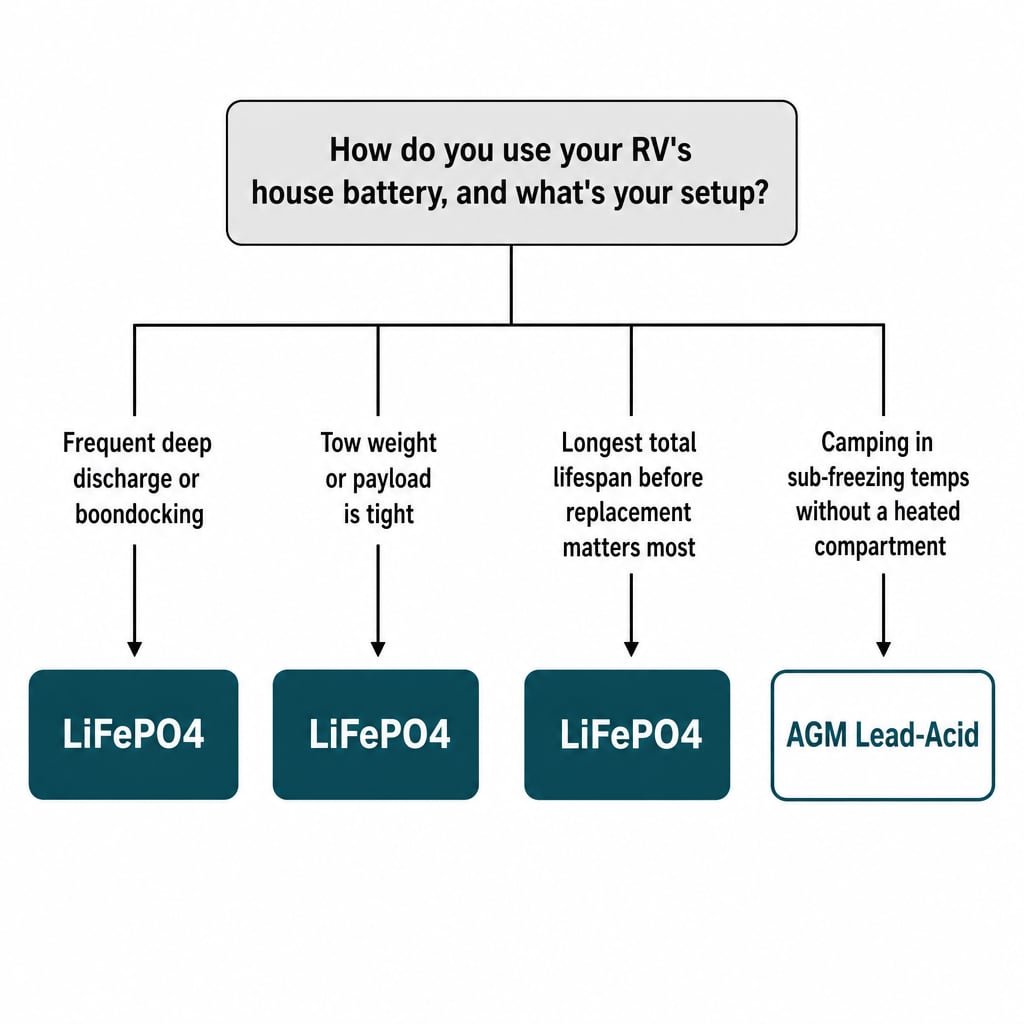
| Lowest upfront cost | Flooded lead-acid | Lowest manufacturer-listed cost per Ah among the four picks here |
| Frequent deep discharge / boondocking | LiFePO4 | Manufacturer-listed usable depth of discharge is far higher than lead-acid's |
| Tow weight or payload is tight | LiFePO4 | Manufacturer-listed weight is roughly half or less for equivalent capacity |
| Camping in sub-freezing temps without a heated compartment | AGM lead-acid | Standard LiFePO4 cells have a manufacturer-stated minimum charge temperature; AGM does not |
| Keeping the existing converter/charger as-is | AGM lead-acid | No charge-profile reprogramming needed — see Charging Systems below |
| Longest total lifespan before replacement | LiFePO4 | Manufacturer-listed cycle counts run several times higher at an equivalent depth of discharge |
| Already maintaining a flooded bank, comfortable watering it | Flooded lead-acid | Highest capacity per dollar of the four, at the cost of a watering routine |
| Long seasonal storage between trips | LiFePO4 | Manufacturer-listed self-discharge is typically lower per month than lead-acid's |
Lead-Acid Batteries (AGM and Flooded) — Pros, Cons, Best Use Cases
What lead-acid covers here
Two different lead-acid subtypes sit under one label here. Sealed/AGM (absorbed glass mat) holds its electrolyte in glass-mat separators — nothing to spill, nothing to top off. Flooded/wet-cell holds liquid electrolyte in a vented case and needs periodic watering, but typically delivers more capacity per dollar. Both are represented by a specific pick below, not a generic stand-in for the chemistry. For a closer look at just these two lead-acid subtypes on their own, see our AGM vs. flooded lead-acid comparison.
Where lead-acid works best
- Budget-first buyers replacing an existing lead-acid battery on a like-for-like basis
- Readers not changing their existing lead-acid-tuned charging system
- Shallow, infrequent-discharge use patterns — mostly shore power, occasional dry camping
- Cold-weather charging without a heated compartment — standard lead-acid chemistry doesn't carry the minimum charge temperature that LiFePO4 does
Where lead-acid falls short
- Manufacturer-listed usable depth of discharge sits well below 100% — discharging deeper shortens cycle life
- Heavier per amp-hour of usable capacity than LiFePO4
- Flooded needs a watering schedule and a vented compartment
- Shorter manufacturer-listed cycle life than LiFePO4 at an equivalent depth of discharge
What manufacturers and retailers typically specify
A complete lead-acid spec sheet states capacity at a named discharge rate, cycle life at a stated depth of discharge, charge voltage, operating temperature, and dimensions and weight — see Common Mistakes below on why the discharge rate matters when comparing Ah figures. Renogy's product page states all of these for the AGM pick below. Trojan's data sheet for the T-105 states capacity at four discharge rates, self-discharge, and operating temperature, but not cycle life, charge voltage, or a warranty term for this specific model — worth confirming directly with Trojan if any of those matter to your decision.
Buyer warnings specific to lead-acid
- The Renogy AGM pick's 500-cycle rating (at 50% depth of discharge, manufacturer-listed) is the shortest cycle life of the four batteries in this comparison — worth weighing against the LiFePO4 side's cycle counts before you decide.
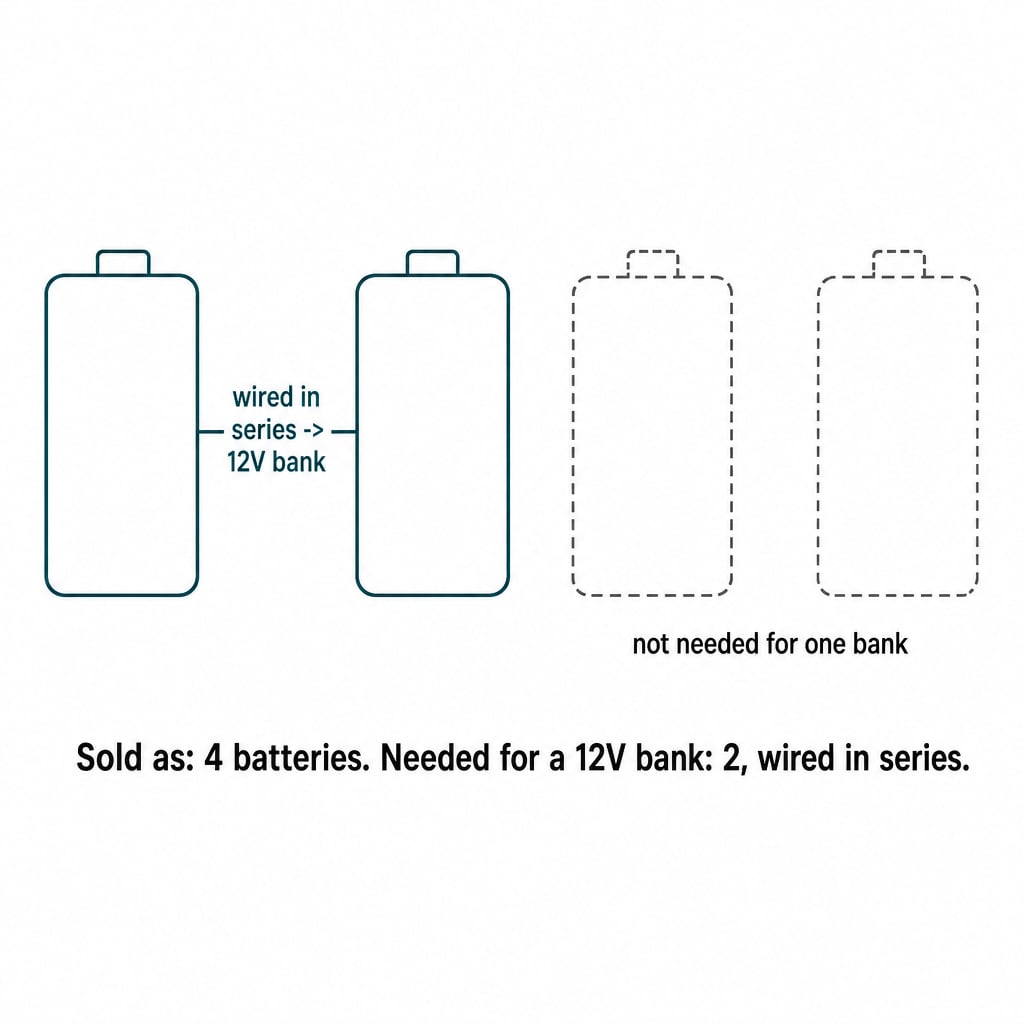
- The Trojan T-105's only confirmed Amazon listing is sold as a pack of 4 six-volt units. A 12-volt RV house bank needs 2 of them wired in series — not all 4. Ordering one pack without accounting for this leaves 2 batteries unaccounted for.
Lithium-Ion (LiFePO4) Batteries (Mainstream and Value) — Pros, Cons, Best Use Cases
What LiFePO4 covers here
Two LiFePO4 subtypes sit under this label: a mainstream, US-assembled pick with a longer warranty, and a value pick that costs less per amp-hour but comes from a newer, less established brand. Both are lithium iron phosphate — the lithium chemistry chosen specifically for RV and marine use because of its thermal stability, not the NMC chemistry used in most consumer electronics. If you've already decided on lithium and want a broader look, see what to look for in an RV lithium battery.
Where LiFePO4 works best
- Boondocking or frequent deep-cycling
- Weight-sensitive tow setups — manufacturer-listed weight for the two picks below is roughly half or less of the AGM pick's for equivalent capacity
- Readers wanting the longest total lifespan before replacement — see best LiFePO4 batteries for RVs for more picks beyond the two compared here
- Readers willing to verify charging-system compatibility once, up front, rather than assuming a drop-in swap
Where LiFePO4 falls short
- Higher upfront cost than lead-acid for equivalent capacity
- Most consumer LiFePO4 packs carry a manufacturer-stated minimum charge temperature below which the battery management system won't accept a charge — confirm the exact number for your specific model (see the buyer warning below)
- An existing lead-acid-tuned converter or charger may need reprogramming, a different charge profile, or replacement
What manufacturers and retailers typically specify
A trustworthy LiFePO4 listing states its battery management system's specs, usable depth of discharge, cycle count, and warranty term. Battle Born's manufacturer page states all of these — 100% manufacturer-listed usable depth of discharge, a 14.2-14.6V charge voltage range, and a 10-year warranty. A thinner listing that omits the depth-of-discharge and BMS detail entirely is worth treating as a gap, not an oversight.
Buyer warnings specific to LiFePO4
- LiTime's Amazon listing advertises up to 15,000 cycles; the manufacturer's own product page states 4,000+ cycles at 100% DOD for this same model. This article uses the manufacturer figure in the comparison table below — verify directly on litime.com if the cycle count is decision-critical for you.
- Confirm the battery management system's low-temperature charge cutoff behavior before relying on the battery through a cold shoulder season, especially if you camp somewhere the compartment isn't heated.
Side-by-Side Comparison
The figures below come from each manufacturer's own product page or data sheet, checked directly rather than pulled from marketing copy. Where a manufacturer doesn't publish a number for a given model, the cell is left blank rather than filled with an estimate or a figure borrowed from a similar model.
| Battery | Chemistry | Capacity (Ah, at rate shown) | Cycle life | Self-discharge | Charge voltage | Operating temperature | Dimensions L x W x H (in) | Weight (lb) | Maintenance |
|---|---|---|---|---|---|---|---|---|---|
| Renogy 12V 100Ah AGM | AGM | 100 Ah (10-hr rate to 10.5V) | 500 cycles at 50% DOD | <3%/month at 77°F | Cycle use 14.4-14.8V; float 13.5-13.8V | Charge 32-122°F; discharge -4-140°F | 13.1 x 6.9 x 8.6 | 63.9 | Sealed, no watering |
| Trojan T-105 6V 225Ah (per unit; sold as a 4-pack, 2 needed in series) | Flooded | 225 Ah (20-hr rate, per unit) | Not published for this model | 5-15%/month, temperature-dependent | Not published for this model | -4°F to 113°F | 7.11 x 10.30 x 11.07 | 62 | Flooded, HydroLink watering system — requires periodic watering |
| Battle Born BB10012 100Ah LiFePO4 | LiFePO4 | 100 Ah at 12V | 3,000-5,000 cycles (manufacturer-listed range; depth-of-discharge basis not stated alongside this figure) | Not published | 14.2-14.6V | Not published | 6.86 x 12.76 x 8.95 | 31 | Sealed, no maintenance; 100% manufacturer-listed usable depth of discharge |
| LiTime 12V 100Ah LiFePO4 | LiFePO4 | 100 Ah at 12V (1,280 Wh) | 4,000+ cycles at 100% DOD (manufacturer-listed) | 3%/month | Not published | Not published | 13 x 6.77 x 8.43 | 24.25 | Sealed, no maintenance; IP65 waterproof |
Blank cells mean the source checked for that battery doesn't publish that figure. The Renogy figures are part of RVFM's compiled battery specification dataset; the Trojan T-105, Battle Born, and LiTime figures were sourced independently for this article and aren't in that shared dataset yet. Trojan's figures describe one 6V unit, not the 4-pack sold on Amazon — see the buyer warning above. Note: the "Battery specification comparison" table further down this page draws on that shared dataset and lists a different Trojan model, the T605 (210 Ah) — a separate SKU from the T-105 recommended here, not a second source for the same battery.
Charging Systems — What Actually Changes
AGM, flooded, and LiFePO4 batteries want different charge voltage profiles. A converter or solar charge controller tuned for one chemistry may not fully charge — or may shorten the life of — a battery from a different chemistry without a compatible or reprogrammed profile. This is the practical crux most "lead-acid vs. lithium" comparisons skip entirely.
Before switching chemistries, check whether your converter or charge controller has a selectable charge profile for the chemistry you're switching to, and confirm the exact voltage setpoints against the new battery's manufacturer-listed charge voltage — not a generic "12V lithium" setting, which can undercharge or overcharge a specific model.
Have a pro do this: confirming charge-profile compatibility and reprogramming a converter or charge controller is DC electrical work with real consequences for battery life and, in some failure modes, safety. If you're not confident checking your system's documentation and matching it against the battery's own spec sheet, have an RV technician do it. The same applies to wiring the Trojan T-105 pair in series for a 12V bank — see the buyer warning above.
How to Decide for Your RV
Match your own discharge pattern, climate, and weight budget against the table above. If you deep-cycle daily and tow near your weight limit, LiFePO4's cycle life and weight advantage likely outweigh the higher upfront cost. If your battery sees light, occasional use and your existing charging system already suits lead-acid, there's no compelling reason to switch chemistries just because lithium is newer. Cold-climate campers without a heated compartment should weigh LiFePO4's charge-temperature limits carefully against AGM's tolerance for unheated storage.
Common Mistakes
Mistake: Assuming any LiFePO4 battery is a drop-in swap. Charging-system compatibility isn't automatic — a lead-acid-tuned converter or solar charge controller may not fully charge a LiFePO4 bank, or may shorten its life, without a compatible or reprogrammed charge profile. See RV converter and charger compatibility before you order.
Mistake: Ordering the Trojan T-105 listing expecting a single 12V battery. It's sold as a pack of 4 six-volt units — see the buyer warning above for the series-wiring math.
Mistake: Comparing two Ah numbers without checking the discharge rate behind each. The same physical battery reads as a different Ah figure depending on whether the manufacturer quotes a 10-hour or 20-hour rate. Renogy's figure above is a 10-hour rate; Trojan's is a 20-hour rate — they aren't directly comparable without accounting for that.
Mistake: Assuming a lead-acid battery can be discharged as deep as LiFePO4 without shortening its life. Manufacturer-listed usable depth of discharge differs materially between the two chemistries — routinely discharging a lead-acid battery as deep as a LiFePO4 battery will shorten its cycle life well below the manufacturer-listed figure.
Recommended Products for Each Side
For sealed/AGM lead-acid: Renogy 12V 100Ah Deep Cycle AGM Battery
The fullest spec sheet of the four picks here — capacity, cycle life, self-discharge, charge voltage, dimensions, and weight all come directly from Renogy's own product page. Its 500-cycle rating is the shortest in this comparison; confirm your charger has an AGM charge profile before switching to it.
For flooded lead-acid: Trojan T-105 6V 225Ah Flooded Deep-Cycle Battery
Sold on Amazon as a pack of 4 six-volt units — see the buyer warning above for the series-wiring math. Decades of RV and golf-cart track record and a full manufacturer data sheet, at the cost of a periodic watering routine the sealed picks here don't need.
For mainstream LiFePO4: Battle Born BB10012 100Ah 12V LiFePO4
No confirmed Amazon listing for this model — one candidate is a charger bundle, and the two standalone candidates returned Amazon's bot-wall page on direct checks rather than a confirmed listing. Battle Born remains the most consistently cited US-assembled LiFePO4 brand in the RV space, with a 10-year warranty and 100% manufacturer-listed usable depth of discharge — this points to the manufacturer directly rather than an unconfirmed Amazon listing.
For value LiFePO4: LiTime 12V 100Ah LiFePO4 Battery
Costs less per amp-hour than the mainstream pick, with its own branded Amazon listing and a 5-year warranty. Manufacturer-listed cycle life is 4,000+ cycles at 100% DOD — see the buyer warning above on Amazon's higher advertised figure.
Battery specification comparison
Every AGM or flooded lead-acid battery's spec sheet lists capacity, cycle life, self-discharge rate, and charge voltage, but each manufacturer publishes them in a different format, at a different discharge rate, and often on a different kind of page entirely. This table pulls those figures directly from each battery's own manufacturer page, official data sheet, or parts listing for the AGM and flooded picks in this comparison, normalized side by side so the numbers can be compared directly instead of hunted down across three separate product pages.
| Battery | Chemistry | Capacity (Ah, at rate shown) | Cycle life | Self-discharge rate | Charge voltage | Operating temperature | Dimensions L x W x H (in) | Weight (lb) | Maintenance | Source | Source checked |
|---|---|---|---|---|---|---|---|---|---|---|---|
| Renogy Deep Cycle AGM Battery 12V 100Ah | AGM | 100 Ah (10-hour rate to 10.5V) | 500 cycles at 50% depth of discharge | <3% per month at 77°F/25°C | Cycle use 14.4-14.8V; float 13.5-13.8V (12V system) | Charge 32-122°F (0-50°C); discharge -4-140°F (-20-60°C) | 13.1 x 6.9 x 8.6 | 63.9 | Sealed, maintenance-free design - manufacturer states no free-flowing electrolyte | Renogy product page (manufacturer) | 2026-09-17 |
| ACDelco Gold M31AGM (88866289), Professional Voyager AGM | AGM | 100 Ah (20-hour rate) | 13.1 x 6.8 x 9.1 | AGM (Absorbed Glass Mat) - maintenance-free, no top off or inspection required | RockAuto parts listing (retailer, built on manufacturer part data) | 2026-09-17 | |||||
| Trojan T605 6V 210Ah Flooded Deep-Cycle (sold as a 4-pack) | Flooded (wet lead-acid) | 210 Ah (20-hour rate); also rated 175 Ah (5-hour) and 232 Ah (100-hour) - per single 6V unit | 5-15% per month, depending on storage temperature | Bulk 7.41V; float 6.75V; equalize 8.10V, at 77°F/25°C (per 6V unit) | -4°F to 113°F (-20°C to 45°C); below 32°F (0°C), maintain state of charge above 60% | 10.30 x 7.13 x 11.15 | 58 | Flooded/wet lead-acid cell with HydroLink single-point watering system - requires periodic watering | Trojan Battery official data sheet (PDF) | 2026-09-17 |
How these numbers were produced: Every figure was read directly from the battery's own manufacturer product page or official PDF data sheet, except the ACDelco M31AGM row, whose figures come from a RockAuto parts listing built on the manufacturer's own part data (ACDelco's and its parent GM Parts distributor's own pages returned 403/500 to a direct fetch). Capacity is quoted at the discharge rate each source itself states, not converted to a common rate: Renogy publishes a 10-hour rate, while ACDelco and Trojan publish a 20-hour rate (among others). Nothing is derived or estimated beyond the unit conversions the source itself already prints in parentheses (for example, inches to millimeters, pounds to kilograms).
- A blank cell means the source checked for that battery does not publish that figure. No number was estimated, averaged from a similar model, or carried over from a different product to fill a gap.
- Capacity (Ah) is shown at the discharge rate each manufacturer itself publishes, not a single standardized rate. Renogy states a 10-hour rate; ACDelco and Trojan state a 20-hour rate (among others each also lists). Comparing two Ah figures without checking the rate behind each one is a genuine source of confusion, not a technicality — the same physical battery reads as a different Ah number depending on which rate is quoted.
- Cycle life is blank for the ACDelco and Trojan rows because neither source publishes a simple cycle-count-at-a-stated-depth-of-discharge figure for these specific models. Trojan's own data sheet shows a capacity-vs-temperature chart instead of a text cycle-life figure, and the RockAuto listing used for the ACDelco model does not carry a cycle-life field at all.
- The Trojan T605 is sold on Amazon as a 4-pack of 6V batteries wired in series pairs to build a 12V bank, not as a single 12V battery. Every figure in the Trojan row (voltage, capacity, charge voltage) describes one 6V unit, not the pack.
- This T605 is a different Trojan model from the Trojan T-105 recommended earlier on this page in the Side-by-Side Comparison table. The two are separate SKUs with different published capacities and specs — this table is not a second source for that battery.
- These figures describe the three specific battery models used as picks in this comparison, not AGM or flooded lead-acid chemistry in general. A different AGM or flooded battery from a different manufacturer can publish different numbers.
- All three sources were checked directly on 2026-09-17. A manufacturer can revise a data sheet, or a retailer can delist a part page, after that date.
These are the entries that matter for this guide. The full table, with every row and its source, is in our complete guide.
FAQ
Is lithium-ion (LiFePO4) always better than lead-acid for an RV house battery?
No. It usually wins on weight, cycle life, and usable capacity, but AGM or flooded lead-acid remains a reasonable choice for light, infrequent use on an unchanged charging system — see Best Choice by Situation above.
Why is LiFePO4 often described as safer than lead-acid?
The chemistries behave differently under abuse: LiFePO4 is more thermally stable than other lithium chemistries, and it doesn't vent hydrogen gas the way flooded lead-acid does during charging. That's a chemistry-level difference, not a claim that either chemistry is risk-free when mishandled or damaged.
Can I replace a lead-acid battery with a lithium-ion battery without changing anything else?
No — see Charging Systems above. Your converter or charge controller likely needs its charge profile checked, and possibly reprogrammed or replaced, before a LiFePO4 battery will charge correctly.
Does a lithium-ion battery cost more than an equivalent lead-acid battery?
Upfront, generally yes. Whether it costs more over the battery's full life depends on how many charge-discharge cycles you'll put it through before replacement — a LiFePO4 battery's manufacturer-listed cycle life is typically several times a lead-acid battery's at an equivalent depth of discharge.
What's the practical difference between AGM and flooded lead-acid for an RV house bank?
AGM is sealed and needs no watering; flooded costs less per amp-hour but requires a watering schedule and a vented compartment. See AGM vs. flooded lead-acid, in depth for the full comparison.
Do I need a different charger for a lithium-ion RV battery?
Usually, or at minimum the existing charger's profile needs checking against the new battery's manufacturer-listed charge voltage. See Charging Systems above.
Sources Reviewed
For this comparison, we reviewed manufacturer pages and data sheets for Renogy, Trojan, Battle Born, and LiTime, retailer and Amazon listings for each product, and public forum discussions where RV owners described choosing between lead-acid and lithium-ion house batteries. Renogy, Trojan, and Battle Born figures come from each manufacturer's own product page; LiTime figures come from litime.com's own product page. All were checked 2026-09-20 (dataset provenance for these figures is footnoted in Side-by-Side Comparison above).
Related Guides
- AGM vs. flooded lead-acid battery comparison
- RV lithium battery buying guide
- Best LiFePO4 batteries for RVs
- RV converter and charger buying guide
- Lithium vs. AGM battery comparison
- RV inverter buying guide