How to Repair an RV Awning: Rips, Holes, and Broken Hardware
Published
Disclosure: This article contains affiliate links. If you buy through these links, we may earn a commission at no extra cost to you. We do not claim hands-on testing unless clearly stated.
Awning damage doesn't come in just one form, and the wrong fix either doesn't hold or makes the real problem harder to see later. A fabric tear needs a different repair than a pinhole, and neither one touches a bent or broken arm. This guide walks through four common awning problems, how to tell them apart, and the specific repair path for each.
It does not cover step-by-step installation or service procedures for arm hardware, or any motor or electrical repair procedure — those are described here, not instructed. It also doesn't cover replacing an awning entirely or replacing just the fabric; those are separate, deeper topics covered elsewhere.
Quick Answer: Which Repair Do You Need?
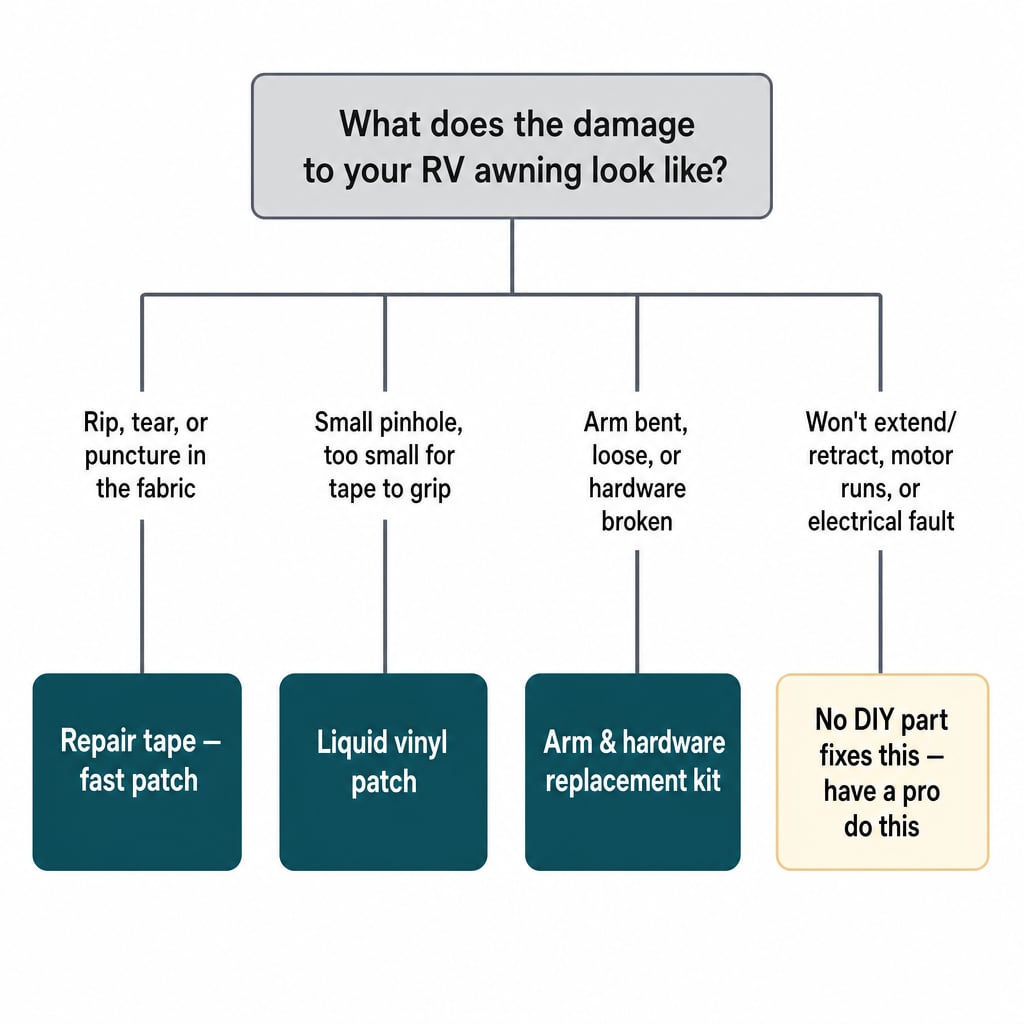
| Symptom | What's Actually Wrong | Fix |
|---|---|---|
| Rip, tear, or puncture in the fabric | Fabric damage, mechanically open | Camco Awning Repair Tape |
| Small pinhole, too small to grip with tape | Fabric damage, too small for an adhesive edge to seat | Carefree Vinyl Liquid Patch |
| Arm bent, loose, won't lock, or hardware visibly broken | Mechanical/hardware failure, not fabric | Solera Hybrid Universal Arms & Hardware Kit |
| Won't extend or retract on its own, motor runs but nothing moves, or an electrical fault | Motor, wiring, or alignment problem | No product pick — have a pro diagnose it |
Find Your Repair
Scenario 1 — Rip or Puncture in the Fabric
If you can see an actual tear or hole with a clean edge, tape is the right first move. It's a self-adhesive patch meant to seal a rip or puncture fast, without cutting into the surrounding fabric or requiring any curing time.
Before you order: measure the longest dimension of the tear and compare it against the tape's 15-foot roll — a long diagonal rip eats roll length fast, and running out mid-repair means a second order. Retailer listings also disagree on this tape's color (one lists "Clear," others list "White") for what appears to be the same product; verify against the actual listing photos before you order, rather than assuming either color.
For the exact measurements you'll want on hand before ordering anything for this repair, see measuring your awning before you order anything.
Scenario 2 — Pinhole Too Small for Tape to Seat Cleanly
A pinhole is a different problem from a tear. Tape needs a clean edge to grip, and a pinhole often doesn't give it one — the adhesive can't seat flush around a hole that small, and the patch lifts at the edges over time. A brush-on liquid vinyl patch solves this differently: it fills and seals the hole itself rather than covering it with an adhesive layer.
Before you order: retailer listings for this product disagree sharply on package size — one lists 1 fluid ounce, another lists 11 ounces for what looks like the same SKU. That's too wide a gap to guess at, so this guide isn't stating a size here; check the specific listing's package size before you buy, especially if you have more than one or two pinholes to cover.
Scenario 3 — Arm Is Bent, Loose, or Hardware Has Failed
If the fabric itself is intact but an arm is bent, won't lock in place, or the hardware is visibly cracked or broken, that's a mechanical problem — no amount of tape or patch addresses it. This calls for an arm and hardware replacement, not a fabric repair.
Before you order: confirm arm length and brand/model compatibility against your own awning before ordering. The manufacturer's page for this kit lists a 69-inch arm length and compatibility with specific awning families — Dometic's 8-foot 8500, 9000, 9100, Sunchaser, and Weather Pro models, and Carefree's 8-foot Spirit, Fiesta, Simplicity Traveler, and Eclipse models — rather than a universal fit across every awning on the market. Replacing arm hardware is a bolt-on job with a manual crank wand, not a wiring job, but it's still worth matching the variant carefully: the wrong arm length or an incompatible mount is a returned order, not a quick fix.
If you want to compare more than this one pick before deciding, see our RV awning parts and hardware roundup.
Scenario 4 — Motor, Electrical, or Alignment Fault (Have a Pro Do This)
If the motor runs but the arms don't move, the awning only extends or retracts on one side, or it doesn't respond to the switch at all, the fabric and arms usually aren't the problem — this points to the motor, the 12V wiring, or an alignment fault instead. None of the three products above fix this, and this guide doesn't walk through diagnosing it yourself.
A technician working on this will typically check the motor, the wiring connections, and the arm alignment as a system, not swap a single part on a guess. That's a diagnostic visit, not a part a reader installs. If your awning is motorized and you're shopping for a different unit entirely rather than fixing this one, see our guide to electric RV awning options.
Tools and Products That Help
All three repair paths above come with a sourced pick: tape for rips and tears, liquid patch for pinholes, and the arm and hardware kit for mechanical failures. Match the product to the scenario, not the other way around, and measure first either way. For options beyond these three picks, see our RV awning parts and hardware roundup.
Common Mistakes
Mistake 1: Patching Before Diagnosing
What it looks like: Fabric gets patched because it's the damage you can see, while a bent arm or an alignment problem underneath goes unaddressed.
Why it's a problem: The fabric patch holds, but the awning keeps straining against hardware that's already compromised, and the real failure shows up again — often worse.
What to do instead: Check the arms and hardware for looseness or visible damage before you patch anything, even if the fabric damage is what caught your eye first.
Mistake 2: Buying Without Measuring
What it looks like: Ordering tape or patch sized for "an awning repair" in general, without measuring the actual damage first.
Why it's a problem: A tear longer than expected eats through a tape roll mid-repair; a patch sized for a pinhole doesn't cover a larger puncture.
What to do instead: Measure the damage's longest dimension before ordering, and reread the product's actual coverage — not just its name — against that number.
Mistake 3: Forcing a Stuck Awning Closed by Hand
What it looks like: An awning that won't retract on its own gets pushed, cranked, or pulled closed by hand to get it out of the way.
Why it's a problem: Forcing a misaligned or stuck mechanism is how a fabric or alignment issue turns into a broken arm.
What to do instead: Check your owner's manual for a manual override procedure specific to your awning's brand and model before forcing anything — mechanisms differ enough between brands that a generic approach can do more damage than the original fault.
When to Replace Instead of Repair
A single rip, puncture, or pinhole is a repair. Fabric that's cracking or delaminating across its whole surface, or an awning with more than one failure point at once, is a replacement call instead — patching one spot on fabric that's failing everywhere just buys a little time before the next hole appears. If you're trying to figure out which length or hardware variant you'd need for a full replacement, our RV awning sizing guide lays out nominal length, fabric cut length, and hardware pitch variant side by side across the major product families.
If you're leaning toward replacing just the fabric rather than the whole assembly, that's a separate guide, since it calls for matching your existing roller and arms rather than a repair product.
Awning Replacement Sizes and Hardware Variants by Family
A headline length like "16 foot" does not by itself tell you whether that number is the frame/roller length or the fabric's actual cut length, and a hardware line's part number does not say which pitch variant it is. This table separates those numbers across the three awning-replacement paths — a complete universal kit, an OEM-style roller-and-fabric assembly, and arm hardware sold on its own — for the product families covered in this guide, with one source per row and a blank left wherever the cited source does not publish that figure.
| Product family / line | What this part actually is | Nominal length as marketed | Fabric cut length as published | Projection (extension depth) as published | Mount type, hardware fit, or pitch variant | Weight as published | Source | Source checked |
|---|---|---|---|---|---|---|---|---|
| VEVOR Manual RV Awning Complete Kit, Aluminum Alloy Frame (universal/aftermarket) | Complete awning assembly: frame + roller + fabric + arms, manual, universal/aftermarket | 16 ft | 15 ft 2 in (15'2") | 7.7 ft | Manual pull-strap operation (no electricity); switchable installation brackets for RV-wall or ground mounting; frame height 5.6 ft | 88.2 lb / 40 kg (complete kit, including all accessories) | VEVOR, 16' Manual RV Awning Complete Kit product page (manufacturer) | 2026-10-06 |
| VEVOR Manual RV Awning Complete Kit, Aluminum Alloy Frame (universal/aftermarket) | Complete awning assembly: frame + roller + fabric + arms, manual, universal/aftermarket | 20 ft | 19 ft 2 in (19'2") | 7.7 ft | Manual pull-strap operation (no electricity); switchable installation brackets for RV-wall or ground mounting; frame height 5.6 ft | 97.0 lb / 44 kg (complete kit, including all accessories) | VEVOR, 20' Manual RV Awning Complete Kit product page (manufacturer) | 2026-10-06 |
| Solera (Lippert Components) Power & Hybrid RV Awning Roller Assembly | Roller tube + attached fabric only — compatible 18V or Hybrid arm hardware sold separately | 10 ft | 9 ft 1 in (9'1") | 8 ft (standard) | Patio roller type, vinyl fabric with integrated light track; compatible with 18V or Hybrid awning hardware (sold separately); shipping dimensions 120" L x 5" W x 5" H | 28 lb (shipping weight) | Lippert, Solera 10' Power & Hybrid RV Awning Roller Assembly product page (manufacturer) | 2026-10-06 |
| Solera (Lippert Components) Power & Hybrid RV Awning Roller Assembly | Roller tube + attached fabric only — compatible 18V or Hybrid arm hardware sold separately | 16 ft | 15 ft 1 in (15'1") | 8 ft (standard) | Patio roller type, vinyl fabric with integrated light track; compatible with 18V or Hybrid awning hardware (sold separately); shipping dimensions 195" L x 6" W x 6" H | 53 lb (shipping weight) | Lippert, Solera 16' Power & Hybrid RV Awning Roller Assembly product page (manufacturer) | 2026-10-06 |
How these numbers were produced: Every figure is quoted from the manufacturer's own product page where one was reachable, or from a retailer page that independently republishes the manufacturer's own stated dimensions where the manufacturer's page was not. No figure is derived, estimated, or averaged across sources. "Nominal length" is the marketed size; "fabric cut length" is the actual fabric dimension once installed — these are two different numbers, and a source that gives only one leaves the other blank rather than assuming they match. Hardware-only rows have no fabric or roller length at all; their decision-critical number is the pitch variant and the drop (how far the awning hangs below the mounting point when extended), shown in the mount/variant column.
- A blank cell means the cited source does not publish that figure. No cell on this table is filled with a figure estimated, averaged, or carried over from a similar size or variant in the same product line.
- Across both the VEVOR complete-kit family and the Solera roller-and-fabric family, the fabric cut length runs shorter than the nominal marketed length by roughly 10 to 11 inches at every size checked. That pattern held for every row sourced here, but it is a pattern, not a rule — confirm the fabric cut length on the specific listing you are ordering rather than subtracting a fixed number from the nominal size yourself.
- The three Dometic 9100 hardware variants (Standard, Basement, Reduced Pitch) are not the same hardware in different lengths — they are different geometries for different mounting situations, distinguished mainly by how far the awning drops below the mounting point when extended: about 13-1/4 inches for Standard, about 31-3/8 inches for Basement, and about 2 inches for Reduced Pitch. Fitting the wrong variant to an RV is a mounting-geometry mismatch, not a cosmetic difference. None of these three rows include fabric or a roller tube — hardware only.
- On 2026-10-03, dometic.com's own product pages for all three 9100 hardware variants returned an empty "no results" category listing rather than the product page itself. Every Dometic row on this table is sourced from a retailer page that independently publishes the same dimensions Dometic's own documentation states elsewhere (channel lengths, pivot height, and drop), not from a direct dometic.com product page — flagged here because that changes the source tier for those three rows specifically.
- "Projection" is how far the awning extends outward from the RV once deployed — a separate measurement from length, and the number that determines ground clearance and patio coverage rather than which length to order.
- This table covers marketed length, fabric cut length, projection, and hardware mounting geometry only. It does not cover load or wind rating for any row: no manufacturer or retailer source found for any product checked here publishes a load or wind-resistance figure, so none is shown and no article drawing on this table should assert one.
This table covers replacement-part sizing — a different question from the repair fixes above. If you're sizing a full replacement rather than patching what you have, the full table, with every row and its source, is in our complete guide.
FAQ
Can I repair a torn RV awning fabric myself?
Yes, for a single rip, puncture, or pinhole — tape or a liquid patch, as covered above. Widespread fabric failure (cracking or delaminating across the whole surface) isn't a DIY patch job; that's a replacement question.
What's the difference between repairing awning fabric and replacing it?
Scale of damage is the deciding factor. One isolated tear or hole is worth repairing; fabric that's failing in multiple places or across its whole surface is worth replacing. See replacing just the fabric if you're past the repair threshold.
Why won't my RV awning open or close?
Usually not a fabric problem. A motor that runs without moving the arms, uneven movement on one side, or no response at all points to a motor, wiring, or alignment fault — see Scenario 4 above. This isn't something to diagnose by guessing at parts.
How do I bring in a stuck RV awning manually?
Many awnings have a manual override for exactly this situation, but the procedure is brand- and model-specific — check your owner's manual rather than following a generic method. If your awning is a manual (non-motorized) type to begin with, see manual RV awning options for how those differ.
Does a bent or loose awning arm mean I need a whole new awning?
Usually no. Arm and hardware replacement kits exist specifically for this — see Scenario 3 above — as long as the fabric itself is intact.
How much does RV awning repair cost?
We don't publish a dollar figure here because no sourced, current figure exists for this across the range of repairs this guide covers. In general terms: DIY materials like tape or liquid patch are low-cost compared to any shop visit, while a shop visit for arm or hardware replacement, or for motor diagnosis, varies by region and local labor rates.
Related Guides
- Replacing your RV awning entirely
- Replacing just the awning fabric
- RV awning buying guide
- RV awning parts and hardware
- Manual RV awning options
- Electric RV awning options
- How to measure your RV awning