RV Water Pump Repair: Diagnose the Real Problem First
Disclosure: This article contains affiliate links. If you buy through these links, we may earn a commission at no extra cost to you. We do not claim hands-on testing unless clearly stated.
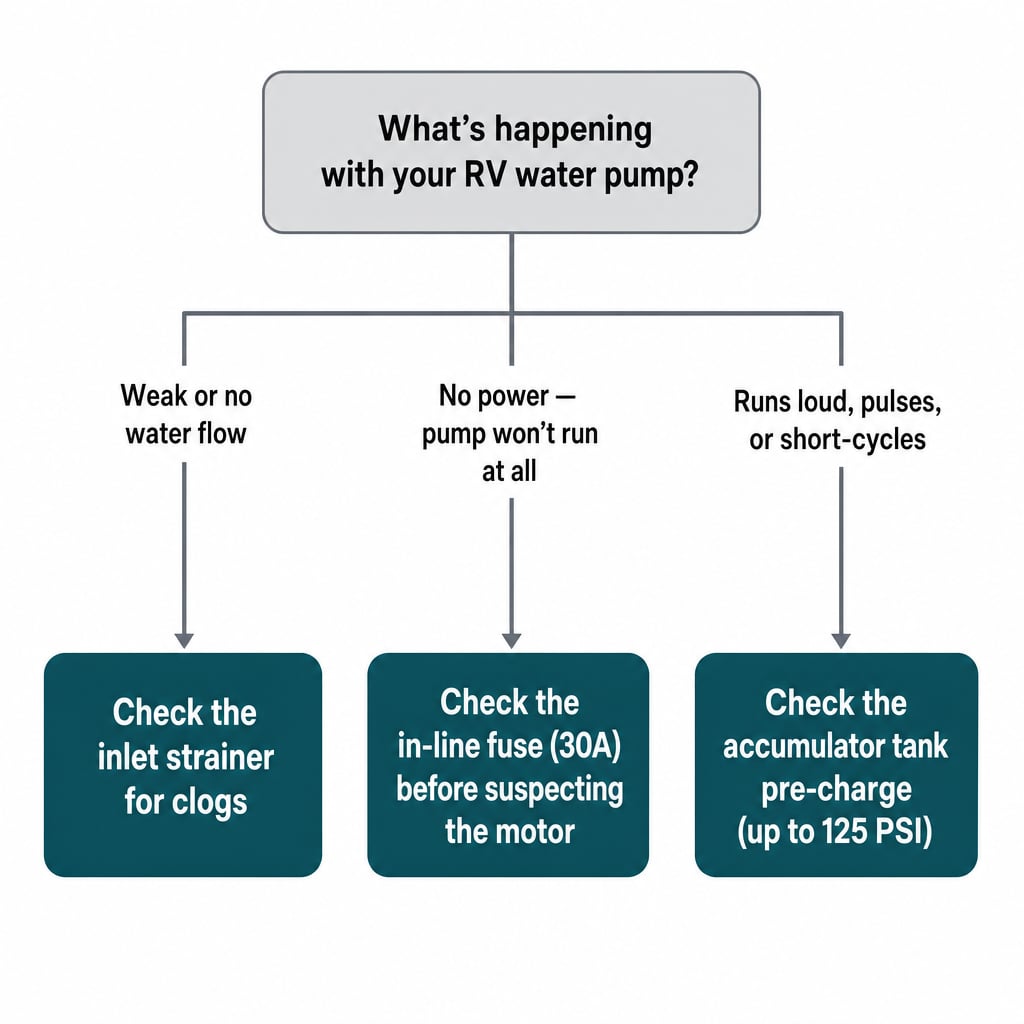
Your RV water pump runs but no water comes out. Or it doesn't run at all. Or it won't stop cycling on and off. All three get lumped together as "the pump is broken" — and often aren't.
This guide separates the three symptom buckets: weak or no flow, no power at all, and loud pulsing or short-cycling. Each traces, more often than not, to a cheap, externally-replaceable part rather than the motor — plus manufacturer-sourced specs to check your own pump's nameplate against.
Not covered here: opening the pump housing, replacing the diaphragm or drive assembly, or tracing wiring beyond the in-line fuse. Those are jobs for a full pump replacement or a qualified 12V technician, not a checklist.
What You'll Need
A multimeter or a simple 12V test light works for the checks below — any generic model will do; this isn't a product endorsement. You'll also want your pump's model or nameplate information on hand, since specs vary by model even within the same brand.
Before you check anything, turn the pump off at its switch or breaker and open a faucet to relieve pressure in the lines. Working on a pressurized system is how you get sprayed, not how you get answers.
RV Water Pump Specs at a Glance
Every demand pump's nameplate lists a flow rate, a shut-off pressure, and a maximum current draw, but no single source puts those numbers side by side across the pump families actually installed in RVs. The table compiles them from each manufacturer's own documentation, so you can check your pump's numbers against a published range instead of guessing whether it's underperforming. See also our RV water pump system diagram.
What the System Has to Do
Strainer, pump, and accumulator tank — how the three parts work together
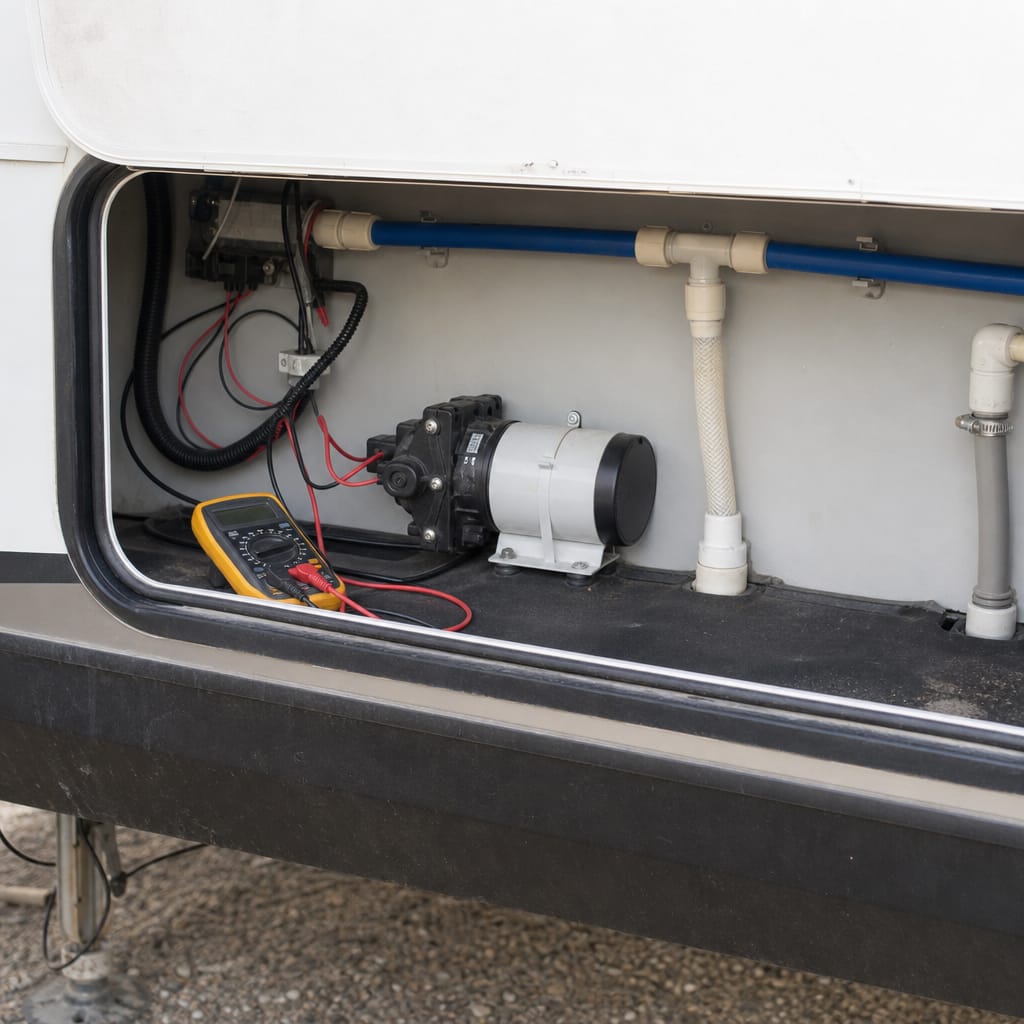
Water gets pulled from the fresh tank through an inlet strainer, a mesh screen that keeps sediment out of the pump. The pump itself is a demand pump: it switches on when a faucet drops line pressure, rather than running continuously. On the outlet side, many systems use a small pre-pressurized accumulator tank as a buffer, smoothing pressure pulses and cutting down on the pump cycling for small draws.
Because these three parts sit in series, a fault anywhere upstream or downstream of the motor can look exactly like a dying pump — reduced flow, dead silence, or pulsing noise all get blamed on the pump first.
Diagnose the Symptom
Match what you're seeing to one of the three buckets below before you assume the motor's dead — and check your pump's nameplate numbers against the specs table above if you want a second data point.
Weak or No Water Flow — Check the Inlet Strainer First
If the pump runs (you can hear it) but delivery is weak or nonexistent, start with the inlet strainer. Its job is to keep debris out of the pump before it ever gets there, and a clogged screen restricts flow enough to read as a failing pump.
The Shurflo by Pentair 255-313 is a twist-on strainer with a clear bowl and a replaceable 50-mesh screen, so you can see debris buildup without tools. The manufacturer's own page doesn't publish a pressure, temperature, or flow-rate rating for this part — treat it as a documented feature set (clear bowl, replaceable screen, easy disassembly), not a performance spec.
Before you order: twist-on strainers aren't universal across pump families — confirm your inlet fitting size first. See our RV water pump buying guide, or if your pump is Shurflo-branded, our Shurflo RV water pump options.
Where this stops: if the strainer is clean and flow is still weak, see the buying guide above for what else to check.
No Power Reaching the Pump — Rule Out the Fuse Before You Suspect the Motor
"No power at all" is one of the most commonly reported water-pump complaints, and it's very often the in-line fuse — not the motor.
Blue Sea Systems rates the 5065, a waterproof in-line ATO/ATC fuse holder, at 30A. It's a generic 12V part, not pump-specific — think of it as the fuse in the pump's supply line. One retailer listing shows "330A" for this holder; every other source agrees on 30A, and ATO/ATC blade fuses don't exist at 330A — that's a data-entry error, not a second valid rating.
Check the fuse before you suspect the motor. For pump options built around this kind of 12V supply, see our 12-volt RV water pump models.
Have a pro do this: if the fuse is intact and there's still no power, that's wiring beyond a fuse swap. Stop here and call a 12V-systems technician — this guide doesn't cover circuit tracing.
Pump Runs Loud, Pulses, or Short-Cycles — the Accumulator Tank
A pump that runs loud, pulses, or keeps kicking on and off for a small draw usually isn't failing — it's missing pressure buffering.
The Shurflo by Pentair 182-200 is a pre-pressurized accumulator tank (24 oz, rated up to 125 PSI) that sits between the pump and the plumbing. Every figure the manufacturer publishes — dimensions, volume, pre-charge pressure, max working pressure — comes straight from Pentair's own product page, making it the best-documented pick in this guide.
Frame this correctly: an accumulator tank reduces or smooths pulsation and short-cycling. It doesn't eliminate pump noise entirely, and it won't fix a symptom caused by a worn check valve — see our RV water pump check valves guide if a tank doesn't resolve the pulsing.
Manufacturer-listed pressure and volume figures assume normal installation and operating conditions; actual performance depends on plumbing layout, water temperature, and how long the pre-charge has held. The manufacturer doesn't publish a weight figure for this part, so we're not inventing one.
Symptom → Likely Cause → What to Check
Use this table as a quick reference once you've matched your symptom to a bucket above.
| Symptom | Likely cause | What to check |
|---|---|---|
| Weak or no water flow | Clogged inlet strainer | Inspect and clean the strainer screen |
| No power — pump won't run | Blown in-line fuse | Check/replace the 30A fuse before suspecting the motor |
| Loud, pulsing, or short-cycling | Worn or missing accumulator pre-charge | Check the tank's pre-charge pressure |
| Pump runs constantly, won't shut off | Failing pressure switch or a downstream leak | Out of scope here — see our RV water pump buying guide |
Tools and Products That Help
For the checks above, the three parts covered in this guide are:
- Inlet strainer — Shurflo by Pentair 255-313 twist-on strainer, for clogged-flow checks
- In-line fuse holder — Blue Sea Systems 5065 waterproof ATO/ATC holder, 30A
- Accumulator tank — Shurflo by Pentair 182-200, 24 oz / 125 PSI max, for pulsing and short-cycling
If your pump is a Flojet rather than a Shurflo, see our Flojet RV water pump picks — fitting and part numbers aren't interchangeable between the two brands. Measure and confirm fitment before ordering any of these.
Skip It If / Have a Pro Do This
Skip the checks above and go straight to a full pump replacement or a professional if:
- The pump motor itself needs replacing — that's a different job, not covered here.
- Diagnosis would require tracing wiring beyond the in-line fuse.
- You've checked the strainer, the fuse, and the accumulator tank, and the symptom persists.
None of these three checks falls under this site's mandatory "have a pro" categories (propane, combustion, shore power or generator wiring, lithium, or hitch and weight-distribution setup). But the same principle applies once a job moves past swapping an external part.
Common Mistakes
Mistake 1: Assuming the Motor Is Dead
What it looks like: No power reaches the pump, so the motor gets blamed and ordered as a replacement.
Why it's a problem: A cheap fuse holder produces the same symptom as a far more expensive pump.
What to do instead: Check the in-line fuse first.
Mistake 2: Treating Pulsing as Normal Pump Noise
What it looks like: The pump pulses or short-cycles, written off as "that's just how pumps sound."
Why it's a problem: Persistent pulsing usually means the accumulator tank has lost its pre-charge or isn't installed at all.
What to do instead: Check the tank's pre-charge pressure before assuming the noise is normal.
Mistake 3: Guessing at Pre-Charge Pressure
What it looks like: Adding air to an accumulator tank based on a remembered number or a forum post.
Why it's a problem: Pre-charge and max working pressure are manufacturer-stated figures that vary by model.
What to do instead: Check the specific tank's own manufacturer page — don't assume one model's numbers apply to another.
RV water pump specs at a glance
Every RV demand pump's nameplate lists a flow rate, a shut-off pressure, and a maximum current draw, but no single published source puts those three numbers side by side across the brands actually installed in RVs. This table compiles them from each manufacturer's own product pages (and, for one Flojet model, its published user guide) across a spread of common 12V and 115V demand pumps, from a 1.4 GPM entry-level pump to a 5.0 GPM variable-speed model, so a reader can check their own pump's nameplate numbers against a real published range before assuming a weak or noisy pump is failing.
| Pump family / model | Voltage | Open flow rate | Shut-off / max pressure | Amp draw | Source | Source checked |
|---|---|---|---|---|---|---|
| Shurflo by Pentair Revolution 4008-101-E65 (OEM model 4008-101-A65) | 12 VDC | 3 GPM (11.4 LPM) | 55 PSI (3.7 BAR) | 7.5 A (max) | Pentair Shurflo Revolution 4008 Series By-Pass Pump product page (manufacturer) | 2026-09-16 |
| Shurflo by Pentair Revolution 4008-131-E65 (OEM model 4008-131-A65) | 24 VDC | 3 GPM (11.4 LPM) | 55 PSI (3.7 BAR) | 4 A (max) | Pentair Shurflo Revolution 4008 Series By-Pass Pump product page (manufacturer) | 2026-09-16 |
| Shurflo by Pentair Revolution 4028-100-E54 (OEM model 4028-100-A54) | 12 VDC | 2.3 GPM (8.7 LPM) | 50 PSI (3.4 BAR) | 5 A (max) | Pentair Shurflo Revolution 4008 Series By-Pass Pump product page (manufacturer) | 2026-09-16 |
| Shurflo by Pentair Revolution 4028-171-E65 (OEM model listed as 4008-171-A65) | 115 VAC | 3 GPM (11.4 LPM) | 55 PSI (3.7 BAR) | 1 A (max) | Pentair Shurflo Revolution 4008 Series By-Pass Pump product page (manufacturer) | 2026-09-16 |
| Shurflo by Pentair 2088-343-135 diaphragm pump | 12 VDC | 3.0 GPM | 45 PSI (control pressure) | 10 A (max) | Pentair Shurflo 2088 Series Diaphragm Pumps product page (manufacturer) | 2026-09-16 |
| Flojet (Xylem) R3426-500 automatic water system pump | 12 VDC | 1.4 GPM (5.3 LPM) | 20 PSI (1.4 BAR) (pressure switch max) | 2.0 A at 10 PSI / 0.7 BAR (not a maximum-draw figure) | Flojet R3426-500 RV water system pump user guide (manufacturer, Xylem) | 2026-09-16 |
| SEAFLO 33-Series (model SFDP1-030-045-33) | 12 VDC | 3.0 GPM (11.3 LPM) | 45 PSI (3.1 BAR) | 6.74 A (max) | SEAFLO 33-Series product page, SEAFLO Direct (manufacturer storefront) | 2026-09-16 |
| SEAFLO 56A-Series variable-speed pump (model SFDP-050-070-56A) | 12 VDC (also offered in 24 VDC) | 5.0 GPM (18.9 LPM) | 70 PSI (4.8 BAR) | 10.0 A (max) | SEAFLO 56A-Series product page, SEAFLO Direct (manufacturer storefront) | 2026-09-16 |
How these numbers were produced: Every figure is quoted from the manufacturer's own product page, except the Flojet R3426-500 row, whose figures come from Flojet's published user guide (a PDF, since Flojet does not publish that table as a web page). Nothing is derived or converted beyond the unit conversions the manufacturer already prints in brackets (for example GPM to LPM, PSI to BAR). Amp draw is not measured the same way by every manufacturer: most rows report a manufacturer-stated maximum current draw, but the Flojet row instead reports the draw at a specific 10 PSI test point. Each row's amp-draw cell states which basis applies to that row.
- No manufacturer checked for this table publishes a cut-in (pump-restart) pressure. Every source states only a shut-off/max pressure, or, for the Shurflo 2088 family, a 'control pressure.' Cut-in pressure is left out of this table entirely rather than estimated from the shut-off figure.
- Amp draw figures are not directly comparable across brands: most rows report a manufacturer-stated maximum current draw, but the Flojet R3426-500 figure is current draw at a 10 PSI test point specifically, not a maximum. Use this column to size a fuse or wire gauge for the specific pump in that row, not to rank brands against each other by power draw.
- The Shurflo 2088-343-135 row is drawn from Pentair's agricultural/industrial diaphragm-pump listing, not its RV-applications page. The 2088 family is a widely used OEM RV pump, but Pentair's own site files this particular listing under agricultural/industrial rather than RV.
- The Flojet document this table cites is titled a 'Standard 3 GPM RV Water System Pump' guide, but the only model documented inside it, R3426-500, is itself rated 1.4 GPM and 20 PSI, a smaller and lower-pressure pump than the document's own title implies. The figures are reported exactly as published in the document, not adjusted to match its filename.
- These are manufacturer bench-test figures, not a guarantee of real-world performance. Actual flow and pressure at the tap depend on battery voltage and wire run, line restriction, elevation lift, and how many fixtures are open at once. A pump reading well below its own published open-flow figure is a genuine symptom worth investigating; a pump reading below a different model's figure on this table is not, since that other model was never the reader's pump to begin with.
- A blank cell would mean the cited source does not state that figure. No row on this table has one, because every model kept here had a published entry for every column shown.
Download the data (CSV) · last updated 2026-09-16 · version 1.0 · CC BY 4.0, attribution to RV Field Manual.
FAQ
What usually causes an RV water pump to run but not deliver water?
Most often, a clogged inlet strainer restricting flow before it reaches the pump.
Why does my RV water pump have no power at all?
One of the most commonly reported complaints, and frequently the in-line fuse rather than the motor. Check the fuse first.
Why does my RV water pump pulse or cycle on and off?
Usually a missing or worn accumulator tank pre-charge. The tank smooths pressure pulses; without it, or with a flat pre-charge, the pump cycles more than it should.
When should I replace the pump instead of repairing it?
If the motor itself has failed, or the symptom persists after checking the strainer, fuse, and accumulator tank — see our guide to replacing an RV water pump.
Sources Reviewed
For this guide, we reviewed manufacturer product pages for the Shurflo by Pentair strainer and accumulator tank, and corroborating retailer listings for the Blue Sea Systems fuse holder after its own manufacturer page blocked direct access. Where a source didn't publish a figure — like the strainer's flow rating or the accumulator tank's weight — we said so rather than estimating one.
Related Guides
- RV water pump buying guide
- 12-volt RV water pump models
- Shurflo RV water pump options
- RV water pump check valves
- Flojet RV water pump picks
- How to replace an RV water pump
- RV water pump system diagram