RV Water Pump Check Valve: Symptoms, Diagnosis, and What to Buy
Published
Disclosure: This article contains affiliate links. If you buy through these links, we may earn a commission at no extra cost to you. We do not claim hands-on testing unless clearly stated.
Your pump won't stop cycling, or water is running backward out of the city-water connection into your fresh tank, and someone on a forum told you to check your check valve. This article covers what the check valve actually does, which symptoms point to it specifically rather than to a failing pressure switch, an air lock, or the pump itself, and which replacement parts are actually correct for which pump families — because the honest answer to "which check valve do I buy" depends entirely on which pump you have. It doesn't cover disassembly or installation steps, and it doesn't cover replacing the whole pump; see our guide to replacing an RV water pump for that.
What the Check Valve Actually Does (Quick Answer)
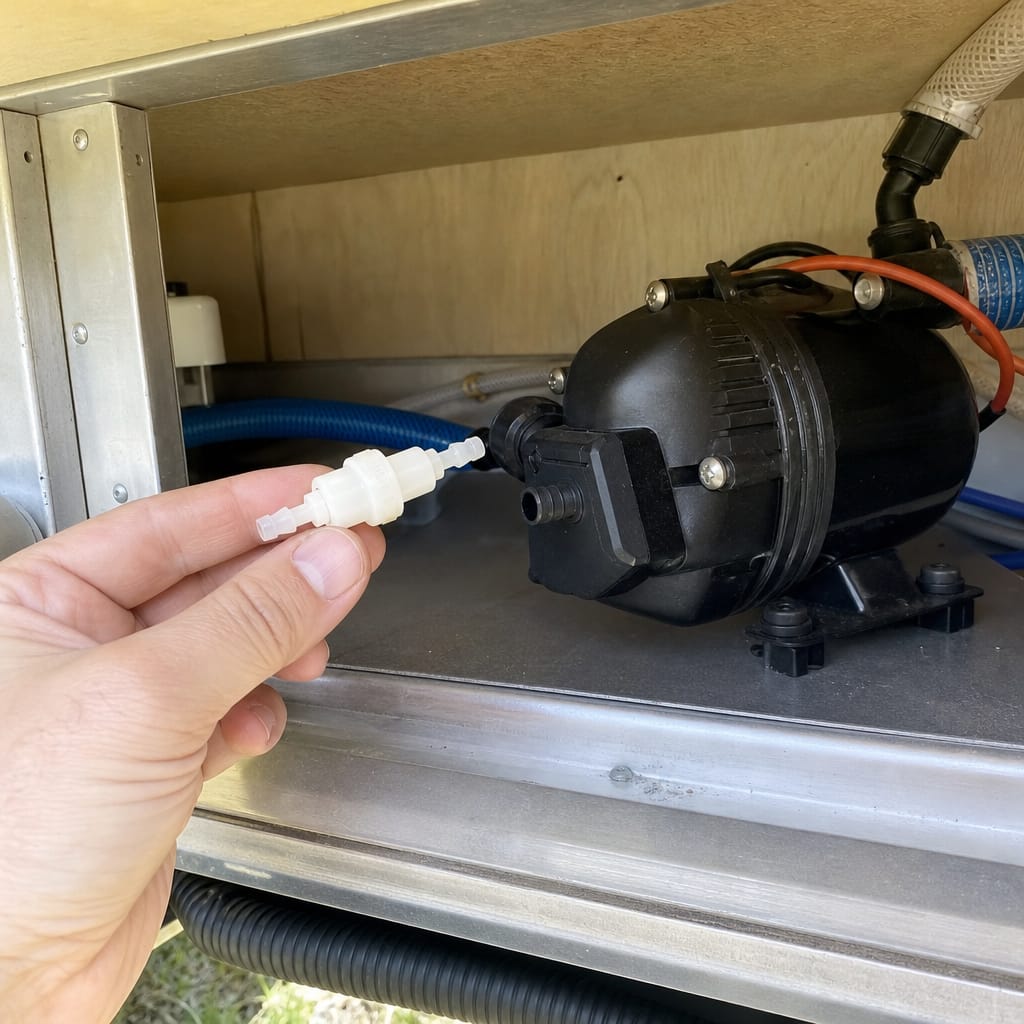
A check valve is a one-way fitting that stops water from flowing backward through the pump when it's off — without it, city-water pressure (or a siphon from the tank) can push water back the wrong direction through the system. It isn't always a part you can order on its own. On some pump families it's built into the pump's internal housing and only available bundled with other components, like a pressure-switch kit; on others it's a standalone inline fitting you can swap by itself. Which case applies to your pump is the real fork in the road for the rest of this article.
Signs Your Check Valve May Be Failing
None of these are proof by themselves — the next section rules out the other usual suspects — but they point most specifically at the check valve.
The pump keeps running with every faucet closed
A check valve that isn't sealing can make the pump cycle or run continuously even with every tap closed, because the system never holds pressure. This symptom has several possible causes beyond the check valve; see our full diagnostic guide for a pump that won't stop cycling if this is your main complaint.
City water backs up into your fresh tank
This is the single clearest symptom that points at the check valve specifically, rather than at the pressure switch or the pump. If you're hooked to city water and see movement or siphoning back toward the fresh tank with the pump off, a failed check valve is the most likely explanation among the ones covered here.
Pressure drops fast after you shut the pump off
Some drop is normal. A fast, obvious drop — pressure that's gone within a few seconds rather than fading gradually — suggests the valve isn't holding.
Air or sputtering at the tap right after the pump cycles
This can also come from a loose fitting or a developing air lock, so treat it as a secondary clue, not a standalone diagnosis.
Confirming It's the Check Valve — Not Something Else
Confirming a bad check valve is a process of elimination, not a single test: rule out the pressure switch, an air lock, and a failing pump first, in that order.
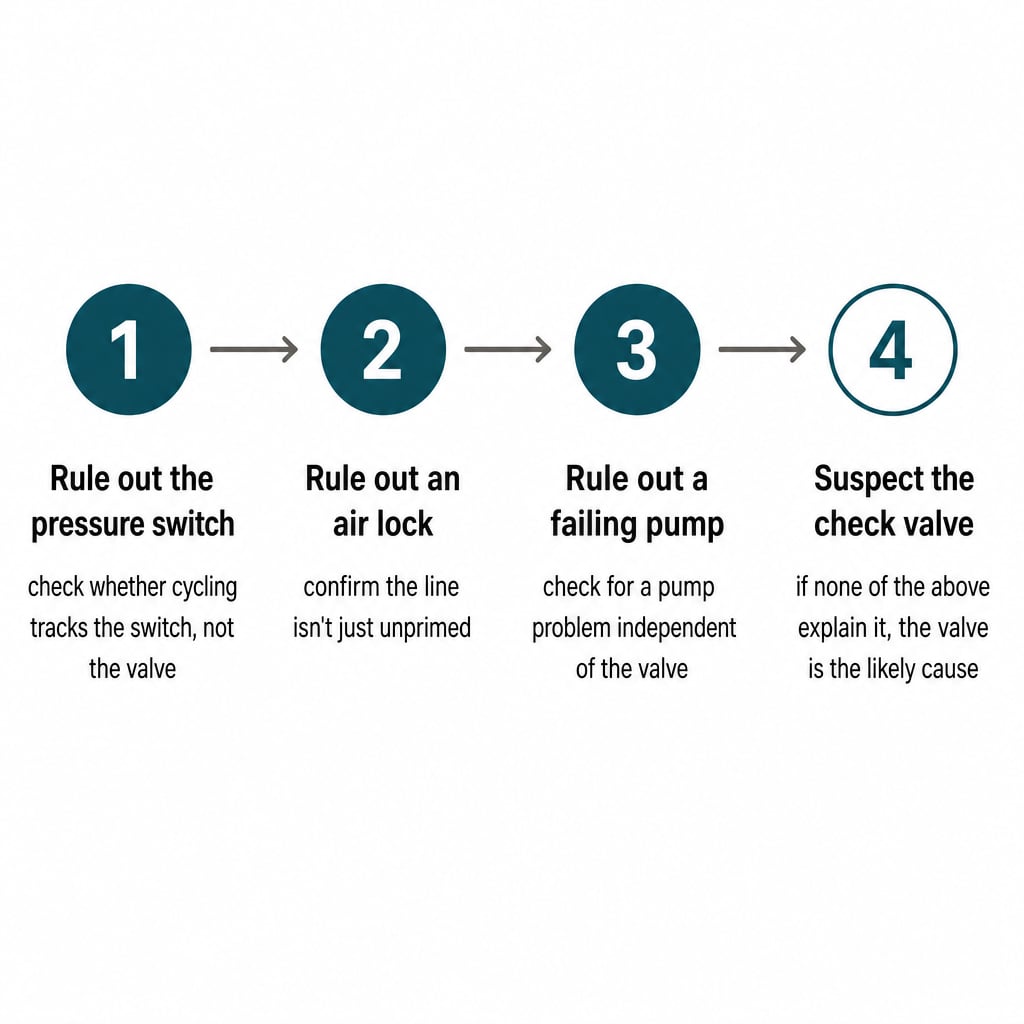
Rule out the pressure switch first
The pressure switch and the check valve cause similar symptoms but are different parts with different failure modes. If your pump short-cycles, see our replacement pressure switch guide before assuming it's the check valve.
Rule out an air lock
A pump that won't build pressure, or that sputters air, can simply be unprimed rather than failing. See how to prime an RV water pump and rule this out before buying any part.
Rule out a pump that's simply failing
A pump nearing the end of its life can produce several of the same symptoms as a bad check valve. Our general RV water pump repair guide and full pump replacement guide cover that path if the pump itself turns out to be the problem.
Where This Job Stops
On several pump families, the check valve is internal to the pump housing — so "replacing the check valve" is really replacing a pump sub-assembly or a switch kit, a bigger job than swapping a standalone inline fitting. This article identifies which case applies to which pump family below and stops there; it doesn't walk through disassembly. Fitting types, torque expectations, and internal layouts differ enough across pump brands that a generic numbered sequence would be wrong for some of them — follow the manufacturer's own instructions for whichever part you end up ordering.
Tools and Products That Help
Which part fits depends on which pump family you have — there isn't one universal check valve for every RV.
Shurflo 2088-family pumps: switch kit bundle. On Shurflo's 2088-series pumps, the check valve isn't sold on its own — it comes bundled into a pressure-switch and upper-housing kit. The listing describes it as fitting "selected" 2088-family pumps, not all of them, so confirm your exact pump model before ordering. No pressure rating is safe to publish here — public sources disagree with each other, and none is confirmed directly by Shurflo or Pentair. See more Shurflo RV water pump options if you're shopping for the pump itself.
No OEM part for your pump? Universal fallback. If your pump brand sells no standalone check valve at all, a generic inline check valve installed downstream of the pump is the documented workaround — a plumbing fitting, not a pump-specific part. No pressure rating is published for it anywhere searched; that's a real gap in the record, not an oversight here. It's sized 1/2-inch MPT by FPT — measure your own fitting's thread size and gender before ordering, since the identical fitting is also sold for RV water heaters.
Flojet Triplex family (3426/3526/3626): no Amazon listing. If your pump is a Flojet Triplex — the same family in our Flojet buying guide — the correct OEM part is the Flojet 20407-034 EPDM check valve kit. It isn't sold on Amazon, so there's no affiliate link to offer; the retailer below is not Amazon, and we don't earn anything from this link.
Flojet 20407-034 EPDM Check Valve Kit at tfpumps.com — a plain link, not an affiliate link; we have no commercial relationship with this retailer.
SEAFLO pumps: no standalone part exists. No standalone check valve is sold for SEAFLO pumps as far as we could find — SEAFLO's internal check valve appears to be a non-serviceable part of the pump itself. If you've confirmed a SEAFLO pump is the problem, the documented fix is replacing the pump; see our full pump replacement guide, which includes a SEAFLO pick.
A buyer warning worth knowing. One part we looked at and did not include, the Shurflo 94-800-03, is a real example of why this matters: public sources conflict on whether it fits the 4008-family or the 4248/4258 family, and no Shurflo/Pentair document resolves it either way. If you see a part number on a forum or retailer page, check it against your pump's own model plate before ordering — don't trust the part number alone.
Before You Order — What to Check on Your Own Pump
- Find the model number on your pump's nameplate, and confirm which family it belongs to — 2088, 4008, Triplex, SEAFLO, or something else.
- If you're going the universal-fitting route, confirm your own fitting's thread size and gender before ordering.
- Don't assume a listing's "selected pumps" or "universal" wording covers your specific model — the listing itself is the source of truth, not the part's general description.
Common Mistakes
Assuming the check valve first. Work through the elimination order above — pressure switch, air lock, pump — before buying a part; see "Confirming It's the Check Valve" above.
Buying a universal check valve without checking thread size. The generic fallback valve above is a 1/2-inch MPT by FPT fitting — order it without measuring your plumbing and it may not thread on.
Trusting a part number found on a forum. Confirm it against your pump's own model plate first — see the Shurflo 94-800-03 warning above.
Forcing a part that doesn't fit, or over-paying for a full pump swap, when neither is necessary. Some pump families (SEAFLO) simply have no standalone check valve — that's a real answer, not a reason to force an incompatible OEM part or jump straight to a full replacement if a downstream universal valve would do.
RV water pump specs at a glance
Every RV demand pump's nameplate lists a flow rate, a shut-off pressure, and a maximum current draw, but no single published source puts those three numbers side by side across the brands actually installed in RVs. This table compiles them from each manufacturer's own product pages (and, for one Flojet model, its published user guide) across a spread of common 12V and 115V demand pumps, from a 1.4 GPM entry-level pump to a 5.0 GPM variable-speed model, so a reader can check their own pump's nameplate numbers against a real published range before assuming a weak or noisy pump is failing.
| Pump family / model | Voltage | Open flow rate | Shut-off / max pressure | Amp draw | Source | Source checked |
|---|---|---|---|---|---|---|
| Shurflo by Pentair Revolution 4008-101-E65 (OEM model 4008-101-A65) | 12 VDC | 3 GPM (11.4 LPM) | 55 PSI (3.7 BAR) | 7.5 A (max) | Pentair Shurflo Revolution 4008 Series By-Pass Pump product page (manufacturer) | 2026-09-20 |
| Shurflo by Pentair Revolution 4008-131-E65 (OEM model 4008-131-A65) | 24 VDC | 3 GPM (11.4 LPM) | 55 PSI (3.7 BAR) | 4 A (max) | Pentair Shurflo Revolution 4008 Series By-Pass Pump product page (manufacturer) | 2026-09-20 |
| Shurflo by Pentair Revolution 4028-171-E65 (OEM model listed as 4008-171-A65) | 115 VAC | 3 GPM (11.4 LPM) | 55 PSI (3.7 BAR) | 1 A (max) | Pentair Shurflo Revolution 4008 Series By-Pass Pump product page (manufacturer) | 2026-09-20 |
| SEAFLO 56A-Series variable-speed pump (model SFDP-050-070-56A) | 12 VDC (also offered in 24 VDC) | 5.0 GPM (18.9 LPM) | 70 PSI (4.8 BAR) | 10.0 A (max) | SEAFLO 56A-Series product page, SEAFLO Direct (manufacturer storefront) | 2026-09-20 |
How these numbers were produced: Every figure is quoted from the manufacturer's own product page, except the Flojet R3426-500 row, whose figures come from Flojet's published user guide (a PDF, since Flojet does not publish that table as a web page). Nothing is derived or converted beyond the unit conversions the manufacturer already prints in brackets (for example GPM to LPM, PSI to BAR). Amp draw is not measured the same way by every manufacturer: most rows report a manufacturer-stated maximum current draw, but the Flojet row instead reports the draw at a specific 10 PSI test point. Each row's amp-draw cell states which basis applies to that row.
- No manufacturer checked for this table publishes a cut-in (pump-restart) pressure. Every source states only a shut-off/max pressure, or, for the Shurflo 2088 family, a 'control pressure.' Cut-in pressure is left out of this table entirely rather than estimated from the shut-off figure.
- Amp draw figures are not directly comparable across brands: most rows report a manufacturer-stated maximum current draw, but the Flojet R3426-500 figure is current draw at a 10 PSI test point specifically, not a maximum. Use this column to size a fuse or wire gauge for the specific pump in that row, not to rank brands against each other by power draw.
- The Shurflo 2088-343-135 row is drawn from Pentair's agricultural/industrial diaphragm-pump listing, not its RV-applications page. The 2088 family is a widely used OEM RV pump, but Pentair's own site files this particular listing under agricultural/industrial rather than RV.
- The Flojet document this table cites is titled a 'Standard 3 GPM RV Water System Pump' guide, but the only model documented inside it, R3426-500, is itself rated 1.4 GPM and 20 PSI, a smaller and lower-pressure pump than the document's own title implies. The figures are reported exactly as published in the document, not adjusted to match its filename.
- These are manufacturer bench-test figures, not a guarantee of real-world performance. Actual flow and pressure at the tap depend on battery voltage and wire run, line restriction, elevation lift, and how many fixtures are open at once. A pump reading well below its own published open-flow figure is a genuine symptom worth investigating; a pump reading below a different model's figure on this table is not, since that other model was never the reader's pump to begin with.
- A blank cell would mean the cited source does not state that figure. No row on this table has one, because every model kept here had a published entry for every column shown.
These are the entries that matter for this guide. The full table, with every row and its source, is in our RV water pump repair triage guide.
FAQ
Can a bad check valve make my RV water pump keep running?
Yes, but it's one of several causes — see the diagnostic guide for a pump that won't stop cycling for the full picture.
Why is city water flowing backward into my fresh tank?
This is the symptom that points most specifically at a failed check valve — a working valve exists specifically to stop that backflow.
Is the check valve a separate part, or is it built into the pump?
Depends on the pump family — see "What the Check Valve Actually Does" above. Check your model family before assuming either way.
What's the difference between a check valve and a pressure switch?
The pressure switch turns the pump on and off based on system pressure; the check valve stops water flowing backward through the pump when it's off. They fail differently but can look similar — see our replacement pressure switch guide to rule the switch out.
Can I just remove a stuck check valve instead of replacing it?
No — removing it defeats the part's entire function, since stopping backflow is what it's there to do. That trades one problem for a different one.
Does every RV water pump have a replaceable check valve?
No — SEAFLO is the documented example; no standalone part is sold for it, so a failed check valve there generally means replacing the pump.
Sources Reviewed
This article draws on Amazon listings and retailer pages for the Shurflo, Valterra, and Flojet parts above, plus manufacturer family pages for Shurflo (Pentair) and Flojet (Xylem) where available. Several pressure-rating and fitment claims in public sources conflicted and are flagged here rather than resolved by picking one; none of the parts has a confirmed manufacturer-direct spec sheet. Forum discussions were reviewed for symptom patterns only, never quoted or cited as fact. All sourcing was checked in October 2026.
Related Guides
- RV water pump repair guide
- RV water pump replacement guide
- RV water pump buying guide
- Diagnosing a pump that keeps running
- Shurflo RV water pump buying guide
- 12V RV water pump roundup