How to Replace an RV Water Pump (Step-by-Step)
Disclosure: This article contains affiliate links. If you buy through these links, we may earn a commission at no extra cost to you. We do not claim hands-on testing unless clearly stated.
No pressure at the tap, a pump that won't stop cycling, or a puddle under the pump bay — and it turns out to be the pump itself, not the tank or a fitting. This guide covers confirming it's actually the pump, matching a replacement to your rig, and what the swap involves well enough to decide whether it's DIY or a shop job. It skips step-by-step disassembly and installation — that's the manufacturer's own instruction sheet — and it doesn't touch propane or AC electrical work, since a 12V DC water pump involves neither.
Is It Actually the Pump?
A pump problem and a plumbing problem look identical at the faucet. Run through this before ordering anything:
- No pressure anywhere in the rig: check the pump's fuse and switch, and confirm the fresh tank isn't empty, before assuming pump failure.
- Pump runs constantly and never shuts off: usually a leak downstream or a check valve that isn't seating, not a failed pump.
- Pump cycles on and off rapidly with every faucet closed: often a leak, a failing check valve, or a loose fitting.
- Pump runs but delivers weak or no flow: a clogged inlet strainer or an airlock can cause this without the pump being at fault.
- Motor noise with no water movement: the pump may be running dry rather than genuinely broken.
For the full picture, see our full RV water pump troubleshooting guide. If you're not sure where the pump physically sits, a labeled diagram of a typical RV water system can help you find it first.
Before You Order a Replacement
Match the voltage and amp draw
Most RV demand pumps run on 12V DC, but 24V and 115V AC variants exist on some rigs, so check your old pump's data plate rather than assuming. Amp draw sets wire gauge and fuse sizing. The manufacturer rates the Shurflo pick below at up to 7.5A at 12V; listed specifications put the Flojet pick's draw in the same range with a 15A fuse recommended. Size the circuit to your replacement's figure if it differs — see the full spec comparison for how these stack up.
Match the mounting footprint and port size
Bolt pattern and thread size vary even within one brand's lineup. Measure your own pump and bracket before ordering — don't assume a same-brand replacement is a drop-in fit. Note the overall dimensions, hole spacing, and both port thread sizes before you buy.
Match or intentionally upgrade flow and pressure
Matching your old pump's GPM and shut-off pressure is the safe default. The manufacturer lists a 3.0 GPM flow rate for the Shurflo and SEAFLO picks below; Shurflo's 55 PSI shut-off is manufacturer-confirmed too, while SEAFLO's listing (not its manufacturer page) states the same 55 PSI. The Flojet pick's shut-off pressure is listed at 50 PSI. Upgrading is fine, but it changes what downstream fixtures can handle — more flow at the pump doesn't help if the plumbing beyond it is the bottleneck. These are baseline figures — real-world flow and pressure vary with supply voltage, plumbing size, and installation. See our RV water pump buying guide for the fuller category view.
What Replacing the Pump Involves
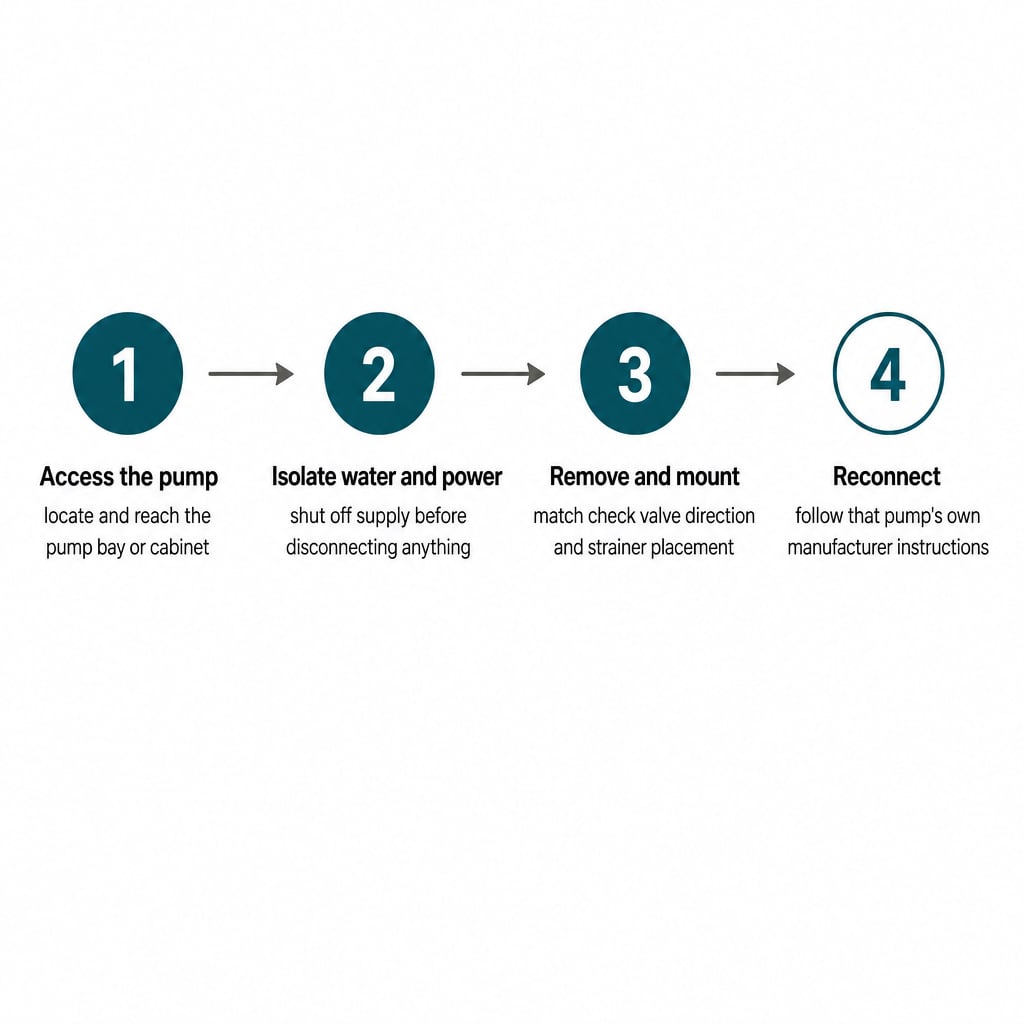
This isn't a step-by-step instruction sheet — fitting type, mounting hardware, and wiring differ enough across pumps that a generic numbered sequence would be wrong for some of them. What follows is the shape of the job in four phases.
Accessing the pump
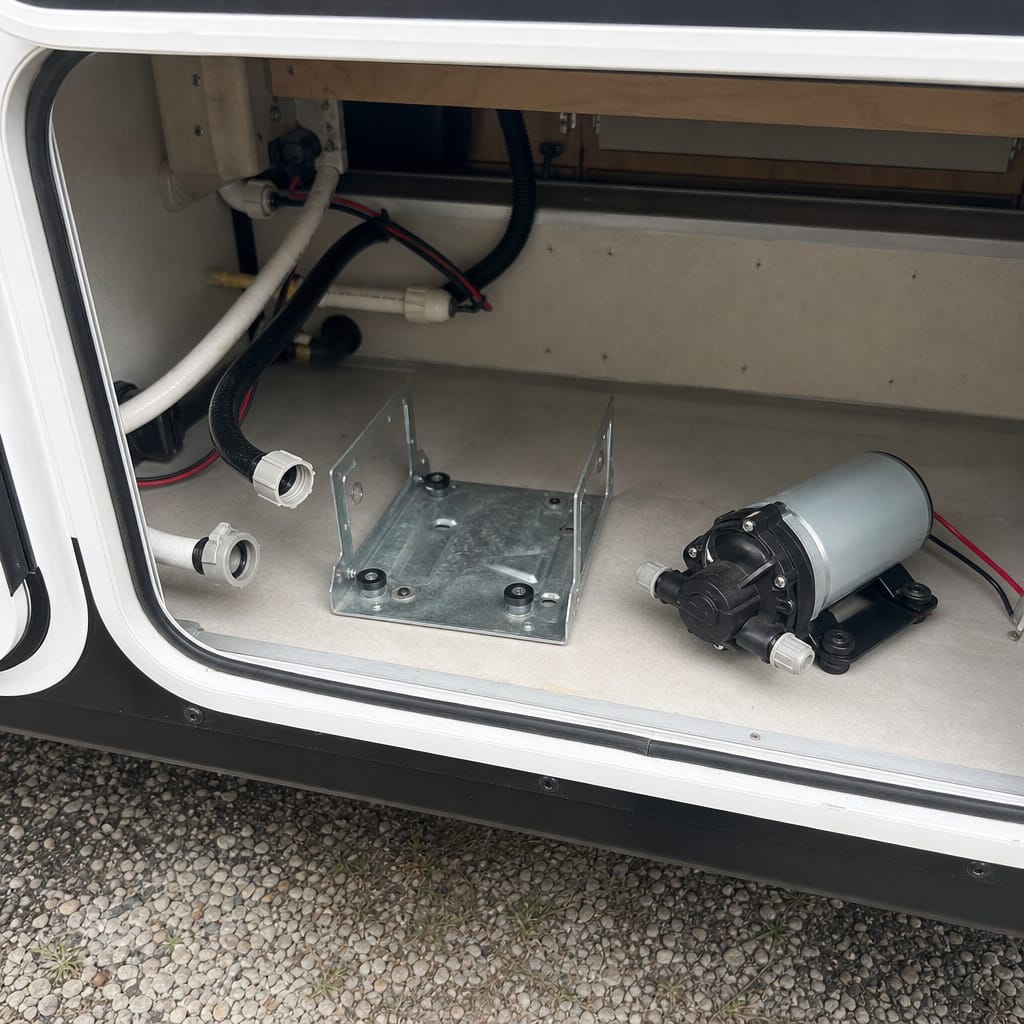
Location varies a lot by rig — some pumps sit behind an easy panel under a dinette or in a wet bay, others behind cabinetry that has to come out first. An inaccessible pump bay is a legitimate reason to hand this one to a shop.
Isolating water and power before disconnecting anything
The fresh water system needs depressurizing and the pump's power disconnected at the source, not just switched off at the panel. Skipping this is how a disconnected line turns into a spray inside the rig.
Removing the old pump and mounting the new one
Beyond unbolting and bolting back in, watch check valve direction and strainer placement — both are easy to get backwards, and a reversed check valve is a recurring cause of a new pump that won't hold pressure. See check valve problems after a pump swap if that happens.
Reconnecting and following the manufacturer's own instructions for that specific pump
Fitting types, torque expectations, and wiring details differ enough across brands that a generic sequence isn't reliable here. Follow the manufacturer's installation instructions for the specific pump you bought, not a walkthrough written for a different model.
Tools and Products That Help
Three picks below cover distinct situations, not one generic "best" pump. For what a replacement typically runs beyond the unit price, see what a replacement pump typically costs. (The reference table further down this page compiles specs for a spread of other pump models; only the Shurflo pick below has a matching row there — use the figures given for each pick here, not that table, for the Flojet and SEAFLO picks.)
Standard replacement: Shurflo Revolution 4008-101-E65 — One of the most widely OEM-installed 12V RV pumps, the straightforward default if you're replacing what's already in your rig. The manufacturer's product page lists a 3.0 GPM flow rate, a 55 PSI shut-off pressure, and a maximum draw of 7.5A, and states the pump tolerates any mounting orientation and can run dry without damage. The same page lists a near-identical sibling code (4008-101-A65) — check the listing carefully. See more Shurflo RV pump options.
Quieter, heavier-duty replacement: Flojet R3526144D — Built around a triplex diaphragm design with a pulsation eliminator, marketed specifically against the noise and short-cycling complaints simpler pumps get. Listed specifications put its shut-off pressure at 50 PSI with a 7.5A draw and a 15A fuse recommendation, and it ships with vibration-dampening mounting feet. See more Flojet RV pump options.
Budget pick with a strong warranty: SEAFLO 42 Series (SFDP1-030-055-42) — The manufacturer's own page lists a 3.0 GPM flow rate, and the Amazon listing states a 4-year warranty. Listed specifications put shut-off pressure at 55 PSI and self-priming lift at up to 6 vertical feet. This pick has the thinnest manufacturer-direct documentation of the three — a reasonable trade if a longer warranty at a lower price matters more to you than a fully manufacturer-confirmed spec sheet.
If your rig came from the factory with a Lippert-brand pump, the Lippert Flow Max 12V (689052) is the direct OEM match — check your old pump's data plate for the Lippert name before assuming you need one of the three picks above.
After You Install It: Priming and Checking for Leaks
A new pump needs priming before it will build pressure — running it dry against a closed system can damage a diaphragm pump. See our guide on how to prime an RV water pump for what that involves.
Once primed, run water at every fixture, including any outdoor shower or ice maker line, and check every fitting you touched for drips, not just the pump itself. A pump that runs constantly or short-cycles right after install almost always points back to a check valve or fitting issue rather than a defective new pump.
Common Mistakes
Ordering by "12V pump" alone. Port size and footprint vary within one brand's lineup — a same-voltage pump can still fail to bolt in. Measure the old pump and bracket first.
Skipping the manufacturer's instruction sheet for a generic walkthrough. Fitting types and wiring details differ enough across brands that a mismatched guide can cause a bad connection.
Not checking check-valve orientation. A reversed check valve is a common cause of a "new pump won't hold pressure" complaint — and it's easy to blame the pump instead. Confirm the flow-direction arrow before final assembly.
Replacing the pump after a freeze without fixing why it cracked. A new pump will crack the same way if the underlying winterizing gap isn't addressed. Review winterizing your RV's water system before the next cold season.
When to Call a Pro Instead
Some situations are worth handing off regardless of your comfort with tools: a pump bay that requires removing cabinetry or paneling to reach, wiring that looks corroded or has been spliced before, or a rig where the pump is integrated into a larger water-system module rather than a standalone unit. None of these make the job hazardous the way propane or shore-power work can be — they just make it bigger than "swap the pump" implies.
RV water pump specs at a glance
Every RV demand pump's nameplate lists a flow rate, a shut-off pressure, and a maximum current draw, but no single published source puts those three numbers side by side across the brands actually installed in RVs. This table compiles them from each manufacturer's own product pages (and, for one Flojet model, its published user guide) across a spread of common 12V and 115V demand pumps, from a 1.4 GPM entry-level pump to a 5.0 GPM variable-speed model, so a reader can check their own pump's nameplate numbers against a real published range before assuming a weak or noisy pump is failing.
| Pump family / model | Voltage | Open flow rate | Shut-off / max pressure | Amp draw | Source | Source checked |
|---|---|---|---|---|---|---|
| Shurflo by Pentair Revolution 4008-101-E65 (OEM model 4008-101-A65) | 12 VDC | 3 GPM (11.4 LPM) | 55 PSI (3.7 BAR) | 7.5 A (max) | Pentair Shurflo Revolution 4008 Series By-Pass Pump product page (manufacturer) | 2026-09-20 |
| Shurflo by Pentair Revolution 4008-131-E65 (OEM model 4008-131-A65) | 24 VDC | 3 GPM (11.4 LPM) | 55 PSI (3.7 BAR) | 4 A (max) | Pentair Shurflo Revolution 4008 Series By-Pass Pump product page (manufacturer) | 2026-09-20 |
| Shurflo by Pentair Revolution 4028-171-E65 (OEM model listed as 4008-171-A65) | 115 VAC | 3 GPM (11.4 LPM) | 55 PSI (3.7 BAR) | 1 A (max) | Pentair Shurflo Revolution 4008 Series By-Pass Pump product page (manufacturer) | 2026-09-20 |
| Flojet (Xylem) R3426-500 automatic water system pump | 12 VDC | 1.4 GPM (5.3 LPM) | 20 PSI (1.4 BAR) (pressure switch max) | 2.0 A at 10 PSI / 0.7 BAR (not a maximum-draw figure) | Flojet R3426-500 RV water system pump user guide (manufacturer, Xylem) | 2026-09-20 |
How these numbers were produced: Every figure is quoted from the manufacturer's own product page, except the Flojet R3426-500 row, whose figures come from Flojet's published user guide (a PDF, since Flojet does not publish that table as a web page). Nothing is derived or converted beyond the unit conversions the manufacturer already prints in brackets (for example GPM to LPM, PSI to BAR). Amp draw is not measured the same way by every manufacturer: most rows report a manufacturer-stated maximum current draw, but the Flojet row instead reports the draw at a specific 10 PSI test point. Each row's amp-draw cell states which basis applies to that row.
- This table doesn't cover two of the three picks recommended above: the Flojet row here is the R3426-500, a smaller and lower-pressure pump than the Flojet R3526144D pick in Tools and Products, and no SEAFLO row is included, so it doesn't reflect the SEAFLO 42 Series (SFDP1-030-055-42) pick either. Only the Shurflo row (4008-101-E65) matches a recommended pick exactly. Use the specs stated in Tools and Products for the Flojet and SEAFLO picks, not this table.
- No manufacturer checked for this table publishes a cut-in (pump-restart) pressure. Every source states only a shut-off/max pressure, or, for the Shurflo 2088 family, a 'control pressure.' Cut-in pressure is left out of this table entirely rather than estimated from the shut-off figure.
- Amp draw figures are not directly comparable across brands: most rows report a manufacturer-stated maximum current draw, but the Flojet R3426-500 figure is current draw at a 10 PSI test point specifically, not a maximum. Use this column to size a fuse or wire gauge for the specific pump in that row, not to rank brands against each other by power draw.
- The Shurflo 2088-343-135 row is drawn from Pentair's agricultural/industrial diaphragm-pump listing, not its RV-applications page. The 2088 family is a widely used OEM RV pump, but Pentair's own site files this particular listing under agricultural/industrial rather than RV.
- The Flojet document this table cites is titled a 'Standard 3 GPM RV Water System Pump' guide, but the only model documented inside it, R3426-500, is itself rated 1.4 GPM and 20 PSI, a smaller and lower-pressure pump than the document's own title implies. The figures are reported exactly as published in the document, not adjusted to match its filename.
- These are manufacturer bench-test figures, not a guarantee of real-world performance. Actual flow and pressure at the tap depend on battery voltage and wire run, line restriction, elevation lift, and how many fixtures are open at once. A pump reading well below its own published open-flow figure is a genuine symptom worth investigating; a pump reading below a different model's figure on this table is not, since that other model was never the reader's pump to begin with.
- A blank cell would mean the cited source does not state that figure. No row on this table has one, because every model kept here had a published entry for every column shown.
These are the entries that matter for this guide. The full table, with every row and its source, is in our RV water pump repair triage guide.
FAQ
How do I know it's the pump and not the tank, an airlock, or a fitting?
Start with the triage list above. If symptoms don't clearly point to the pump, our full troubleshooting guide covers the other possibilities.
Do I need to match my old pump's exact voltage and amp draw — and can I switch brands?
Voltage, yes — 12V, 24V, and 115V AC pumps aren't interchangeable. Amp draw sets wire gauge and fuse sizing; size the circuit to your replacement's figure if it differs. Brand doesn't matter as much as fit: any brand works as long as voltage, footprint, and port size match.
Can I install a higher-flow pump than the one that came with my RV?
Usually. But downstream fixtures and plumbing size the practical ceiling — a higher-GPM pump won't push more water through a line that's already the bottleneck.
How long do RV water pumps usually last?
There's no manufacturer-published lifespan figure to cite here — it depends on usage, water quality, and winterizing history. The closest sourceable proxy is warranty length, and of the three picks above, only the SEAFLO listing states a term (4 years) among the sources checked for this article.
Why does my new pump keep cycling on and off after I installed it?
Almost always a reversed check valve or a slightly leaking fitting, not a defective pump — see Common Mistakes above before assuming you got a bad unit.
Does replacing the pump change how I should winterize?
Not in principle, but a fresh install is a good moment to confirm your bypass valve setup is still connected correctly.
Sources Reviewed
This article draws on manufacturer product pages and data sheets for Shurflo (Pentair), Flojet (Xylem), SEAFLO, and Lippert, corroborated where noted against retailer listings, plus the Amazon listings for each featured pump. Forum and social-media discussions about pump replacement were reviewed for common patterns, not quoted or cited as fact. All figures were checked in September 2026.
Related Guides
- RV water pump buying guide
- What a replacement pump typically costs
- Labeled RV water pump diagram
- Check valve problems and fixes
- 12V RV water pump roundup