How to Sanitize an RV Fresh Water Tank Without Bleach
Published
Disclosure: This article contains affiliate links. If you buy through these links, we may earn a commission at no extra cost to you. We do not claim hands-on testing unless clearly stated.
Searching "sanitize without bleach" surfaces three different kinds of products and a lot of pantry-chemistry advice, and they are not interchangeable — picking the wrong one for your actual goal is how the water still tastes off afterward. This covers the three real bleach-free categories, what each one actually claims to do, sourced dosing where it exists, and which one fits which reader. Not covered here: the bleach method itself, water heater bypass mechanics in detail, or winterizing your RV.
Quick Answer / What You'll Need
"Bleach-free" online usually means one of three things: an EPA-registered detergent-and-sanitizer kit, a single-chemical stabilized-chlorine-dioxide product, or a hydrogen-peroxide product — plus, with a caveat, plain vinegar or citric acid. Only the first three carry a manufacturer sanitizing or disinfecting claim. Vinegar and citric acid are cleaning and descaling methods, covered honestly below, not oversold here as equivalents.
Before You Start
A few checks apply no matter which bleach-free product you pick:
- Bypass the water heater if your rig has a bypass valve. The same wasted-solution logic from the bleach method applies to any treatment chemical — heating or dosing an extra 6–10 gallons for no benefit. See our water heater bypass valve guide if you're unsure whether your rig has one.
- Remove or bypass any inline water filter first. Filter media isn't rated for sanitizing-strength chemistry, regardless of brand. Our RV water filter buying guide compares filter types if you're not sure which one you have.
- Decide your actual priority first. No mixing, no separate extra purchase, lowest cost, or "I just want to use what's already under my sink" — the right answer below depends on which of those matters most to you.
Choosing Your Bleach-Free Method
Which one you actually want depends on what you're optimizing for, not which bottle has the most reassuring label.
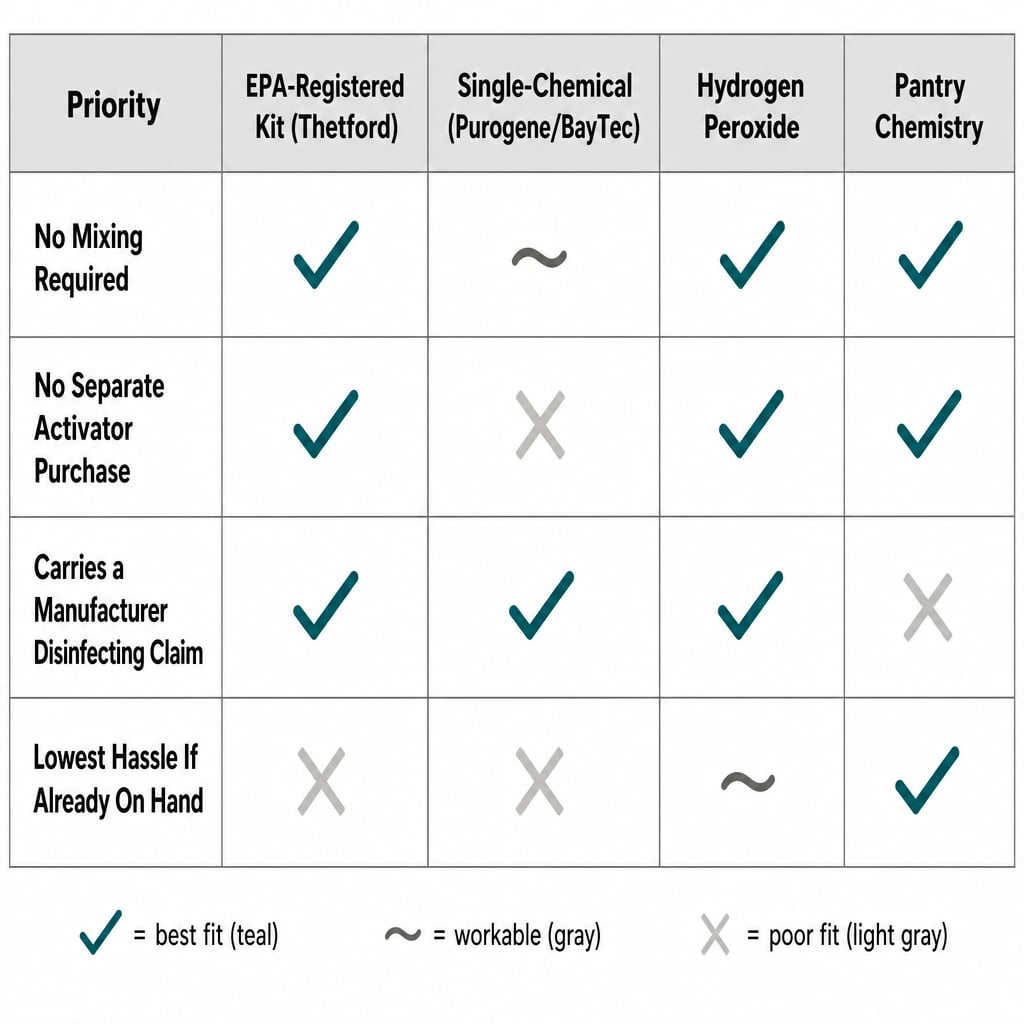
The EPA-registered kit and the hydrogen-peroxide product both avoid mixing — one because its two steps are pre-formulated, the other because it's a single ready-to-use liquid. The single-chemical product sits in between: routine use needs no mixing, but its strongest disinfection protocol means combining the treatment with a separately bought activator. That activator purchase is the one thing keeping it from being the simplest choice on paper. All three registered products carry a manufacturer disinfecting claim; pantry chemistry does not, which is why it's the lowest-hassle option only if cleaning and descaling, not disinfecting, was your actual goal.
EPA-Registered Options Compared
These two differ more than their shared "EPA-registered" label suggests.
Thetford's Fresh Water Tank Sanitizer Detergent and Treatment (36662) ships as a two-bottle kit, and the two steps are sequential and distinct, not interchangeable: a detergent cleaning pass first, then a separate sanitizer pass. Retailer listings for this kit (not Thetford's own site, which didn't yield the exact figures) describe roughly 1 oz per 4 gallons for cleaning and 2 oz per 8 gallons with a minimum 60-second contact time for sanitizing. Treat those ratios as a reseller-sourced starting point, not a manufacturer-confirmed number, and check your own tank size before scaling them.
The Purogene/BayTec 16 oz Drinking Water Treatment and Water System Sanitizer is a different shape of product: one stabilized-chlorine-dioxide chemical, no separate detergent step. BayTec's own product page states routine treatment at 1 oz per 30 gallons, and the stronger full-disinfection protocol at 2 teaspoons per gallon plus a half-teaspoon of activator crystals per ounce. That full-disinfection step needs a separately purchased Citric Acid Activator, not something included in the bottle. Budget for it as a two-item purchase if full disinfection, not just routine maintenance, is the goal.
Hydrogen Peroxide Method
Nature's Freedom RV Hydrogen Peroxide is one of the few hydrogen-peroxide products actually formulated and labeled for RV tanks, rather than a drugstore bottle repurposed for the job, and its own product copy states it sanitizes water lines in addition to deodorizing. It's also NSF listed. What it doesn't state anywhere this session could find is which concentration this specific gallon jug uses — Nature's Freedom sells separate lines at different strengths, and the RV-labeled one doesn't say which. A trustworthy hydrogen-peroxide listing should state both the disinfecting claim and the actual percentage; this one states only the first.
Pantry Chemistry: Vinegar and Citric Acid
Plain white vinegar and citric acid are genuinely useful for an RV tank — just not for this job. Every manufacturer-sourced product copy for vinegar- or citric-acid-based tank products found this session used language like "cleaner," "deodorizer," or descaling claims, never "sanitize" or "disinfect." That's not a knock on either ingredient; it's a different job. Vinegar and citric acid cut mineral scale and odor-causing residue effectively. But if your goal is disinfecting — not just descaling — neither is sourced as doing that, and treating "natural" as a stand-in for "equivalent" is how this method ends in water that's clean of scale but not proven sanitized.
However you treated the tank, judge the result by taste and smell after a full flush, not by how the process felt. If you used Thetford or Purogene/BayTec — both chlorine-based — the chlorine-test-strip method from our bleach-method guide applies directly. Peroxide and pantry-chemistry methods don't have an equivalent at-home strip; a normal taste and smell after flushing is the practical signal you have to go on.
Common Mistakes
Mistake 1: Treating Vinegar or Citric Acid as a Sanitizer
What it looks like: Using a vinegar or citric-acid rinse and assuming the tank is now disinfected.
Why it's a problem: Neither is sourced as a sanitizing or disinfecting agent — they clean and descale.
What to do instead: Use one of the EPA-registered or peroxide options above if disinfecting, not just descaling, is the goal.
Mistake 2: Buying the Purogene/BayTec Bottle Expecting Full Disinfection
What it looks like: Dosing the 16 oz bottle alone at the stronger ratio without the activator.
Why it's a problem: Full disinfection strength requires a separately purchased Citric Acid Activator Crystals product.
What to do instead: Buy both if you want the stronger protocol; the bottle alone covers routine treatment.
Mistake 3: Assuming a Hydrogen Peroxide Product Matches a Drugstore Bottle
What it looks like: Dosing an RV-labeled peroxide product like the generic 3% bottle from a pharmacy.
Why it's a problem: Concentrations vary by product line, and this SKU's isn't published.
What to do instead: Follow the product's own label instructions rather than a generic peroxide ratio.
Mistake 4: Leaving an Inline Filter Installed
What it looks like: Running any of these treatments with a drinking or refrigerator filter still in place.
Why it's a problem: Filter media isn't rated for sanitizing-strength chemistry.
What to do instead: Remove or bypass it first — see our inline RV water filter roundup.
Who Should Still Just Use Bleach
Readers who want the lowest-cost, most widely available, single-step option and don't mind handling bleach are better served by the bleach method instead. If your owner's manual advises against a particular chemical for your tank material, follow the manual — the more conservative default whenever the two disagree.
Tools and Products That Help
- EPA-registered kit — Thetford 36662, two-part detergent-and-sanitizer treatment
- Single-chemical option — Purogene/BayTec 16 oz, no separate detergent step, activator sold separately for full disinfection
- Hydrogen peroxide — Nature's Freedom RV Hydrogen Peroxide, 1 gallon, NSF listed
- If you'd rather go the bleach route instead, the bleach method covers its own inline sanitizing device and chlorine test strips.
RV water filter specs at a glance
RV water filter listings mix flow rate, micron rating, rated capacity and certification claims inconsistently, and rarely say which of those numbers actually comes from the manufacturer versus a retailer's own copy. This table puts seven products spanning the four common RV filter types side by side, with one source per figure and a blank left wherever the cited source does not publish that number.
| Product | Product type | Micron rating | Manufacturer-stated flow rate | Rated capacity | NSF/ANSI standard cited | Dimensions / connection | Source | Source checked |
|---|---|---|---|---|---|---|---|---|
| Camco TastePURE RV Water Filter with Flexible Hose Protector (40043) | Single-stage inline exterior filter (standard/budget tier) | 20 micron (sediment) | "lasts an average of 3 months" (not a gallon figure) | NSF/ANSI 42, NSF/ANSI 53; CSA lead-free content certified to NSF/ANSI 372 | 2.56 in x 3.88 in x 12.19 in; standard garden hose female coupling, pre-tank filtering | Panther RV Products, Camco TastePURE 40043 listing (retailer) | 2026-10-25 | |
| FRIZZLIFE MV99 RV Inline Water Filter | Single-stage inline exterior filter (high-flow / fine-filtration tier) | 0.5 micron | 1.4 GPM @ 60 psi | 5,000 gal (chlorine reduction); 1,000 gal (lead reduction) | NSF/ANSI 42 & 53 | 5 in L x 5 in W x 15 in H; 3/4-inch garden hose, lead-free brass fittings | Frizzlife MV99 product page (manufacturer) | 2026-10-25 |
| RV Water Filter Store Enhanced Anti-Scale Water Filter System | Two-stage sediment + carbon canister system | 1 micron (stage 1, sediment); 0.5 micron (stage 2, carbon block) | 3-4 GPM @ 60 psi | Dual 10 in x 2.5 in canisters; hose fittings, max 65 PSI | RV Water Filter Store, Enhanced RV Water Filtration System + Anti-Scale product page (manufacturer) | 2026-10-25 | ||
| Camco TastePURE XL RV Water Filter with Flexible Hose Protector (40019) | Single-stage inline exterior filter (high-capacity tier, same line as 40043) | 20 micron (sediment) | "lasts an average of 3 months" per this listing (other retail summaries claim 6 months; not confirmed on any directly-fetched page) | NSF/ANSI 42, NSF/ANSI 53; CSA lead-free content certified to NSF/ANSI 372 | 3.31 in x 4.5 in x 15.25 in | Panther RV Products, Camco TastePURE XL 40019 listing (retailer) | 2026-10-25 |
How these numbers were produced: Every figure is quoted from the cited source and never derived or estimated. Where a manufacturer's own product page did not publish a figure, a retailer or distributor page is used instead and named as such in that row's source; where neither published a figure, the cell is left blank. 'Rated capacity' is reported in whichever unit the source actually states — gallons for some products, months of expected cartridge life for others — these are not interchangeable and are not converted between each other.
- A blank cell means the cited source does not publish that figure. No cell on this table is filled with a figure estimated from a similar product or a different SKU in the same line.
- Flow rate figures are not necessarily measured under the same test pressure across rows. Some manufacturers publish a flow rate at a stated PSI (for example '1.4 GPM @ 60 psi'); others publish a bare GPM figure with no test pressure noted. Comparing two flow-rate figures across brands assumes comparable test conditions that not every source states.
- Camco TastePURE 40043's widely repeated 2.5 GPM flow-rate figure could not be confirmed here. Camco's own product page (camcooutdoors.com) does not publish a flow-rate figure for this model, and the one retailer page found stating 2.5 GPM returned an access error on every direct fetch attempt. The flow-rate cell for this row is left blank rather than repeating an unconfirmed number.
- Clearsource Premier's own product page describes reducing bacteria (including Legionella and E. coli) and cysts (including giardia) without citing any NSF/ANSI standard number, and without any other mention of NSF anywhere on the page. This is the broadest health-adjacent claim of any product in this set and the least standard-specific.
- Culligan RV-EZ-3 has no manufacturer (culligan.com) page; the figures here come from a distributor page (freshwatersystems.com), which also marked the product discontinued at the time it was checked. Its flow rate is not published on any source found for this table.
- RV Water Filter Store's Enhanced Anti-Scale system publishes no NSF/ANSI certification and no rated capacity in gallons on its own product page, despite publishing flow rate and micron ratings clearly.
- Frizzlife FZ-2's stage-by-stage micron ratings and a gallon-based capacity figure are repeated across several retail summaries but could not be confirmed on Frizzlife's own FZ-2 product page, which states only a 6-12 month lifespan and housing compatibility. Those unconfirmed figures are left blank.
The full table, with every row and its source, is in our RV water filter buying guide, which is the canonical home for this dataset.
FAQ
What can I use instead of bleach to sanitize my RV fresh water tank?
An EPA-registered kit, a single-chemical product, or hydrogen peroxide — see "Choosing Your Bleach-Free Method" above.
Is hydrogen peroxide safe to sanitize an RV water tank?
Nature's Freedom's RV-labeled product is NSF listed and states a sanitizing claim, but its concentration isn't published — see "Hydrogen Peroxide Method."
Can I sanitize my RV's water tank with just vinegar or citric acid?
They clean and descale effectively, but no manufacturer-sourced copy calls either one a sanitizer or disinfectant — see "Pantry Chemistry."
Do bleach-free sanitizers still need the water heater bypassed?
Yes — the same wasted-solution logic applies to any tank chemical. See "Before You Start."
How long does a bleach-free sanitizer need to sit in the tank?
Thetford's sanitizing step calls for a 60-second minimum per retailer listings; Purogene/BayTec's full-disinfection dose has its own ratio — see "EPA-Registered Options Compared."
Which bleach-free method is the least hassle?
Depends on your priority — see the decision matrix above.
Do I need to remove my inline water filter before using a bleach-free sanitizer?
Yes, regardless of product — see "Before You Start" and Mistake 4.
Sources Reviewed
For the EPA-registered kit, we reviewed retailer listings (Fisheries Supply, Hanna RV, RV Upgrade Store) for Thetford 36662's dosing figures — Thetford's own site did not yield the specific ratios this session. For the single-chemical option, we reviewed BayTec's own product page (bayteccontainers.com/purogene-water-treatment.html) for dosing figures; a direct fetch of Bio-Cide International's own site did not succeed this session. For the hydrogen-peroxide product, we reviewed Nature's Freedom's own product page, which states its sanitizing claim and NSF listing but not its concentration. For vinegar and citric acid, we reviewed manufacturer copy for several branded tank-cleaning products, none of which used sanitizing or disinfecting language.
Related Guides
- How to sanitize an RV fresh water tank (the bleach method)
- RV water filter buying guide
- Inline RV water filter roundup
- RV water heater bypass valves
- How to winterize an RV
- How to winterize an RV water heater