How to Choose an RV Water Filter
Disclosure: This article contains affiliate links. If you buy through these links, we may earn a commission at no extra cost to you. We do not claim hands-on testing unless clearly stated.
You've decided you need an RV water filter. Then the listings stop lining up — one retailer's flow-rate number doesn't match another's for the same model, "certified" appears with no standard number attached, and it's not clear whether you need a hose-end filter, a mounted canister, or something under the sink.
This guide covers four product types — single-stage inline, two-stage canister, whole-RV multi-canister, and under-sink point-of-use — the specs worth checking on any listing, and which type matches how you use your rig. It doesn't cover step-by-step installation (see our RV winterizing guide for that level of detail) or drinking-water safety guarantees: filtration reduces the specific contaminants a manufacturer's own certification names, not a substitute for knowing your source water is safe. (Filtering and sanitizing your fresh water tank are separate jobs, too.)
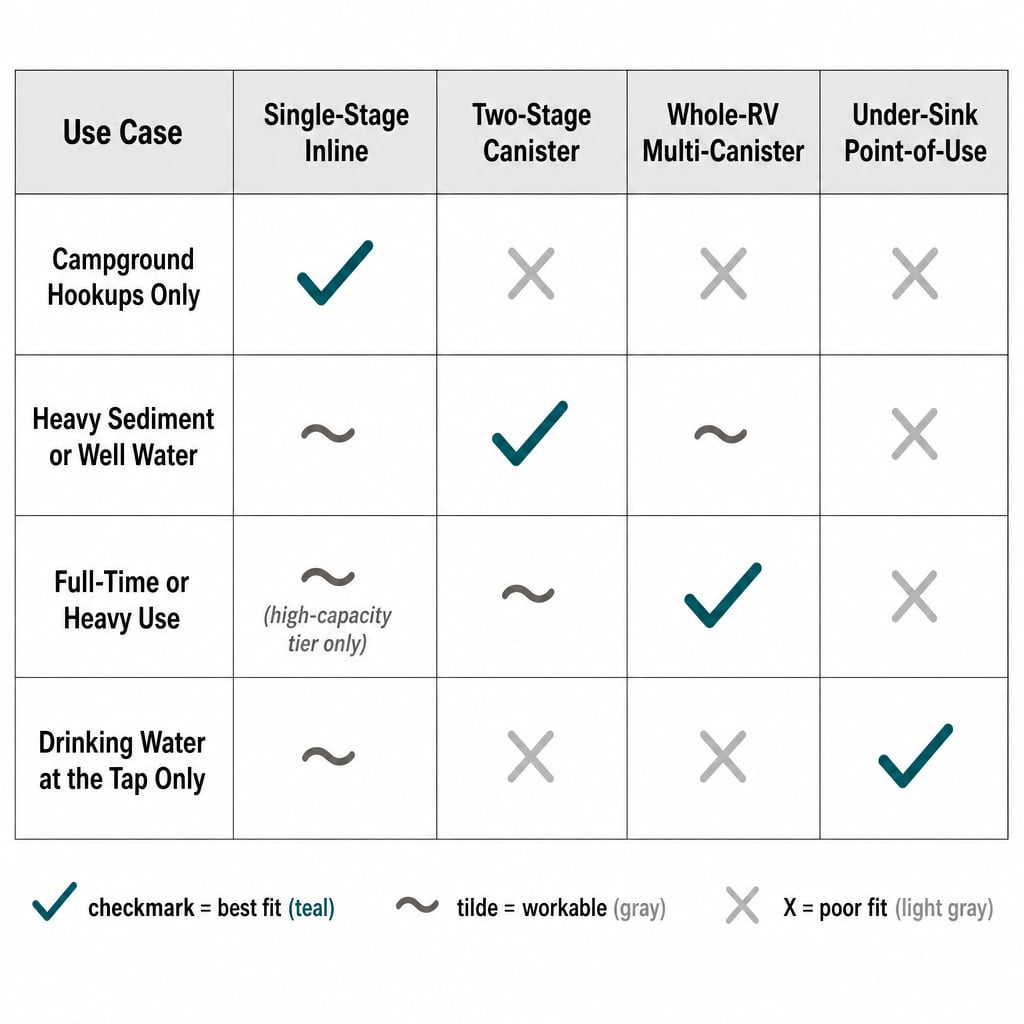
Quick Recommendation by Use Case
| Use case | Best product type | Why |
|---|---|---|
| Weekend or occasional use, campground hookups only | Single-stage inline (standard tier) | Lowest setup effort, no mounting space needed |
| Full-time use, don't want to swap cartridges every trip | Single-stage inline (high-capacity tier) | Longer manufacturer-rated cartridge life, same format |
| Slow fill or taste/odor with a standard filter | High-flow, fine-filtration inline | Finer micron rating with a documented flow rate, not a guess |
| Sediment or scale buildup at campgrounds or wells | Two-stage sediment + carbon canister | Dedicated sediment stage ahead of the carbon stage |
| Full-time/heavy use, want the broadest reduction rig-wide | Whole-RV multi-canister system | Highest rated capacity and flow, mounted at the inlet |
| Filtering only what you drink and cook with | Interior/under-sink point-of-use filter | Filters at the tap, not the whole system |
| Already own a housing, just replacing the cartridge | Replacement cartridge matched to your housing | Must match the housing — it's an accessory, not a system |
RV Water Filter Specs at a Glance
Flow rate, micron rating, rated capacity, and NSF/ANSI certification get stated inconsistently across retailers, and rarely with a note on which number actually came from the manufacturer. The table compiles those figures from each product's own manufacturer page where one exists, names the source when it doesn't, and leaves a cell blank rather than repeating an unconfirmed number.
Key Factors to Consider
Filtration stages and micron rating
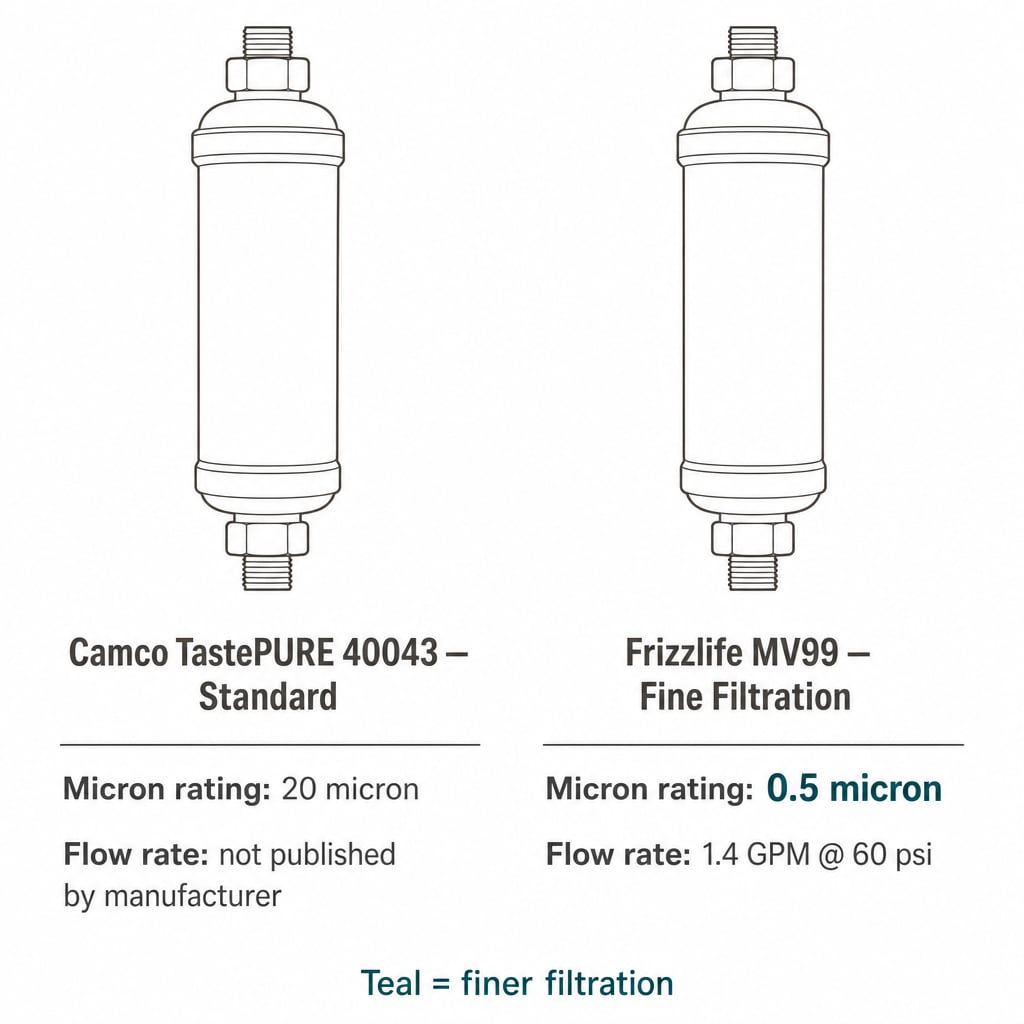
A single-stage filter runs sediment and carbon media in one housing; a two-stage canister runs a dedicated sediment stage ahead of a separate carbon stage; whole-RV systems add more. A lower micron number means finer filtration — the RV Water Filter Store Enhanced Anti-Scale system's carbon stage is rated to 0.5 micron, versus 20 micron for a standard Camco TastePURE cartridge. Neither is "wrong"; they're built for different jobs.
Flow rate vs. filtration fineness
This is a genuine trade-off, not a marketing line: finer filtration media generally restricts flow more than coarser media. The FRIZZLIFE MV99 states a manufacturer flow rate of 1.4 GPM at 60 psi with 0.5-micron filtration. Camco doesn't publish any flow-rate figure for the TastePURE 40043 — a 2.5 GPM number circulates on retailer pages, but the one page stating it returned an access error on direct check. The honest comparison is "Frizzlife documents 1.4 GPM at a fine rating" against "Camco doesn't publish a flow number at all," not "Camco is faster." Don't compare flow-rate numbers across brands unless both are manufacturer-stated at a comparable test pressure.
NSF/ANSI standard the filter is rated to
"Certified" alone is a weak claim. NSF/ANSI 42 covers aesthetic effects (taste, odor, chlorine); NSF/ANSI 53 covers health-related contaminant reduction. A listing that names the specific standard tells you more than one that just says "NSF certified" — Culligan's RV-EZ-3 listing, for example, states "NSF Certified" without naming which standard.
Rated capacity and cartridge life
Capacity shows up in different units across listings — some manufacturers state gallons (Frizzlife's MV99: 5,000 for chlorine reduction, 1,000 for lead), others state months of cartridge life (Camco's TastePURE line: "an average of 3 months"). These aren't interchangeable and actual life depends on your usage and source water.
Installation location, footprint, and connection type
An inline filter connects at the hose — no dedicated mounting space needed. A canister mounts near the inlet and needs clearance to swap cartridges; the Clearsource Premier whole-RV system, for example, measures 15 in W x 15.25 in H x 7.5 in D and weighs 24 lb per its manufacturer spec sheet. An under-sink filter installs in the cabinet below the tap. Check clearance before buying, not after.
Usage pattern and total cost of ownership
A weekend camper on campground hookups has different needs than a full-time boondocker — the jump from a standard cartridge tier to a high-capacity one, or from an inline filter to a whole-RV system, usually tracks how often you're on the road. Compare manufacturer-stated cartridge life across options, not just sticker cost: a cartridge rated for 3 months means more frequent replacement than one rated for 5,000 gallons of moderate use, regardless of unit price.
Product Types Explained
Single-stage inline exterior filter
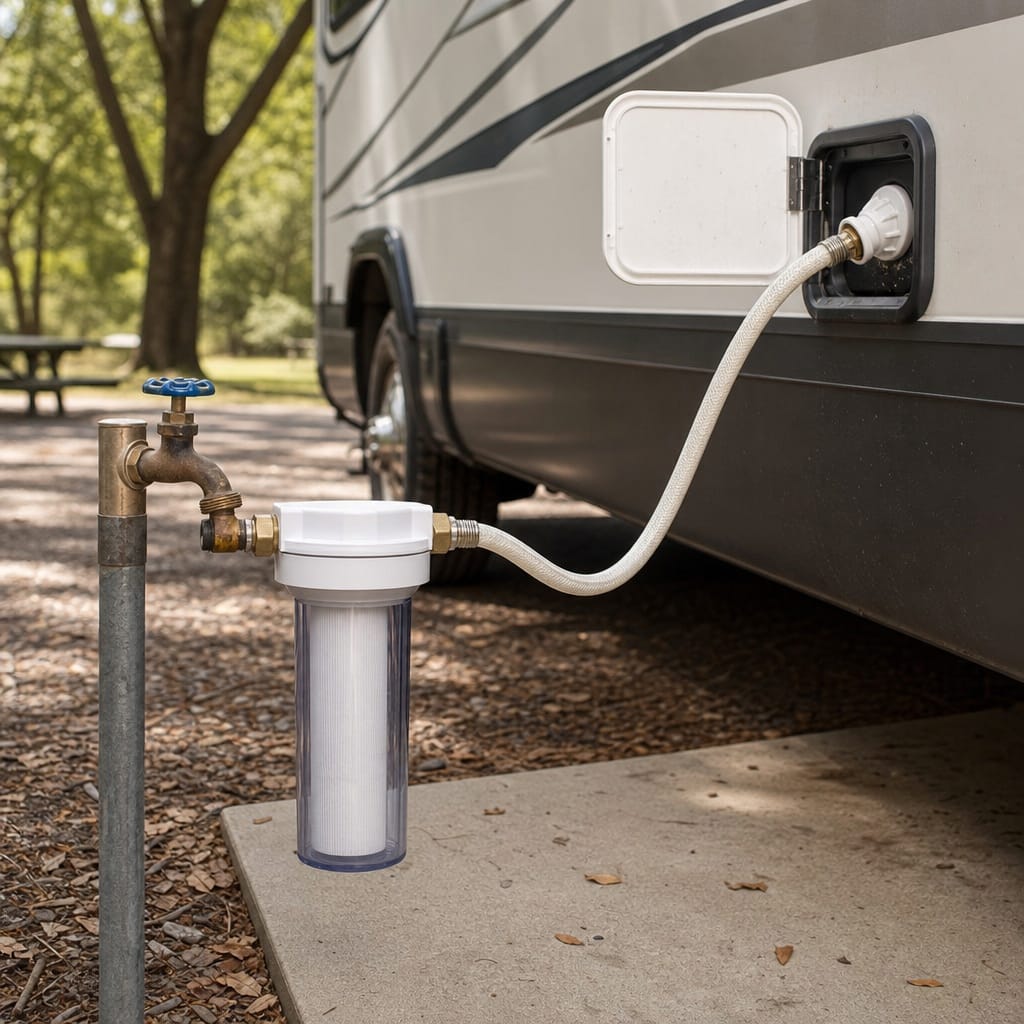
A hose-end filter connected between the campground spigot and your RV's fresh-water inlet. This is the simplest format in the category — no mounting bracket, no cabinet space, just a housing in the hose line.
Best for: casual through full-time use, depending on cartridge tier.
Limitations: single filtration stage — not built for heavy sediment or scale.
What to look for: micron rating, manufacturer-stated flow rate (if published), rated capacity.
For most readers, Camco TastePURE 40043 is the most established name in the category — Panther RV Products' listing (corroborated by a second retailer) states NSF/ANSI 42 and 53 certification and CSA lead-free content for the 40043, though Camco's own product page doesn't publish a certification number, a flow-rate figure, a micron rating, or a capacity figure of any kind (see the specs table above for why). If a standard filter leaves you with slow fills or a lingering taste, the FRIZZLIFE MV99 steps up to 0.5-micron filtration with a manufacturer-documented 1.4 GPM at 60 psi — read that as finer filtration with adequately documented flow, not "the highest-flow option."
A higher-capacity cartridge variant, the Camco TastePURE XL, exists in the same line for readers who don't want to swap filters every trip. See our full roundup of Camco TastePURE filters or our inline RV water filter roundup for the complete lineup.
Two-stage sediment + carbon canister system
A mounted canister housing that runs a dedicated sediment stage ahead of a separate carbon stage — more filtration depth than an inline filter, at the cost of mounting space.
Best for: campgrounds or wells with visible sediment or scale.
Limitations: needs mounting clearance; more parts than an inline housing.
What to look for: whether an anti-scale stage is documented, and whether the brand has more than one product tier (a sign of a more established line).
The RV Water Filter Store Enhanced Anti-Scale system covers this use case with a 1-micron sediment stage ahead of a 0.5-micron carbon block that adds a food-grade anti-scale phosphate stage, at a manufacturer-stated 3–4 GPM. It's part of a documented multi-tier line (Essential/Enhanced/Elite tiers), though it's a smaller, less-established brand than Camco or Culligan — worth checking current availability before you commit. Its own page doesn't state an NSF/ANSI certification or a rated capacity in gallons, despite stating flow rate and micron ratings clearly.
See our full RV water filter line roundup for more two-stage options.
Whole-RV high-capacity multi-canister system
A multi-canister setup installed at the fresh-water inlet, filtering everything entering the rig — not just one tap.
Best for: full-time or heavy-use RVers wanting reduction across the whole system.
Limitations: the largest footprint and highest capacity in this guide — confirm clearance first.
What to look for: micron ratings per stage, flow rate, and whether a contaminant-reduction claim cites an actual NSF/ANSI standard.
The Clearsource Premier RV Water Filter System leads this category on documentation — dimensions, weight, and a 6–6.5 GPM flow rate all come from the manufacturer's own page. The two-stage design pairs a coconut-shell carbon block with a hospital-grade 0.2-micron absolute-rated second stage — a finer, "absolute" rating than the "nominal" 0.5-micron rating some competing systems use, per the manufacturer's own comparison language.
Interior / under-sink point-of-use filter
Installs in the cabinet under your kitchen sink and filters water only at that tap — it doesn't touch shower or tank water.
Best for: readers who want better-tasting drinking water without touching the whole system.
Limitations: doesn't affect water anywhere else in the rig; no manufacturer page was found for this guide's representative pick.
What to look for: since this pick is retailer-sourced only, verify capacity and flow rate on the listing you're actually buying from.
The Culligan RV-EZ-3 is the only under-sink candidate found for this guide. Its listed 500-gallon capacity and "NSF Certified" claim (no standard number given) come from a distributor page, not culligan.com — no manufacturer page could be located, and no flow-rate figure is published anywhere. It's the weakest-sourced pick here; verify current specs directly before buying.
When to Choose Each Type
Choose inline if your setup is mostly campground hookups and you want the simplest install. Choose a two-stage canister if you're seeing visible sediment or scale. Choose whole-RV if you're full-time or heavy-use and want reduction across every tap, not just drinking water. Choose under-sink if all you care about is water you drink and cook with.
These aren't mutually exclusive — a full-timer might run a whole-RV system generally and add an under-sink filter specifically for drinking water.
Measurement Checklist
Before buying, check:
- Hose thread size at your fresh-water inlet — standard garden-hose thread (GHT) on nearly all RVs, but confirm on yours
- Clearance where a canister or whole-RV housing would mount — height, depth, and room to swap cartridges
- Under-sink cabinet space for a point-of-use filter — housing height plus room to change the cartridge
- Distance from your inlet to where a whole-RV system's canisters would sit, if not mounting at the inlet
- The exact model of your current housing before buying a replacement cartridge — not universal
Mistakes to Avoid
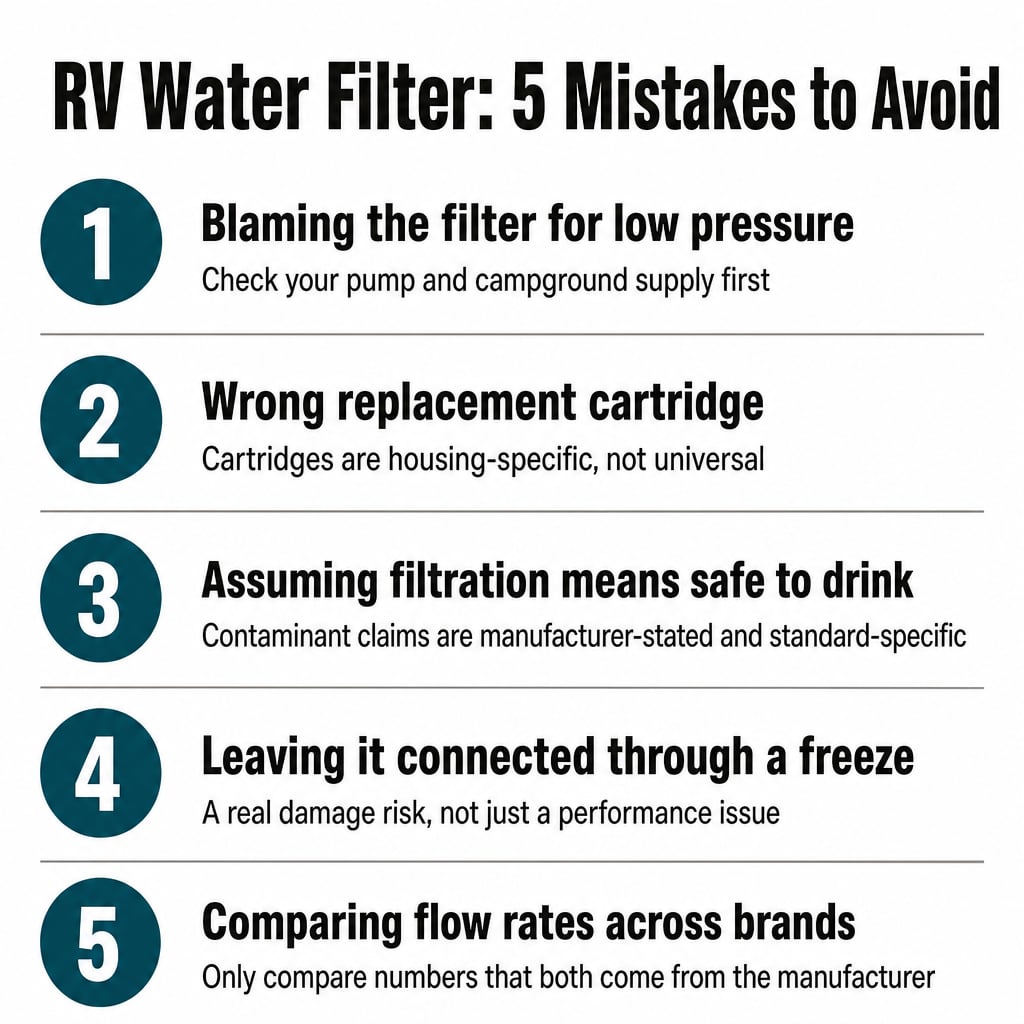
Blaming the filter for low water pressure. Rule out your RV's own water pump and the campground's supply pressure first — see our guide to diagnosing and repairing an RV water pump if flow is weak throughout the rig, not just after a filter swap.
Buying a replacement cartridge that doesn't match your housing. Cartridges are housing-specific — the Frizzlife FZ-2, for instance, only fits the MV99/MP99/MK99/MS99 family. Check your exact model before ordering.
Assuming a contaminant-reduction claim means the water is safe to drink from any source. Treat pathogen claims as manufacturer-stated, not a guarantee — check the product's own page for a named NSF/ANSI standard before assuming any broad "reduces bacteria" language covers your situation.
Leaving the filter connected and full of water through a freeze. A real damage risk to the housing, not just a performance issue — the winterizing guide linked in the intro covers the full procedure.
Comparing flow-rate numbers across brands without checking the source. The Camco-vs-Frizzlife comparison above is the clearest example here: one number is manufacturer-stated, the other isn't published at all. A retailer summary isn't the same evidence as the product's own page.
Safety / Installation Notes
This guide describes what installing or connecting each filter type generally involves — a hose-end filter in the hose line, a canister mounted with brackets near the inlet, an under-sink filter in the cabinet below the tap — not step-by-step instructions. That's not a substitute for the instructions that ship with your specific model.
RV water filter specs at a glance
RV water filter listings mix flow rate, micron rating, rated capacity and certification claims inconsistently, and rarely say which of those numbers actually comes from the manufacturer versus a retailer's own copy. This table puts seven products spanning the four common RV filter types side by side, with one source per figure and a blank left wherever the cited source does not publish that number.
| Product | Product type | Micron rating | Manufacturer-stated flow rate | Rated capacity | NSF/ANSI standard cited | Dimensions / connection | Source | Source checked |
|---|---|---|---|---|---|---|---|---|
| Camco TastePURE RV Water Filter with Flexible Hose Protector (40043) | Single-stage inline exterior filter (standard/budget tier) | 20 micron (sediment) | "lasts an average of 3 months" (not a gallon figure) | NSF/ANSI 42, NSF/ANSI 53; CSA lead-free content certified to NSF/ANSI 372 | 2.56 in x 3.88 in x 12.19 in; standard garden hose female coupling, pre-tank filtering | Panther RV Products, Camco TastePURE 40043 listing (retailer) | 2026-09-20 | |
| FRIZZLIFE MV99 RV Inline Water Filter | Single-stage inline exterior filter (high-flow / fine-filtration tier) | 0.5 micron | 1.4 GPM @ 60 psi | 5,000 gal (chlorine reduction); 1,000 gal (lead reduction) | NSF/ANSI 42 & 53 | 5 in L x 5 in W x 15 in H; 3/4-inch garden hose, lead-free brass fittings | Frizzlife MV99 product page (manufacturer) | 2026-09-20 |
| RV Water Filter Store Enhanced Anti-Scale Water Filter System | Two-stage sediment + carbon canister system | 1 micron (stage 1, sediment); 0.5 micron (stage 2, carbon block) | 3-4 GPM @ 60 psi | Dual 10 in x 2.5 in canisters; hose fittings, max 65 PSI | RV Water Filter Store, Enhanced RV Water Filtration System + Anti-Scale product page (manufacturer) | 2026-09-20 | ||
| Clearsource Premier™ RV Water Filter System | Whole-RV high-capacity multi-canister system | 0.2 micron, absolute rating (stage 2); stage 1 is a coconut shell carbon block filter, no micron figure stated for it | 6-6.5 GPM | 15 in W x 15.25 in H x 7.5 in D; 24 lb; connection type not stated | Clearsource Premier RV Water Filter System product page (manufacturer) | 2026-09-20 | ||
| Culligan RV-EZ-3 EZ-Change RV Drinking Water Filtration System | Interior / under-sink point-of-use filter | 0.5 micron (nominal) | 500 gal | "NSF Certified" (no specific standard number published) | Min. 30 PSI / max. 100 PSI; twist-on/twist-off cartridge, quick-connect fittings with double water shut-off | Fresh Water Systems, Culligan RV-EZ-3 RV & Marine Water Filter System listing (distributor) | 2026-09-20 | |
| Camco TastePURE XL RV Water Filter with Flexible Hose Protector (40019) | Single-stage inline exterior filter (high-capacity tier, same line as 40043) | 20 micron (sediment) | "lasts an average of 3 months" per this listing (other retail summaries claim 6 months; not confirmed on any directly-fetched page) | NSF/ANSI 42, NSF/ANSI 53; CSA lead-free content certified to NSF/ANSI 372 | 3.31 in x 4.5 in x 15.25 in | Panther RV Products, Camco TastePURE XL 40019 listing (retailer) | 2026-09-20 | |
| Frizzlife FZ-2 Replacement Filter Cartridge | Replacement filter cartridge (accessory, not a standalone system) — fits the MV99/MP99/MK99/MS99 housing family | Quick-change cartridge (manufacturer's own term; specific mechanism not otherwise described) | Frizzlife FZ-2 product page (manufacturer) | 2026-09-20 |
How these numbers were produced: Every figure is quoted from the cited source and never derived or estimated. Where a manufacturer's own product page did not publish a figure, a retailer or distributor page is used instead and named as such in that row's source; where neither published a figure, the cell is left blank. 'Rated capacity' is reported in whichever unit the source actually states — gallons for some products, months of expected cartridge life for others — these are not interchangeable and are not converted between each other.
- A blank cell means the cited source does not publish that figure. No cell on this table is filled with a figure estimated from a similar product or a different SKU in the same line.
- Flow rate figures are not necessarily measured under the same test pressure across rows. Some manufacturers publish a flow rate at a stated PSI (for example '1.4 GPM @ 60 psi'); others publish a bare GPM figure with no test pressure noted. Comparing two flow-rate figures across brands assumes comparable test conditions that not every source states.
- Camco TastePURE 40043's widely repeated 2.5 GPM flow-rate figure could not be confirmed here. Camco's own product page (camcooutdoors.com) does not publish a flow-rate figure for this model, and the one retailer page found stating 2.5 GPM returned an access error on every direct fetch attempt. The flow-rate cell for this row is left blank rather than repeating an unconfirmed number.
- Clearsource Premier's own product page describes reducing bacteria (including Legionella and E. coli) and cysts (including giardia) without citing any NSF/ANSI standard number, and without any other mention of NSF anywhere on the page. This is the broadest health-adjacent claim of any product in this set and the least standard-specific.
- Culligan RV-EZ-3 has no manufacturer (culligan.com) page; the figures here come from a distributor page (freshwatersystems.com), which also marked the product discontinued at the time it was checked. Its flow rate is not published on any source found for this table.
- RV Water Filter Store's Enhanced Anti-Scale system publishes no NSF/ANSI certification and no rated capacity in gallons on its own product page, despite publishing flow rate and micron ratings clearly.
- Frizzlife FZ-2's stage-by-stage micron ratings and a gallon-based capacity figure are repeated across several retail summaries but could not be confirmed on Frizzlife's own FZ-2 product page, which states only a 6-12 month lifespan and housing compatibility. Those unconfirmed figures are left blank.
Download the data (CSV) · last updated 2026-09-20 · version 1.0 · CC BY 4.0, attribution to RV Field Manual.
FAQ
Do I need an RV-specific water filter, or will a regular garden-hose filter work?
RV-specific filters are typically NSF-rated with garden-hose-thread fittings sized for RV inlets — a real distinction, not marketing.
What's the difference between an inline filter and a canister or whole-RV system?
Inline is single-stage and portable. Canister and whole-RV systems are multi-stage and mounted, filtering more thoroughly at the cost of dedicated space.
How often do I need to replace an RV water filter cartridge?
Depends on the manufacturer's rated capacity — a gallon figure or a months-of-life figure — and how much you use the system.
Will a water filter fix low water pressure in my RV?
Not necessarily — finer filtration can slightly reduce flow. Check your water pump and campground supply pressure first; see Mistakes to Avoid above.
Can an RV water filter make untreated or questionable water safe to drink?
No. Filtration reduces the contaminants named in the manufacturer's certification — not a substitute for knowing your source is safe.
What NSF/ANSI standard should I look for on an RV water filter?
NSF/ANSI 42 covers aesthetic effects like taste and chlorine; NSF/ANSI 53 covers health-related contaminant reduction. Naming a specific standard is a more precise claim than just "certified."
Do I need to remove or winterize my RV water filter before storing the RV?
Yes — a filter left connected through a freeze can be damaged. See the winterizing guide linked in the intro for the procedure.
Sources Reviewed
For this guide, we reviewed manufacturer product pages where available (Frizzlife, RV Water Filter Store, Clearsource), retailer and distributor listings where a manufacturer page didn't exist or lacked a needed figure (Panther RV Products for Camco's TastePURE models, Fresh Water Systems for the Culligan RV-EZ-3), and recurring patterns in public buyer and forum discussions — used only to identify which mistakes readers actually run into, never as a source for any spec. We do not claim hands-on testing.
Related Guides
- our full roundup of Camco TastePURE filters
- inline RV water filter roundup
- whole-RV water filter system roundup
- how to sanitize your RV's fresh water tank
- diagnosing and repairing an RV water pump
- full RV winterizing guide