Should You Cover Your RV for Winter? What a Cover Actually Does
Published
Disclosure: This article contains affiliate links. If you buy through these links, we may earn a commission at no extra cost to you. We do not claim hands-on testing unless clearly stated.
Every fall, RV owners argue online about whether a cover helps over winter or just traps moisture against the shell. Both sides have a point, and the answer depends on the cover's material and how it's ventilated, not on brand loyalty.
This guide resolves that debate first, then treats "cover the RV for winter" as three separate decisions — the body, the rooftop AC unit, and the tires — each matched to a different measurement. It doesn't cover winterizing the plumbing and engine systems, or replacing a cracked roof vent lid, which is a different repair; see replacing a cracked roof vent cover for that job.
Quick Answer
| Question | Short answer |
|---|---|
| Does a cover help in winter? | Depends on material and ventilation — see "Does covering cause mold?" below |
| Does covering cause mold? | Only when a non-breathable cover traps moisture against the rig; breathable material and ground clearance reduce this |
| Do I need to cover the AC unit separately? | Yes — sized and shaped to the AC's brand and model, not the RV |
| Do I need tire covers too? | Yes, if stored outside long-term — sized by tire diameter, not rig class |
What a Winter Cover Actually Does
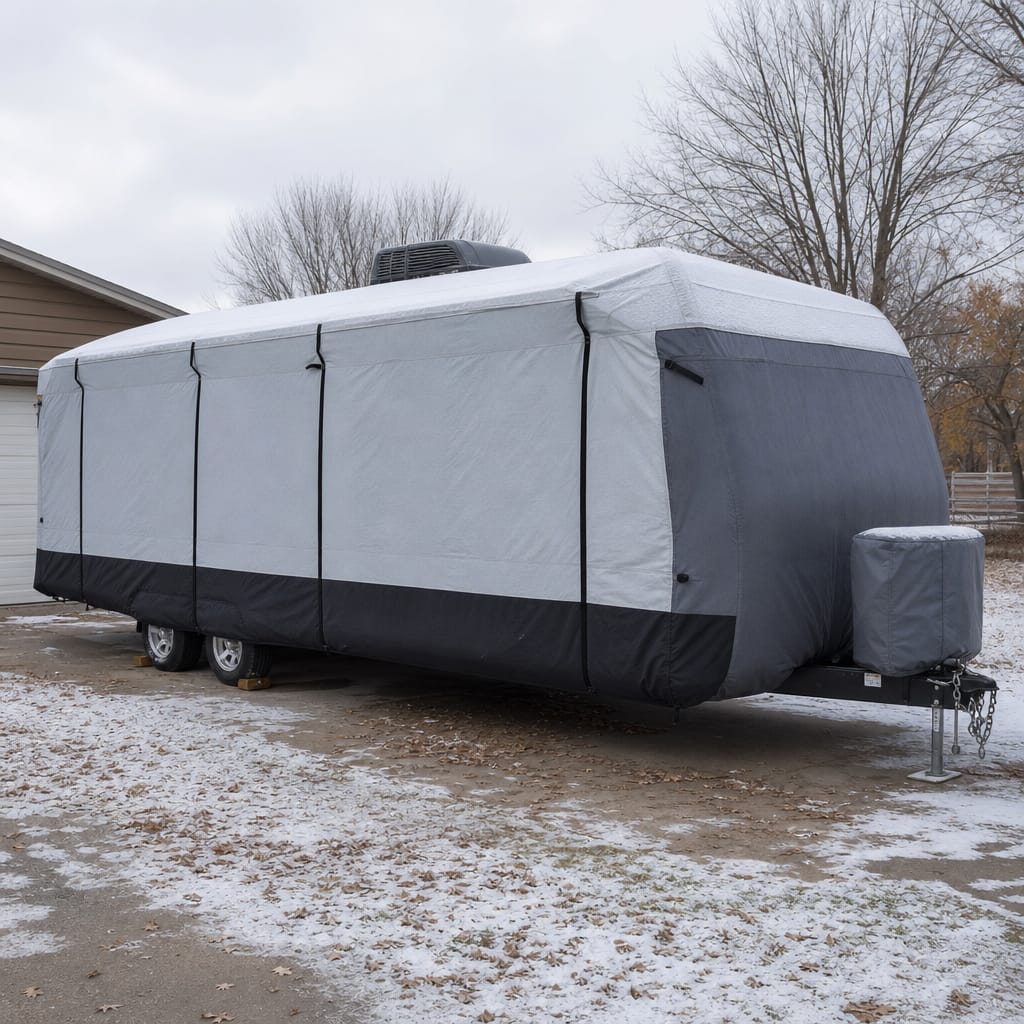
A cover's job is narrow: block UV, shed snow and ice off the roof, and keep rain and snow off seals and decals. An anti-pooling design — a raised center ridge or support pole instead of a flat top — matters specifically in winter, since standing snow or ice on a flat cover top is a real failure mode, not a cosmetic one.
What it doesn't do is replace winterizing the plumbing and engine systems. Retailers describe features like multi-layer top panels as weatherproofing aids, not guarantees of performance in every climate — read "weatherproof" as the listing's description, not a tested claim. For a full walkthrough of what to look for across cover types, see our full buying guide to RV covers.
Does Covering Your RV Cause Mold or Trap Moisture?
The mechanism matters more than the brand name. A cover that can't breathe traps the humidity that naturally collects between the rig's shell and the cover fabric; a breathable fabric lets that moisture escape instead of condensing.
Breathable vs. non-breathable materials
Non-breathable fabrics (vinyl, tarps) block UV well but seal moisture in with the rig. Breathable fabrics are woven to let water vapor pass through while still shedding liquid rain and snow — the trade-off is usually a higher price and a softer feel than a tarp.
Ventilation and ground clearance
Covers designed with raised roof support (for anti-pooling) also tend to leave more airflow between the cover and the rig's surfaces, and keeping the cover clear of the ground reduces moisture wicking up from wet soil or snowmelt.
Signs you're trapping moisture
Condensation visible on the inside of the cover, or a mildew smell when you pull it off in spring, both mean the cover trapped more moisture than it let escape. Either is a reason to switch to a more breathable material or improve ventilation, not a reason to give up on covering entirely.
Matching the Cover to the Job
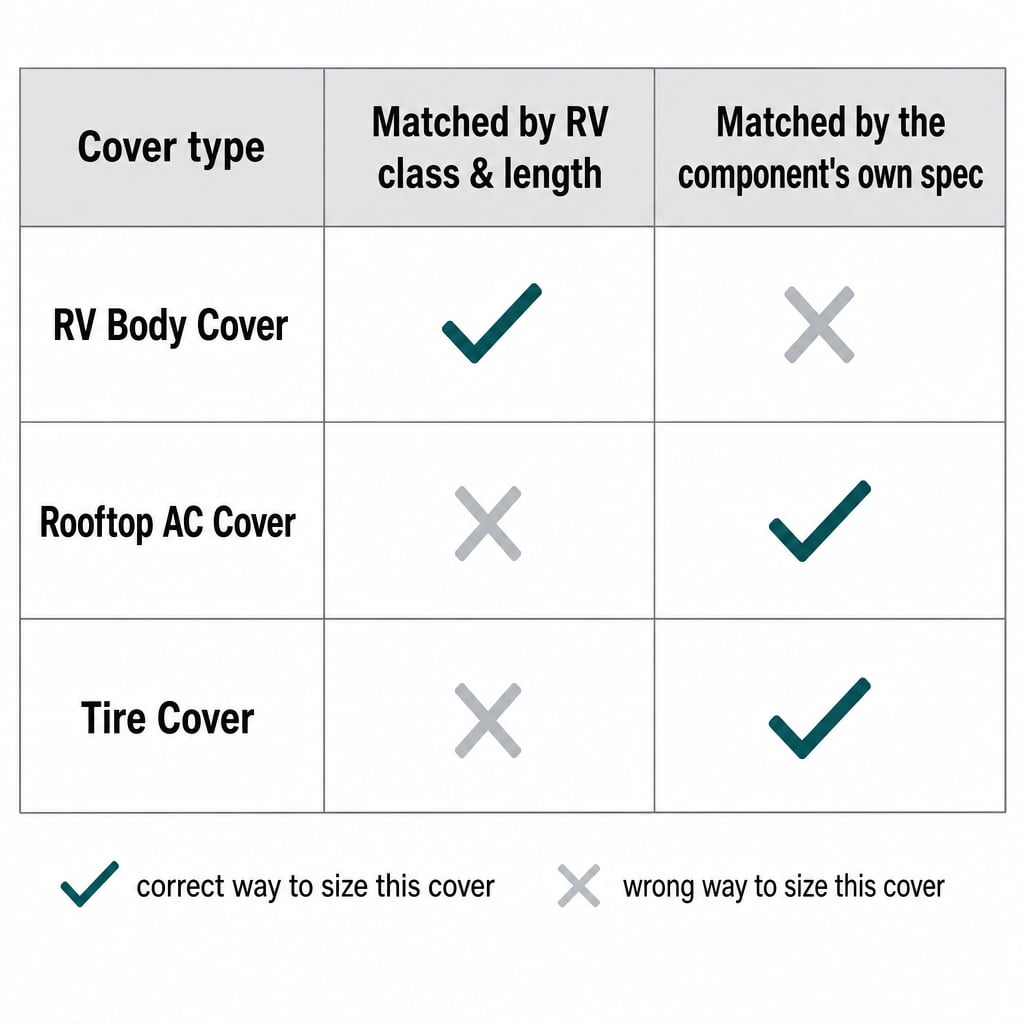
Buying "an RV cover" is really three separate purchases, and each one is sized by something different. Mixing them up — sizing the AC cover or the tire cover by the RV's own class or length instead of by the component itself — is the single most common mistake in this category.
Covering the RV body
A body cover is sized by your RV's class and length — but it's still one SKU in a multi-size line, not a universal fit, so match your rig's exact length to the SKU rather than rounding to the nearest size.
Camco ULTRAGuard Supreme RV Cover (fits 31'–34' Class A) (
) is one of the few body covers with a winter-specific detail you can actually check: a raised roof support pole that keeps the top from pooling snow and ice, instead of the flat panel some covers use. Retailers consistently describe a 3-layer top panel, though no Camco manufacturer page could be located to confirm it directly — treat that as retailer-described, not manufacturer-stated.For more long-term storage options across lengths and classes, see our roundup of the best RV covers for long-term storage.
Covering the rooftop AC unit
The AC cover has nothing to do with your RV's class or length. It's sized and shaped to your AC unit's own brand and model — a Dometic Duo-Therm/Brisk Air/Quick Cool unit and a Coleman Mach unit use differently shaped housings, and the wrong shape won't seat correctly even if the stated dimensions look close.
Classic Accessories Over Drive RV Air Conditioner Cover (
See our roundup of the best RV air conditioner covers for more AC-specific options once you've confirmed your unit's brand and model.
Covering tires and wheels
Tire covers are sized by tire diameter, independent of your RV's class — measure the tire itself rather than assuming a size from your rig type.
ADCO Ultra Tyre Gard Wheel Cover (27"–29", white) (
) covers that diameter range. Retailers list a 3-year warranty on this product; no ADCO manufacturer page could be located to confirm that figure directly, so treat it as retailer-stated rather than a confirmed fact.See our roundup of the best RV tire covers for other diameter ranges.
Common Mistakes
- Buying a body cover by class/length alone, without measuring. Nominal class sizing is a starting point, not a substitute for your rig's actual length.
- Assuming one AC cover shape fits every rooftop unit. Brand/model mismatch is the single most common error in this category — see "Matching the Cover to the Job" above.
- Leaving a non-breathable cover on through spring thaw. That's exactly when trapped moisture does the most damage, right as temperatures swing.
- Not securing a tire cover tightly enough against wind. A loose cover flaps and tears well before the season ends.
Skip It If
- Your rig is stored under a carport, roof, or inside a building — most of a cover's value (snow, ice, UV) doesn't apply there.
- You're storing short-term, not through a full winter — some cover lines are explicitly marketed for moderate climates and short-term storage rather than long-term winter exposure, and using one outside that scope doesn't match the product.
- You can't commit to checking or airing the cover out periodically — a forgotten non-breathable cover left sealed all winter is worse than no cover at all.
FAQ
Do RV covers really help in winter?
It depends on storage conditions more than on any single product — covered-but-exposed storage benefits the most; a rig already under a roof or carport gets little added benefit.
Do RV covers cause mold or condensation problems?
Only when a non-breathable material traps moisture against the shell with poor ventilation. The mechanism (breathability plus airflow) determines the outcome, not the brand.
Can I use a tarp instead of a purpose-built RV cover?
A tarp blocks UV and rain but isn't built with venting or anti-pooling features, and it tends to abrade the finish where it flaps against the surface — a bigger risk over a full winter than over a short-term cover.
Do I need to cover the AC unit separately from the body?
Yes. AC covers are sized and shaped by the unit's brand and model, not by the RV's class or length — see "Covering the rooftop AC unit" above.
What size tire cover do I need?
Measure your tire's diameter directly. Tire covers are sold by that measurement, independent of your RV's class or length.
Does a travel trailer need a different cover than a motorhome?
Yes — body covers are sold by RV type (travel trailer, Class A/B/C motorhome, fifth wheel, etc.) as well as by length, so the type matters as much as the size.
Sources Reviewed
Camco's body-cover specifications are drawn from aggregated retailer listings (Amazon, Walmart), consistent across sources but without a locatable Camco manufacturer page to confirm them directly. The Classic Accessories AC cover's manufacturer pages returned repeated HTTP errors on direct fetch; its stated dimensions come from conflicting retailer figures that could not be pinned to this specific listing, which is why none appear above. The ADCO wheel cover's warranty claim is sourced from retailer listings (including etrailer.com and Hanna RV) rather than a manufacturer page, which could not be located for this product.
Related Guides
- RV Cover Buying Guide
- Best RV Covers for Long-Term Storage
- Best RV Air Conditioner Covers
- Best RV Tire Covers
- Replacing a Cracked RV Roof Vent Cover
- How to Winterize an RV