How RV Water Filter Installation Differs by Type
Published
Disclosure: This article contains affiliate links. If you buy through these links, we may earn a commission at no extra cost to you. We do not claim hands-on testing unless clearly stated.
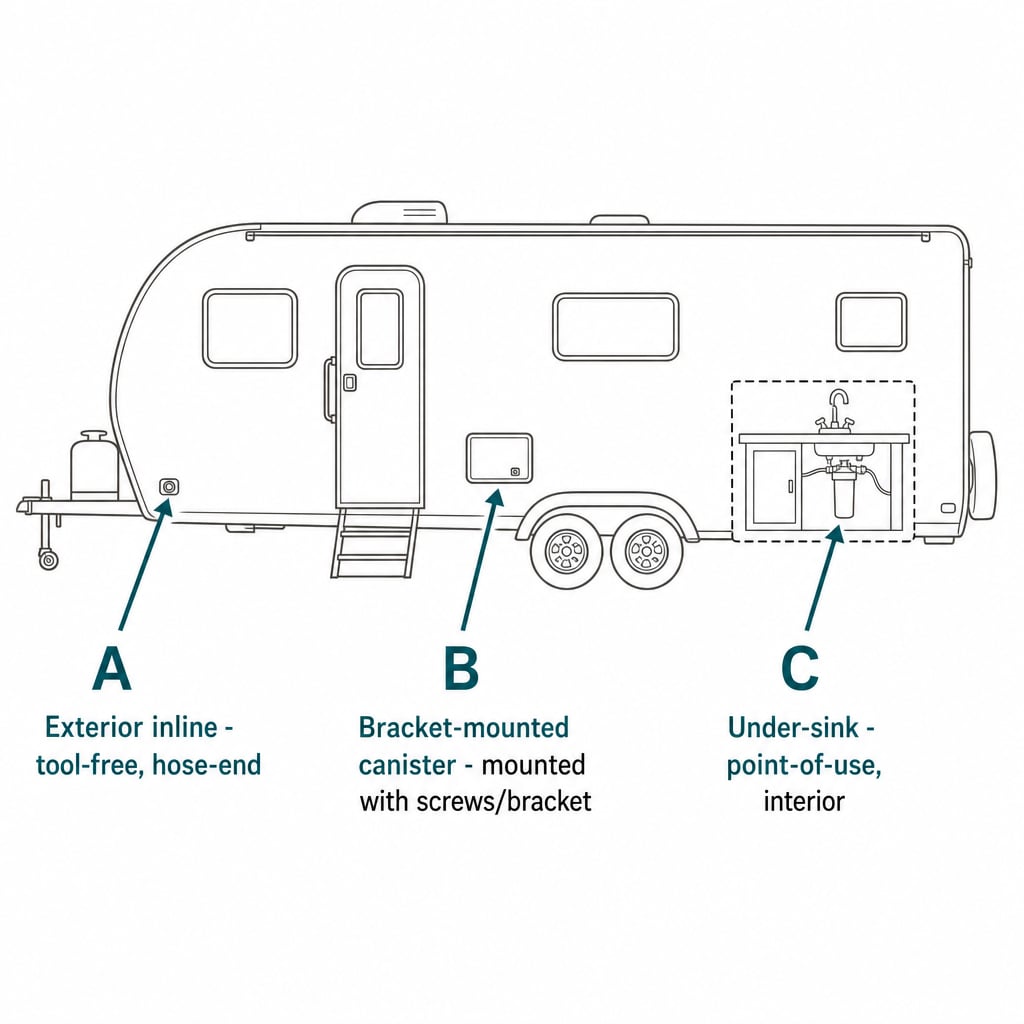
Most "RV water filter" listings describe the cartridge inside, not where the filter goes on your rig — and the three common locations have genuinely different effort levels. This article covers those three locations (exterior inline at the city-water hookup, bracket-mounted canister, interior under-sink), what each involves, and what to check on your rig before ordering. It does not cover step-by-step installation instructions, a ranked "best filter" list by brand, or sanitizing and winterizing the fresh water system, covered in their own guides.
What It Has to Do
Whatever location you pick, the filter's job is the same: reduce taste, odor, chlorine, and sediment between the water source and your tap, and for some models, finer contaminants — strictly per whatever certification the manufacturer states (NSF/ANSI 42 or 53, where cited), not a blanket "makes the water safe" claim. A side-by-side look at flow rate, micron rating, and certification across several common RV filters, compiled from manufacturer and retailer pages, is in our RV water filter buying guide.
Which filter to buy and where it goes are two different decisions. This article is organized around the second one, because almost nothing else is.
Three Installation Locations, and What Each One Involves
These three locations map to effort and permanence, not to filtration quality — you can get strong filtration at any of the three.
Exterior Inline, at the City-Water Hookup (Tool-Free)
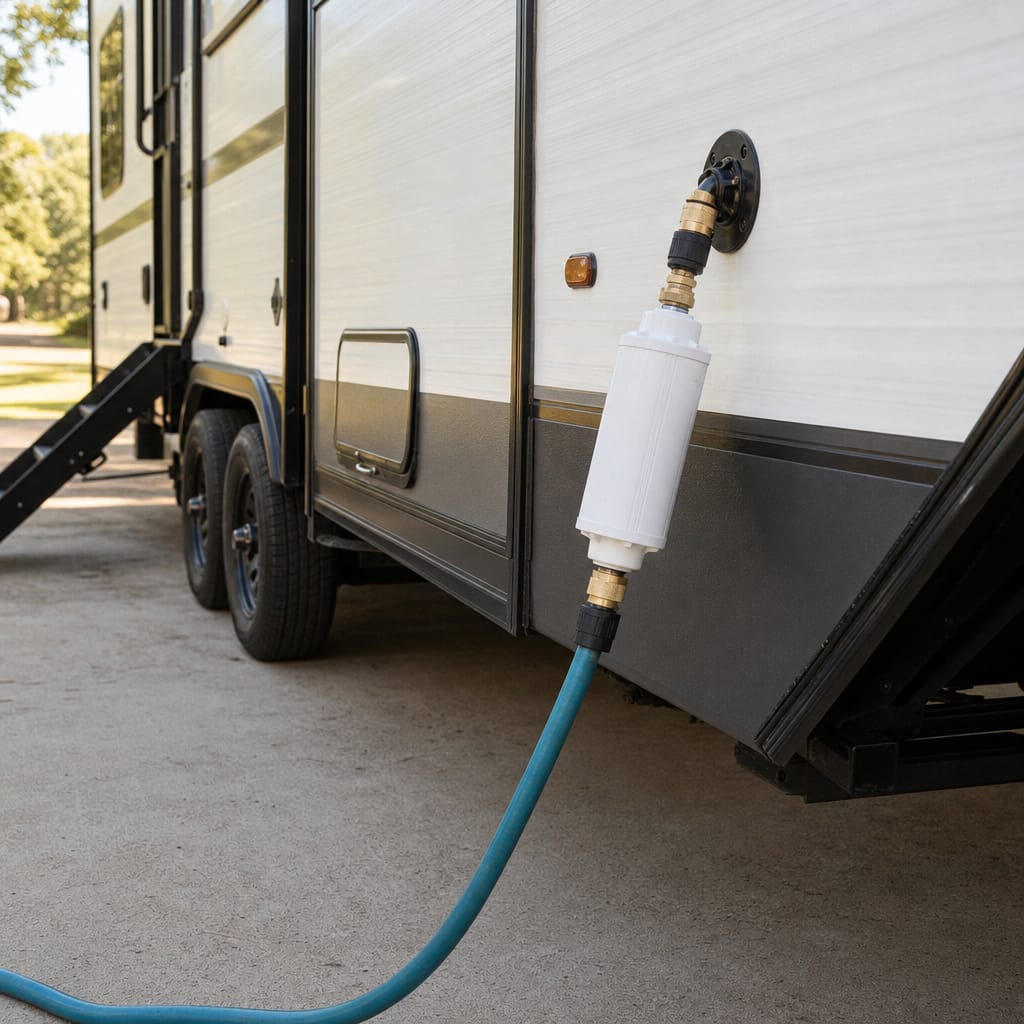
This is the location most readers mean by "add a filter": it screws between the garden hose and the city-water inlet, ahead of the tank. No bracket, no cutting into plumbing — it's the swap most readers picture, and the lowest-effort of the three.
Camco's own product page confirms the dimensions (2.56 x 3.88 x 12.19 inches); a retailer listing — not Camco directly — states NSF/ANSI 42 and 53 certification, CSA lead-free content certified to NSF/ANSI 372, and a 20-micron sediment rating, plus a cartridge life of "an average of 3 months" — Camco's own page doesn't give a specific gallon or month figure. A retailer page also states a 2.5 GPM flow rate for this model, but that figure isn't confirmed on any page we could load directly — treat it as unconfirmed rather than a spec you can plan around.
Before you order: confirm your hookup takes a standard garden-hose female coupling — this filter is a pre-tank, hose-end design, and not every connection on every rig is the same fitting. For inline exterior filter options beyond this one pick, see our inline exterior filter options.
Bracket-Mounted Canister, Exterior or Wet-Bay
This tier is a standalone chassis or dual-canister housing mounted to a wall or wet-bay panel with screws or a bracket — more permanent than a hose-end swap, and it needs mounting space the exterior-inline option doesn't.
The manufacturer lists the Clearsource Premier at a 6–6.5 GPM flow rate, with dimensions of 15 x 15.25 x 7.5 inches and a weight of 24 pounds — all stated directly on Clearsource's own product page. Its two filtration stages include a 0.2-micron absolute-rated stage and a coconut-shell carbon block stage. The manufacturer's page also describes reducing bacteria and cysts, but doesn't cite a specific NSF/ANSI standard number behind that claim — so we're stating it here as filtration stages and micron ratings only, not as a certified-contaminant-removal claim.
Before you order: measure the clearance in your wet bay or exterior panel before buying — at 24 pounds and over a foot in two dimensions, this isn't a unit you want to discover doesn't fit after it arrives. Confirm the mount can support that weight. For more options at this tier, see our whole-RV filter systems.
Interior, Under-Sink (Point-of-Use)
This location mounts inside a cabinet and filters only the water drawn at that one tap, rather than the whole fresh-water line — the opposite trade-off from the two exterior tiers above.
The Culligan RV-EZ-3 is the weakest-sourced of the three picks, and worth saying so plainly: no Culligan manufacturer page could be found for this model, and the 500-gallon rated capacity and "NSF Certified" label both come from a distributor page rather than Culligan directly. That same distributor page also marked the listing discontinued at the time it was checked. No flow-rate figure is published anywhere we could find. Its twist-on/twist-off cartridge and quick-connect double-shutoff fittings are stated on that same distributor page.
Before you order: check cabinet clearance under your sink, and whether your rig's plumbing already has a dedicated point-of-use tap or would need one — that's a consideration for whoever handles the install, not an instruction to add one yourself.
Tools and Products That Help
A few other products are worth knowing about without needing their own location profile:
- Finer filtration, same tier — the FRIZZLIFE MV99 is an exterior-inline filter like the Camco pick above, but the manufacturer lists a 0.5-micron rating against Camco's 20 micron. Its manufacturer-stated 1.4 GPM flow rate is lower than Camco's unconfirmed 2.5 GPM figure, so treat this as finer filtration, not higher flow.
- Another bracket-mounted option — the RV Water Filter Store's Enhanced Anti-Scale system is a dual-canister system like the Clearsource pick above, with a 1-micron sediment stage and a 0.5-micron carbon-with-anti-scale stage; the manufacturer states flow rate and micron ratings clearly but publishes no NSF/ANSI certification and no rated capacity.
- A mounting accessory — Camco's 52001 Hydro Life exterior filter holder mounts an exterior filter; it's a bracket, not a filter, and no manufacturer page confirmed its material.
- A middle effort tier — the Beech Lane BL-113 external dual filter system sits between the tool-free and permanent tiers: exterior-mounted, but needs its included bracket and a wrench for cartridge changes. Its dimensions, capacity, and flow rate aren't confirmed anywhere, so treat it as a concept — a wrench-required tier exists — not a spec'd pick.
Whichever filter and location you land on, remove or bypass it before you sanitize your fresh water tank — chlorine degrades most filter media. See our guide to sanitizing your fresh water tank for that separate job.
Common Mistakes
Mistake 1: Assuming Every Hookup Takes the Same Fitting
What it looks like: Ordering an exterior-inline filter without checking the coupling type on your rig's city-water inlet.
Why it's a problem: These filters are built around a standard garden-hose female coupling — not every connection matches that without an adapter.
What to do instead: Check your inlet's fitting before ordering, not after it arrives.
Mistake 2: Treating a Distributor's Numbers as the Manufacturer's
What it looks like: Repeating a capacity or certification figure that only appears on a retailer or distributor page, as if the manufacturer stated it directly — the under-sink profile above is the clearest example of this.
Why it's a problem: A distributor's own numbers can be outdated, especially on a listing already marked discontinued.
What to do instead: Check whether a figure traces back to the manufacturer's own page, and treat distributor-only numbers as a weaker signal, not a guarantee.
Mistake 3: Picking the Bracket Tier Without Checking Clearance First
What it looks like: Ordering a bracket-mounted canister system before confirming there's room to mount it in the wet bay or on an exterior panel.
Why it's a problem: These units are bulkier and heavier than a hose-end filter — a tight wet bay can rule one out entirely.
What to do instead: Measure the available space and check what the mount needs to support before ordering.
RV water filter specs at a glance
RV water filter listings mix flow rate, micron rating, rated capacity and certification claims inconsistently, and rarely say which of those numbers actually comes from the manufacturer versus a retailer's own copy. This table puts seven products spanning the four common RV filter types side by side, with one source per figure and a blank left wherever the cited source does not publish that number.
| Product | Product type | Micron rating | Manufacturer-stated flow rate | Rated capacity | NSF/ANSI standard cited | Dimensions / connection | Source | Source checked |
|---|---|---|---|---|---|---|---|---|
| Camco TastePURE RV Water Filter with Flexible Hose Protector (40043) | Single-stage inline exterior filter (standard/budget tier) | 20 micron (sediment) | "lasts an average of 3 months" (not a gallon figure) | NSF/ANSI 42, NSF/ANSI 53; CSA lead-free content certified to NSF/ANSI 372 | 2.56 in x 3.88 in x 12.19 in; standard garden hose female coupling, pre-tank filtering | Panther RV Products, Camco TastePURE 40043 listing (retailer) | 2026-10-25 | |
| FRIZZLIFE MV99 RV Inline Water Filter | Single-stage inline exterior filter (high-flow / fine-filtration tier) | 0.5 micron | 1.4 GPM @ 60 psi | 5,000 gal (chlorine reduction); 1,000 gal (lead reduction) | NSF/ANSI 42 & 53 | 5 in L x 5 in W x 15 in H; 3/4-inch garden hose, lead-free brass fittings | Frizzlife MV99 product page (manufacturer) | 2026-10-25 |
| RV Water Filter Store Enhanced Anti-Scale Water Filter System | Two-stage sediment + carbon canister system | 1 micron (stage 1, sediment); 0.5 micron (stage 2, carbon block) | 3-4 GPM @ 60 psi | Dual 10 in x 2.5 in canisters; hose fittings, max 65 PSI | RV Water Filter Store, Enhanced RV Water Filtration System + Anti-Scale product page (manufacturer) | 2026-10-25 | ||
| Camco TastePURE XL RV Water Filter with Flexible Hose Protector (40019) | Single-stage inline exterior filter (high-capacity tier, same line as 40043) | 20 micron (sediment) | "lasts an average of 3 months" per this listing (other retail summaries claim 6 months; not confirmed on any directly-fetched page) | NSF/ANSI 42, NSF/ANSI 53; CSA lead-free content certified to NSF/ANSI 372 | 3.31 in x 4.5 in x 15.25 in | Panther RV Products, Camco TastePURE XL 40019 listing (retailer) | 2026-10-25 |
How these numbers were produced: Every figure is quoted from the cited source and never derived or estimated. Where a manufacturer's own product page did not publish a figure, a retailer or distributor page is used instead and named as such in that row's source; where neither published a figure, the cell is left blank. 'Rated capacity' is reported in whichever unit the source actually states — gallons for some products, months of expected cartridge life for others — these are not interchangeable and are not converted between each other.
- A blank cell means the cited source does not publish that figure. No cell on this table is filled with a figure estimated from a similar product or a different SKU in the same line.
- Flow rate figures are not necessarily measured under the same test pressure across rows. Some manufacturers publish a flow rate at a stated PSI (for example '1.4 GPM @ 60 psi'); others publish a bare GPM figure with no test pressure noted. Comparing two flow-rate figures across brands assumes comparable test conditions that not every source states.
- Camco TastePURE 40043's widely repeated 2.5 GPM flow-rate figure could not be confirmed here. Camco's own product page (camcooutdoors.com) does not publish a flow-rate figure for this model, and the one retailer page found stating 2.5 GPM returned an access error on every direct fetch attempt. The flow-rate cell for this row is left blank rather than repeating an unconfirmed number.
- Clearsource Premier's own product page describes reducing bacteria (including Legionella and E. coli) and cysts (including giardia) without citing any NSF/ANSI standard number, and without any other mention of NSF anywhere on the page. This is the broadest health-adjacent claim of any product in this set and the least standard-specific.
- Culligan RV-EZ-3 has no manufacturer (culligan.com) page; the figures here come from a distributor page (freshwatersystems.com), which also marked the product discontinued at the time it was checked. Its flow rate is not published on any source found for this table.
- RV Water Filter Store's Enhanced Anti-Scale system publishes no NSF/ANSI certification and no rated capacity in gallons on its own product page, despite publishing flow rate and micron ratings clearly.
- Frizzlife FZ-2's stage-by-stage micron ratings and a gallon-based capacity figure are repeated across several retail summaries but could not be confirmed on Frizzlife's own FZ-2 product page, which states only a 6-12 month lifespan and housing compatibility. Those unconfirmed figures are left blank.
These are the entries that matter for this guide. The full table, with every row and its source, is in our RV water filter buying guide.
FAQ
Does it matter where the water filter goes on my RV?
Yes — effort and permanence differ a lot by location. Filtration quality doesn't depend on location alone; you can get strong filtration from any of the three tiers above.
Can I install a water filter without any tools?
The exterior-inline, hose-end type is the tool-free option. The bracket-mounted and under-sink types both involve mounting hardware.
Does an exterior filter protect my whole RV's plumbing?
Exterior-inline and bracket-mounted systems sit upstream of the whole fresh-water line. Under-sink, point-of-use systems filter only the water drawn at that one tap — they don't protect the rest of the line.
Is a more expensive filter location always better filtration?
No. Cost and effort track the location and the mounting hardware involved, not necessarily the filtration itself — tie your choice to your rig's space and your own tolerance for a more permanent install, not price alone.
Should I install the filter before or after my water pressure regulator?
There's no single universal answer to this — it can vary by setup. Check your own regulator's and filter's documentation rather than assuming an order.
Do all RVs need a water filter?
Not strictly — it's a step up in taste, odor, and sediment reduction over whatever the city-water or campground source already provides, not a requirement. Whether it's worth it depends on how much that matters to you and where you typically fill up. Either way, pull the filter before you sanitize the tank — see our sanitizing without bleach guide if you'd rather skip bleach for that job too.
Sources Reviewed
For the exterior-inline pick, we reviewed Camco's own TastePURE 40043 product page for dimensions and SKU/UPC, and a Panther RV Products retailer listing for micron rating, certification, and cartridge-life wording; the widely repeated 2.5 GPM flow-rate figure could not be confirmed on any directly-loaded page. For the bracket-mounted pick, we reviewed Clearsource's own Premier product page. For the under-sink pick, no Culligan manufacturer page exists for the RV-EZ-3; its figures come from a Fresh Water Systems distributor listing, which also marked the product discontinued at check time. For the light mentions, we reviewed Frizzlife's own MV99 page and the RV Water Filter Store's own Enhanced Anti-Scale page; no manufacturer page could be found for the Camco 52001 holder or the Beech Lane BL-113.
Related Guides
- RV water filter buying guide
- Inline exterior filter roundup
- Whole-RV water filter systems
- How to sanitize your RV fresh water tank
- Sanitizing without bleach