Why Your RV Water Pump Won't Prime
Published
Disclosure: This article contains affiliate links. If you buy through these links, we may earn a commission at no extra cost to you. We do not claim hands-on testing unless clearly stated.
The tank reads full, the pump is running, and the faucet is still giving you nothing — or a weak trickle that never builds. That's not the same problem as a pump that won't switch on at all, and the fix isn't the same either.
This guide covers what "priming" actually means for a 12V demand pump, the handful of causes that actually stop it from happening, and which of those you can check yourself versus which point to something bigger. It does not cover opening the pump housing, swapping the check valve, or replacing the pump itself — those are jobs for our RV water pump repair guide and our pump replacement guide, not a diagnostic read like this one.
What Priming Actually Means for a Demand Pump
A demand pump doesn't just need water sitting in the tank. It needs an unbroken column of water between the tank and the faucet, with the air that was in that line purged out, before it can build and hold pressure. Air is compressible and water isn't — so as long as there's an air pocket anywhere in the supply line, the pump can run all day without ever producing steady flow.
That's the piece most generic troubleshooting skips. A full tank is necessary, but it isn't sufficient: the air still has to get out of the line between the tank and the faucet, and that's the step that actually fails. Everything below sorts the causes by what you're seeing, because a pump that won't prime at all and a pump that primes and then loses it again point to different parts. For the plumbing path itself, see how water moves from tank to faucet.
Why It Won't Prime — Common Causes by Symptom
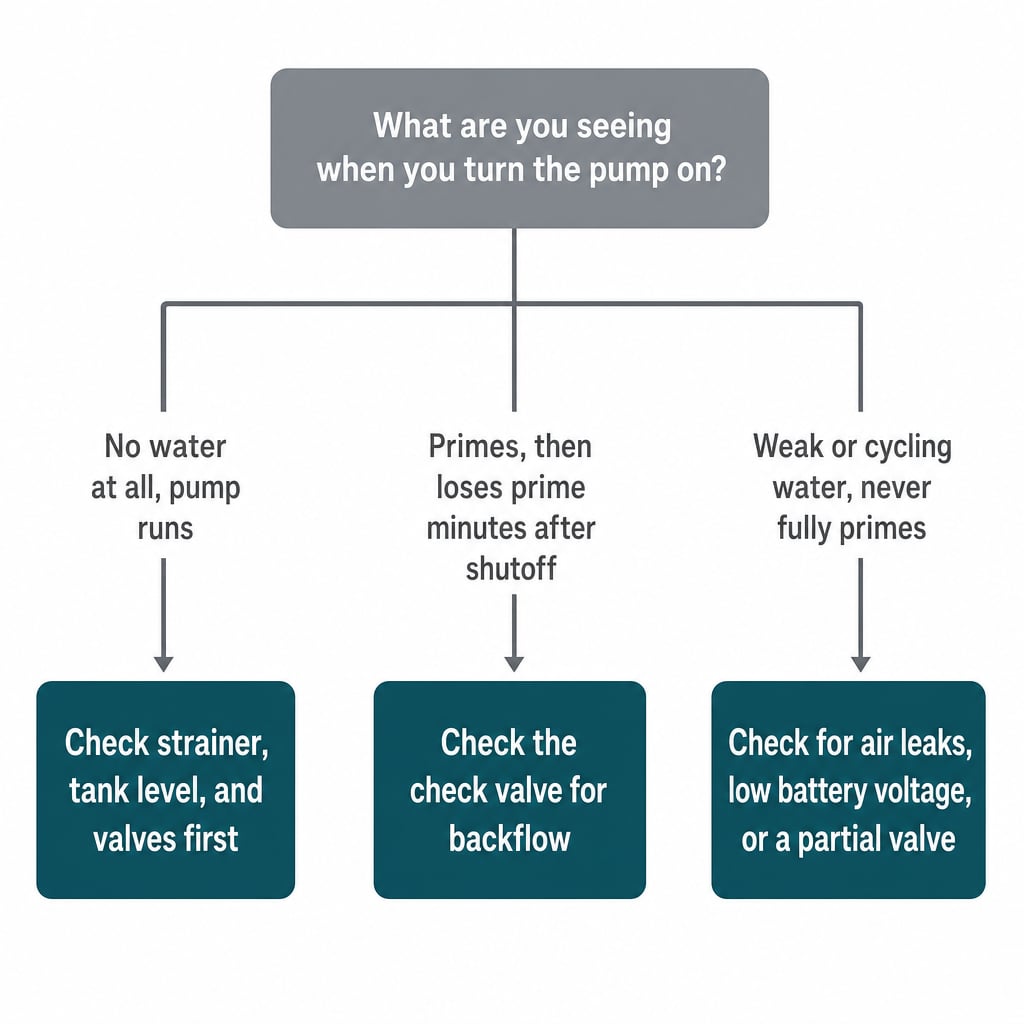
Match what you're seeing to one of the three patterns below before you assume the pump itself is bad.
Pump Runs, No Water at All
The pump is audibly running, but nothing comes out of the faucet — not even a trickle. The most common cause is a clogged or missing inlet strainer: the mesh screen that keeps sediment out of the pump is also the first thing that can starve it of water entirely. An empty or near-empty fresh tank produces the identical symptom, as does a closed valve somewhere between the tank and the pump.
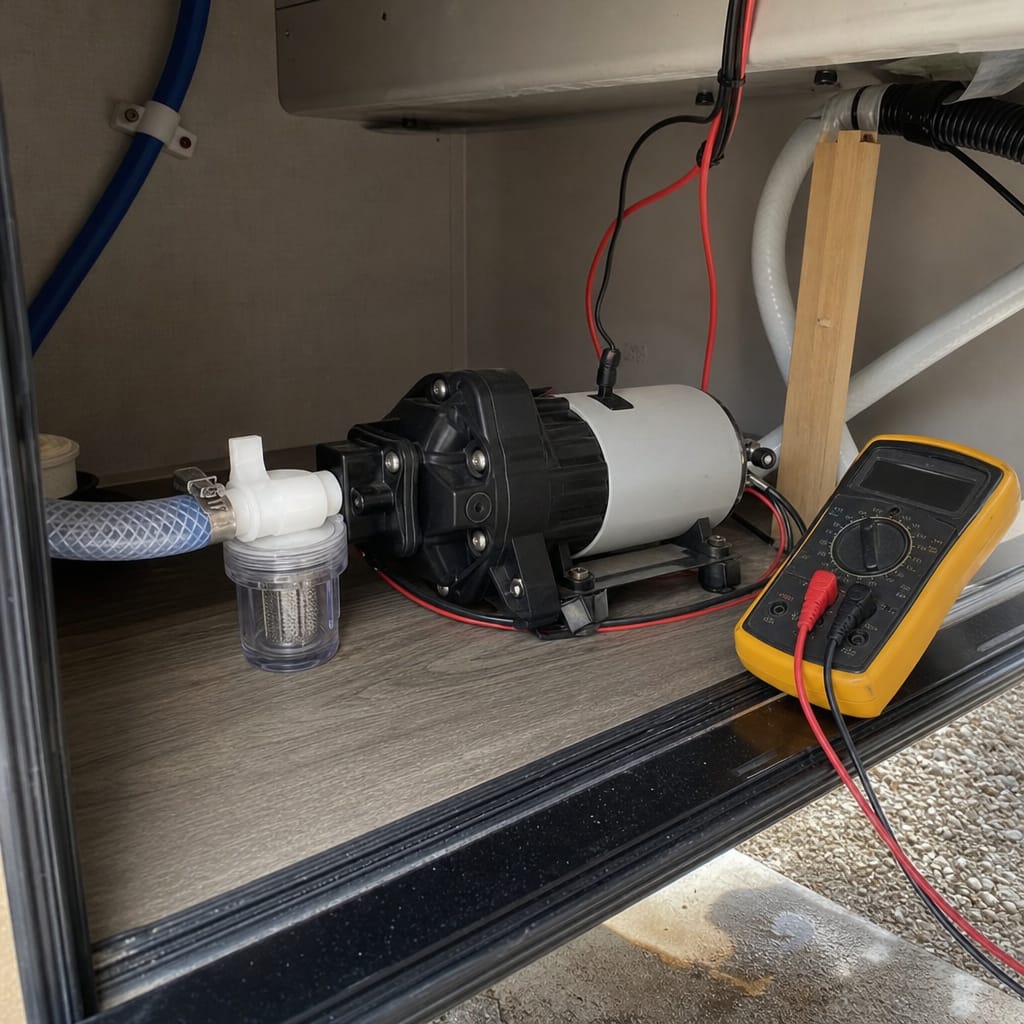
Check, in order: the tank level gauge against what's actually in the tank (gauges drift), any valve in the line between tank and pump, and the inlet strainer itself for visible clogging. The Shurflo pump specs and models page covers what a clean strainer should look like on that brand's pumps specifically, since fitting and screen style vary by model.
Pump Primes, Then Loses Prime Again Shortly After Shutdown
This is a different pattern: the pump builds pressure and holds it while running, but a few minutes after you shut it off, the next time you open a faucet you're back to air and sputtering. That points to backflow — water draining back past a failed or missing check valve instead of staying in the line, letting air back in from the discharge side.
A check valve that's doing its job keeps that water column intact between uses. If yours doesn't, you lose the prime every time, not just once. For what's involved in confirming and replacing one, see the dedicated check-valve guide.
Pump Cycles or Runs Weak Without Fully Priming
If the pump is running but the flow is weak, or it kicks on and off rapidly without ever settling into steady pressure, the likely causes are different again: an air leak at a fitting somewhere in the line (letting air back in continuously, not just once), a 12V battery that's too weak to keep the motor at full speed, or a valve that's only partially open. A pump starved of adequate voltage can run audibly without ever building the pressure it's rated for.
Check fitting connections for looseness or a visible gap, and check battery voltage at the pump itself — not just at the battery terminals, since a long or thin wire run can drop voltage along the way.
"The Priming Valve" — Why Its Location Isn't Universal
Some systems have a dedicated accessory valve near the pump specifically for manual priming. Many don't — on a lot of RV plumbing layouts, there's no separate priming valve at all, just the pump and the supply line. Where one exists, its placement is set by the pump manufacturer and the rig's own plumbing layout, not by any industry standard.
If your owner's documentation mentions a priming valve, the only reliable way to find it is to check your own pump's model and your rig's own plumbing diagram — not a generic location described for a different model.
Where This Stops Being a Quick Check
If you've checked the strainer, the tank level, the valves, the check valve, and the battery voltage, and the pump still won't hold a prime, the cause is probably internal to the pump — a worn diaphragm, a failing motor — or deeper in the plumbing than a visual check can reach. That's a repair job, not something this guide walks through. See what a full repair involves for what that diagnosis and fix actually covers.
Parts That Help
Two of the causes above trace to a specific, sourced part rather than a full repair. Both are from the same manufacturer; nothing in either diagnosis points toward a different brand's part.
For a clogged or missing inlet strainer, the Shurflo by Pentair 255-313 Twist-On Water Strainer (1/2" pipe inlet) is a twist-on part with a clear bowl and a replaceable 50-mesh screen, so you can see buildup without tools.
The manufacturer's own page doesn't publish a pressure, temperature, or flow-rate rating for this part — we're not inventing one. Confirm your pump's inlet is a 1/2" pipe fitting before ordering; strainers aren't interchangeable across every pump family.
For a failed or missing check valve causing lost prime after shutdown, the Shurflo by Pentair In-Line Check Valve (item 340-001) carries a manufacturer-listed backsurge rating of up to 100 PSI and 1/2" barb ports.
One thing to confirm before buying: the listing this part ships under also carries a "fuel line check valve" subtitle, consistent with the same physical part being cross-sold for marine and fuel use — check that the listing you're ordering matches your pump's check-valve port size, since the manufacturer's page doesn't publish dimensions or material for this part either. For what installing a replacement check valve actually involves, see the dedicated guide.
If you've already replaced both of these and the pump still won't hold a prime, that's usually a sign the pump itself — not an external part — is the problem; see when it's time to replace the pump instead.
RV water pump specs at a glance
Every RV demand pump's nameplate lists a flow rate, a shut-off pressure, and a maximum current draw, but no single published source puts those three numbers side by side across the brands actually installed in RVs. This table compiles them from each manufacturer's own product pages (and, for one Flojet model, its published user guide) across a spread of common 12V and 115V demand pumps, from a 1.4 GPM entry-level pump to a 5.0 GPM variable-speed model, so a reader can check their own pump's nameplate numbers against a real published range before assuming a weak or noisy pump is failing.
| Pump family / model | Voltage | Open flow rate | Shut-off / max pressure | Amp draw | Source | Source checked |
|---|---|---|---|---|---|---|
| Shurflo by Pentair Revolution 4008-101-E65 (OEM model 4008-101-A65) | 12 VDC | 3 GPM (11.4 LPM) | 55 PSI (3.7 BAR) | 7.5 A (max) | Pentair Shurflo Revolution 4008 Series By-Pass Pump product page (manufacturer) | 2026-10-18 |
| Shurflo by Pentair Revolution 4008-131-E65 (OEM model 4008-131-A65) | 24 VDC | 3 GPM (11.4 LPM) | 55 PSI (3.7 BAR) | 4 A (max) | Pentair Shurflo Revolution 4008 Series By-Pass Pump product page (manufacturer) | 2026-10-18 |
| Shurflo by Pentair Revolution 4028-100-E54 (OEM model 4028-100-A54) | 12 VDC | 2.3 GPM (8.7 LPM) | 50 PSI (3.4 BAR) | 5 A (max) | Pentair Shurflo Revolution 4008 Series By-Pass Pump product page (manufacturer) | 2026-10-18 |
| Shurflo by Pentair Revolution 4028-171-E65 (OEM model listed as 4008-171-A65) | 115 VAC | 3 GPM (11.4 LPM) | 55 PSI (3.7 BAR) | 1 A (max) | Pentair Shurflo Revolution 4008 Series By-Pass Pump product page (manufacturer) | 2026-10-18 |
How these numbers were produced: Every figure is quoted from the manufacturer's own product page, except the Flojet R3426-500 row, whose figures come from Flojet's published user guide (a PDF, since Flojet does not publish that table as a web page). Nothing is derived or converted beyond the unit conversions the manufacturer already prints in brackets (for example GPM to LPM, PSI to BAR). Amp draw is not measured the same way by every manufacturer: most rows report a manufacturer-stated maximum current draw, but the Flojet row instead reports the draw at a specific 10 PSI test point. Each row's amp-draw cell states which basis applies to that row.
- No manufacturer checked for this table publishes a cut-in (pump-restart) pressure. Every source states only a shut-off/max pressure, or, for the Shurflo 2088 family, a 'control pressure.' Cut-in pressure is left out of this table entirely rather than estimated from the shut-off figure.
- Amp draw figures are not directly comparable across brands: most rows report a manufacturer-stated maximum current draw, but the Flojet R3426-500 figure is current draw at a 10 PSI test point specifically, not a maximum. Use this column to size a fuse or wire gauge for the specific pump in that row, not to rank brands against each other by power draw.
- The Shurflo 2088-343-135 row is drawn from Pentair's agricultural/industrial diaphragm-pump listing, not its RV-applications page. The 2088 family is a widely used OEM RV pump, but Pentair's own site files this particular listing under agricultural/industrial rather than RV.
- The Flojet document this table cites is titled a 'Standard 3 GPM RV Water System Pump' guide, but the only model documented inside it, R3426-500, is itself rated 1.4 GPM and 20 PSI, a smaller and lower-pressure pump than the document's own title implies. The figures are reported exactly as published in the document, not adjusted to match its filename.
- These are manufacturer bench-test figures, not a guarantee of real-world performance. Actual flow and pressure at the tap depend on battery voltage and wire run, line restriction, elevation lift, and how many fixtures are open at once. A pump reading well below its own published open-flow figure is a genuine symptom worth investigating; a pump reading below a different model's figure on this table is not, since that other model was never the reader's pump to begin with.
- A blank cell would mean the cited source does not state that figure. No row on this table has one, because every model kept here had a published entry for every column shown.
These are the entries that matter for this guide. The full table, with every row and its source, is in our RV water pump repair triage guide.
FAQ
My tank is full — why won't my pump prime?
A full tank gives the pump water to draw on, but priming also requires the air in the line between the tank and the faucet to be purged. A full tank with trapped air in the line still won't prime.
My water pump runs but no water comes out at all — what's wrong?
Start with the inlet strainer and the tank level gauge against the actual tank contents, then check for a closed valve between the tank and the pump. All three produce this identical symptom.
Why does my pump prime, then lose prime again a few minutes after I shut it off?
That pattern points to backflow through a failed or missing check valve, which lets the water column drain back and air re-enter the line between uses.
Where is the priming valve on an RV water pump?
Not every system has one, and where it exists, its location is set by the pump manufacturer and your rig's own plumbing layout. Check your own pump's documentation rather than a generic description.
Can a weak RV battery stop the pump from priming?
Yes. A pump starved of adequate voltage can run without building full pressure. Check voltage at the pump itself, since a long wire run can drop voltage along the way even when the battery tests fine at the terminals.
Is this something I can check myself, or do I need a professional?
The checks above — strainer, tank level, valves, check valve, voltage — are things you can look at yourself. If the symptom persists after all of them, the cause is likely internal to the pump or deeper in the plumbing, and that's a repair job.
Sources Reviewed
For this guide, we reviewed the Pentair manufacturer pages for the Shurflo inlet strainer and in-line check valve, and the corresponding Amazon listings. Where a figure wasn't published — dimensions and material for both parts, and a flow or pressure rating for the strainer — we said so rather than estimating one.
Related Guides
- How to repair an RV water pump
- When to replace an RV water pump
- RV water pump check valves
- Shurflo RV water pump options
- RV water pump system diagram
- Flojet RV water pump picks