RV Water Pump Maintenance: The 3 Tasks That Actually Matter
Published
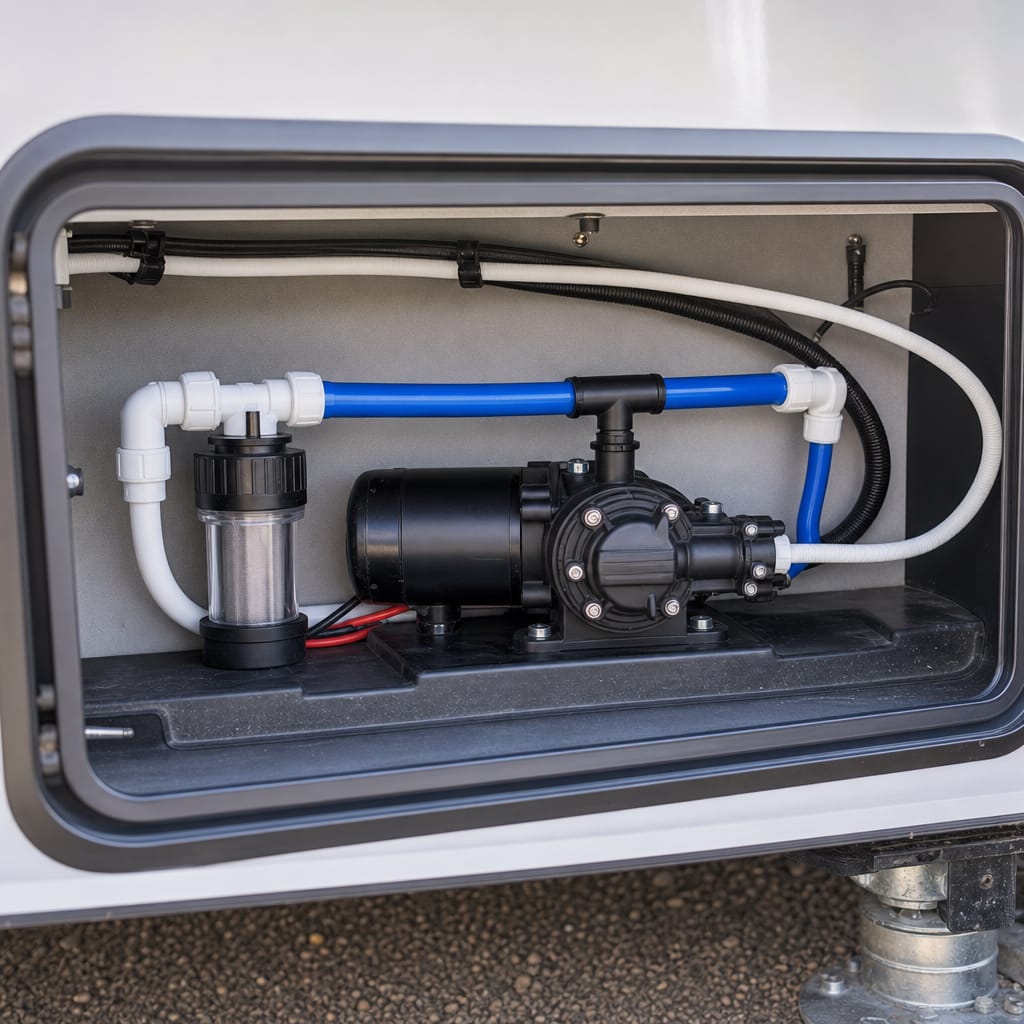
Disclosure: This article contains affiliate links. If you buy through these links, we may earn a commission at no extra cost to you. We do not claim hands-on testing unless clearly stated.
Search for "RV water pump maintenance" and most results assume your pump has already failed. This isn't that article. If your pump still works — maybe a little weaker than it used to, maybe a little noisier — there are exactly three small, preventable problems that turn into "the pump is dead" if you ignore them long enough.
This guide covers those three tasks: what each one prevents, what it looks like when you skip it, and the low-cost part that addresses it. It does not cover diagnosing a pump that's already stopped working, or deciding between a repair and a full replacement — those are separate guides, linked below.
What RV Water Pump Maintenance Actually Involves
If you only read one section, read this one. RV water pump maintenance comes down to three tasks on a pump that's still running normally:
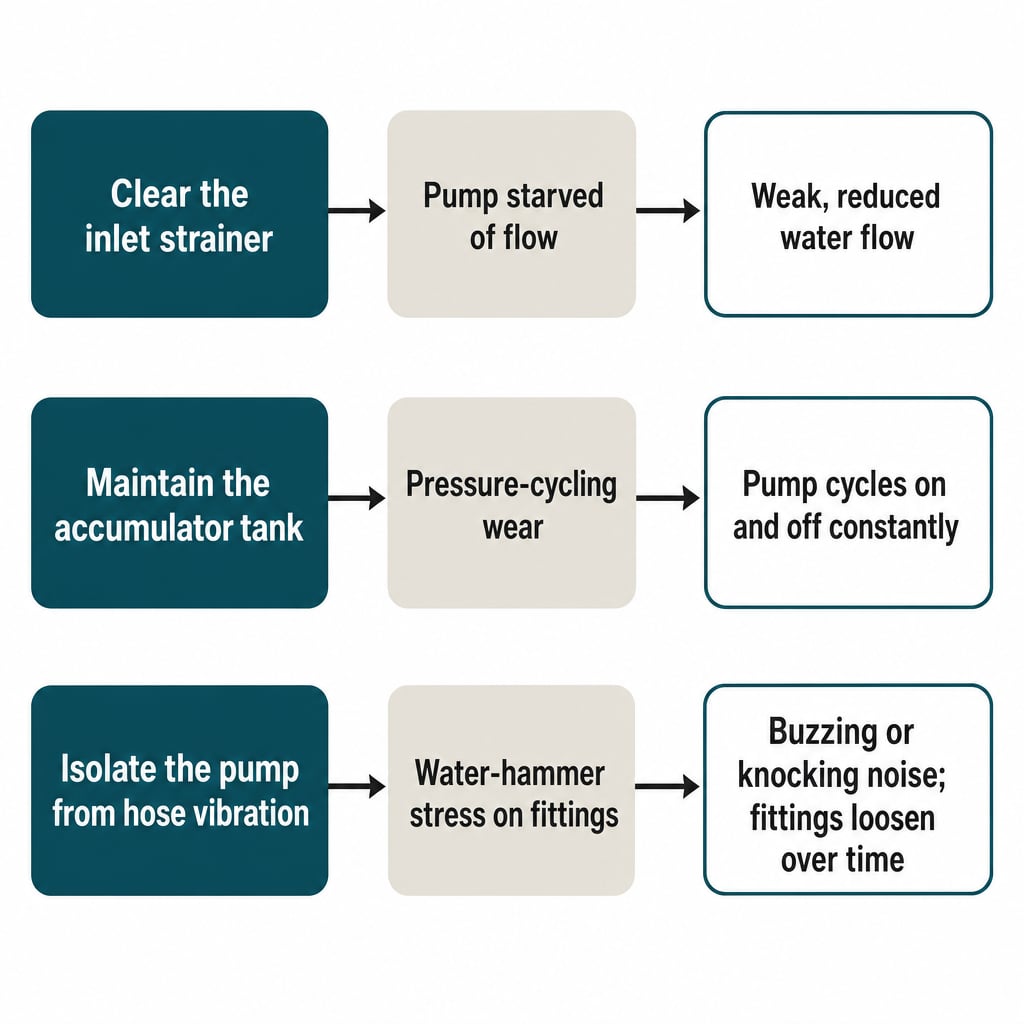
- Clear the inlet strainer — keeps debris from restricting flow before it reaches the pump.
- Maintain the accumulator tank — reduces the on/off pressure-cycling that wears out a demand pump faster than steady running.
- Isolate the pump from hose vibration — cuts down on water-hammer stress at the hose connections.
None of these follows a fixed schedule you can set and forget. Do them before a long trip, or as soon as flow or noise tells you something's changed — not on a calendar.
Why This Matters Before Your Pump "Fails"
Every failure mode RV owners search for — constant cycling, weak flow, a pump that dies early — traces back to one of the three tasks above, skipped long enough to become a symptom.
A strainer that's never cleaned doesn't fail outright — flow just gets weaker as the clog grows. A pump with no working accumulator tank doesn't break either; it cycles on and off far more than designed, which is wear, not malfunction. And a pump rattling against its own hose connections isn't broken, but the vibration is loosening fittings that will eventually leak.
If your pump is already doing one of these things constantly, this is the wrong article — see our troubleshooting guide for a pump that's already pulsing or short-cycling instead. This one is for catching the problem before it gets there.
The 3 Preventive Maintenance Tasks
Task 1 — Keep the Inlet Strainer Clear
The inlet strainer sits between the fresh water tank and the pump, and its only job is to stop sediment before it reaches the impeller. When it's never been cleaned, you don't usually notice a dramatic failure — you notice flow that's gradually gotten weaker, and a pump that's working harder than it should to deliver the same amount of water.
There's no fixed cleaning interval published for this part — treat it as condition-based. Check it before a long trip, or as soon as flow feels noticeably weaker than it used to.
The Shurflo by Pentair 255-313 is a twist-on strainer with a clear bowl and a replaceable screen, built specifically so you can see and clear debris without tools. That's the feature worth paying for here: the manufacturer's own product page doesn't publish a pressure, temperature, or flow-rate rating for this part, so don't expect — or look for — a performance spec on it. Judge it on ease of disassembly, not a number that isn't there.
Before you order: confirm your pump's inlet fitting size before buying a twist-on strainer — they aren't universal across pump families. See how a wrong-size or clogged strainer shows up as a priming problem for context.
Task 2 — Reduce Pressure-Cycling Wear With an Accumulator Tank
A demand pump turns on when line pressure drops and off when it's restored. Without any pressure buffer downstream, even a small draw — a dripping faucet, a slow leak — can make the pump cycle on and off constantly. Every cycle is a small mechanical stress on the motor and switch, and a pump that cycles far more than it needs to wears out faster than one that runs in longer, steadier stretches.
An accumulator tank fixes this by holding a reserve of pressurized water between the pump and the plumbing, smoothing out small draws so the pump doesn't have to restart for every one of them.
The Shurflo by Pentair 182-200 is a pre-pressurized accumulator tank. The manufacturer lists a 24-ounce capacity and a maximum working pressure of 125 PSI — treat both as manufacturer-listed figures, not guarantees; actual performance depends on your plumbing layout and how well the tank holds its pre-charge over time. The manufacturer doesn't publish a weight for this part, so we're not going to guess one.
Where this one stops: if your pump already cycles constantly and adding a tank doesn't change that, the cause is likely elsewhere — see our troubleshooting guide, which traces constant short-cycling to a failing pressure switch or a downstream leak.
Task 3 — Reduce Vibration and Water-Hammer Stress on Hose Connections
A pump bolted directly to rigid plumbing transmits every bit of its own vibration straight into the hose fittings. Over time, that shows up as a buzzing or knocking noise through the walls or floor near the pump, and — more importantly — as fittings that gradually work themselves loose.
The fix is a flexible connection kit installed between the pump and the rigid plumbing, so the pump's vibration is absorbed before it reaches the fittings instead of being transmitted through them.
The Valterra P23512PB is a pump connection kit built around flexible hose sections and nylon fittings. Two things to know before you install it. First, the nylon fittings are hand-tighten only — every source checked on this part agrees that using a wrench or pliers on them risks cracking the fitting, not making it more secure. Second, Valterra's own marketing describes this kit as fitting RVs broadly; that's marketing language, not a spec. Pump port sizes vary, so measure and confirm your pump has 1/2" ports before ordering — don't assume "fits RVs" means it fits yours.
Where this one stops: if tightening or replacing connections doesn't stop the noise, see our RV water pump repair guide for what else to check before assuming the pump itself is failing.
Tools and Products That Help
- Inlet strainer — Shurflo by Pentair 255-313, for Task 1. View on Amazon
- Accumulator tank — Shurflo by Pentair 182-200 (24 oz / 125 PSI max), for Task 2. View on Amazon
- Pump connection kit — Valterra P23512PB, for Task 3. View on Amazon
Measure your own fittings and ports before ordering — none of these are universal across pump brands.
Common Mistakes
Mistake 1: Tightening the Connection Kit's Fittings With a Wrench
What it looks like: The nylon fittings get snugged down with a wrench or pliers, like any other plumbing fitting.
Why it's a problem: Nylon cracks under tool pressure well before it would leak from being hand-tight.
What to do instead: Hand-tighten only, as covered under Task 3 above.
Mistake 2: Waiting Until Flow Is Visibly Weak to Check the Strainer
What it looks like: The strainer only gets checked once water pressure has noticeably dropped.
Why it's a problem: By then it's often restricting flow significantly, and the pump has been working harder than it needed to.
What to do instead: Check it on a schedule tied to use — before long trips — not only once flow is already bad.
Mistake 3: Assuming "Fits All RVs" Means No Measuring Required
What it looks like: A connection kit or strainer gets ordered based on marketing copy alone.
Why it's a problem: Port sizes and fitting types vary by pump brand and model; "fits all RVs" is a sales claim, not a spec.
What to do instead: Measure your pump's ports and fittings before ordering.
Mistake 4: Treating an Already-Failing Pump as a Maintenance Job
What it looks like: A pump that's already cycling constantly, running weak, or not running at all gets these same three tasks applied, expecting them to fix it.
Why it's a problem: These tasks prevent wear on a pump that still works. They don't diagnose or repair one already showing a failure symptom.
What to do instead: If your pump is already misbehaving, start with deciding between repair and replacement instead.
RV water pump specs at a glance
Every RV demand pump's nameplate lists a flow rate, a shut-off pressure, and a maximum current draw, but no single published source puts those three numbers side by side across the brands actually installed in RVs. This table compiles them from each manufacturer's own product pages (and, for one Flojet model, its published user guide) across a spread of common 12V and 115V demand pumps, from a 1.4 GPM entry-level pump to a 5.0 GPM variable-speed model, so a reader can check their own pump's nameplate numbers against a real published range before assuming a weak or noisy pump is failing.
| Pump family / model | Voltage | Open flow rate | Shut-off / max pressure | Amp draw | Source | Source checked |
|---|---|---|---|---|---|---|
| Shurflo by Pentair Revolution 4008-101-E65 (OEM model 4008-101-A65) | 12 VDC | 3 GPM (11.4 LPM) | 55 PSI (3.7 BAR) | 7.5 A (max) | Pentair Shurflo Revolution 4008 Series By-Pass Pump product page (manufacturer) | 2026-11-10 |
| Shurflo by Pentair Revolution 4008-131-E65 (OEM model 4008-131-A65) | 24 VDC | 3 GPM (11.4 LPM) | 55 PSI (3.7 BAR) | 4 A (max) | Pentair Shurflo Revolution 4008 Series By-Pass Pump product page (manufacturer) | 2026-11-10 |
| Shurflo by Pentair Revolution 4028-100-E54 (OEM model 4028-100-A54) | 12 VDC | 2.3 GPM (8.7 LPM) | 50 PSI (3.4 BAR) | 5 A (max) | Pentair Shurflo Revolution 4008 Series By-Pass Pump product page (manufacturer) | 2026-11-10 |
| Shurflo by Pentair Revolution 4028-171-E65 (OEM model listed as 4008-171-A65) | 115 VAC | 3 GPM (11.4 LPM) | 55 PSI (3.7 BAR) | 1 A (max) | Pentair Shurflo Revolution 4008 Series By-Pass Pump product page (manufacturer) | 2026-11-10 |
How these numbers were produced: Every figure is quoted from the manufacturer's own product page, except the Flojet R3426-500 row, whose figures come from Flojet's published user guide (a PDF, since Flojet does not publish that table as a web page). Nothing is derived or converted beyond the unit conversions the manufacturer already prints in brackets (for example GPM to LPM, PSI to BAR). Amp draw is not measured the same way by every manufacturer: most rows report a manufacturer-stated maximum current draw, but the Flojet row instead reports the draw at a specific 10 PSI test point. Each row's amp-draw cell states which basis applies to that row.
- No manufacturer checked for this table publishes a cut-in (pump-restart) pressure; every source states only a shut-off/max pressure, except the Shurflo 2088-343-135 row, whose source prints its 45 PSI figure with no pressure-type label at all (see that row's note). Cut-in pressure is left out of this table entirely rather than estimated from the shut-off figure.
- Amp draw figures are not directly comparable across brands: most rows report a manufacturer-stated maximum current draw, but the Flojet R3426-500 figure is current draw at a 10 PSI test point specifically, not a maximum. Use this column to size a fuse or wire gauge for the specific pump in that row, not to rank brands against each other by power draw.
- The Shurflo 2088-343-135 row is drawn from Pentair's agricultural/industrial diaphragm-pump listing, not its RV-applications page. The 2088 family is a widely used OEM RV pump, but Pentair's own site files this particular listing under agricultural/industrial rather than RV.
- The Flojet document this table cites is titled a 'Standard 3 GPM RV Water System Pump' guide, but the only model documented inside it, R3426-500, is itself rated 1.4 GPM and 20 PSI, a smaller and lower-pressure pump than the document's own title implies. The figures are reported exactly as published in the document, not adjusted to match its filename.
- These are manufacturer bench-test figures, not a guarantee of real-world performance. Actual flow and pressure at the tap depend on battery voltage and wire run, line restriction, elevation lift, and how many fixtures are open at once. A pump reading well below its own published open-flow figure is a genuine symptom worth investigating; a pump reading below a different model's figure on this table is not, since that other model was never the reader's pump to begin with.
- A blank cell would mean the cited source does not state that figure. No row on this table has one, because every model kept here had a published entry for every column shown.
These are the entries that matter for this guide. The full table, with every row and its source, is in our RV water pump repair triage guide.
FAQ
How often should I clean my RV water pump's inlet strainer?
There's no fixed interval published for this part. Check it before long trips, or any time flow feels weaker than it used to.
Do I need an accumulator tank if my pump already has one built in?
Some demand pumps integrate a small accumulator internally. Check your pump's own documentation before adding a second one.
Why does my RV water pump keep turning on and off with no faucet open?
Usually a leak or a failing check valve — not something an accumulator tank alone fixes.
Will a pump connection or silencing kit fit any RV water pump?
No. Port size and connection type vary by pump brand and model. Measure your own pump's ports before ordering.
Is a noisy water pump a sign it needs to be replaced?
Not necessarily. Vibration and connection noise is often fixable with Task 3 above. A pump that's actually failing shows other symptoms — weak flow regardless of the strainer, or not running at all.
What's the difference between maintaining a water pump and repairing one?
Maintenance is what you do to a pump that still works, to keep it working. Repair is what you do once something's already wrong. If yours is already showing a symptom, see how repair differs from routine maintenance.
Sources Reviewed
For this guide, we reviewed the manufacturer pages for the Shurflo by Pentair strainer and accumulator tank, and corroborated the Valterra kit's specs across four retailer listings after its manufacturer page blocked access. Where a figure wasn't published, we said so rather than estimating one.